Before I get into this review, I should preface that while I’m a fan of the cosmic horror genre, I am not a fan of Lovecraft’s work due to these magnificent and mind-bending monsters having roots in Lovecraft’s own personal beliefs that are steeped in ignorant fears for other peoples and cultures that are far apart from Western ideals. We as a modern audience should be aware of these terrible creatures’ racists roots and work to not just have the conversation about these works, but also work to bring to life cosmic horrors from a place that aren’t to justify one’s trepidations of thy neighbor due to their race, creed or culture.
I picked up this fantastically illustrated adaptation of Lovecraft’s magnus opus not to be a fan, but to challenge my own ignorance to see what the original 1928 story that is so deeply ingrained in the DNA of the cosmic horror genre is all about. Separating Lovecraft’s beliefs from this work, I can understand how this story and others penned by this author laid the groundwork for maddening confrontations humanity can face when placed in front of the complete and abyssal unknowns that reside in the darkest of places.
The Call of Cthulhu is an interesting narrative, as it is told from the perspective of Francis Wayland Thurston, the executor of his recently deceased great-uncle George Gammel Angell, who was a professor with a focus on ancient languages and cultures. As Francis goes through his late uncle’s belongings, he comes across three narratives that seem to be all linked by an unthinkable entity called simply, Cthulhu. As Francis explores his uncle’s notes into further detail, he soon uncovers a lost and forgotten unnatural history of our planet that is ripe with madness and monsters that leads him to spiral at the dark truth that hides beneath our world and beyond.

What I think is impressive, Lovecraft’s beliefs aside, is that this tale of the creeping terror that lies underneath our world showcases the themes that knowledge is a double edged sword. The more you know about something, the heavier it weighs on the psyche. I think it’s well-illustrated by Tanabe’s art style, as the characters’ facial expressions become more and more haggard the closer and closer they get to facing the abyssal mass of that lies sleeping in the fabled realms of Ryleh. This story feels phenomenally cinematic, as the well-drawn panels and engaging dialogue blend together to bring the reader a real page turner in this unique and digestible adaptation of the original text.
Dark Horse collaborated with Gou Tanabe in this manga-inspired retelling of H.P Lovecraft’s original text and with Tanabe’s art, it melds the words and imagery to create a story with engrossing detail. You can get a real feel of the world and the creeping madness that Francis begins the three Cthulhu tied accounts that shows a mad sculptor grappling with nightmares come to life, a police inspector uncovering a forgotten and maddening cult that wishes to bring the Old Ones awake from their slumbers and a Norwegian steamboat that unintentionally discovers to their dismay, a lost continent filled with haunting relics of a prehistory that would be best forgotten.

These three stories each play into different themes that one usually experiences in the realms of cosmic horrors. In the story of Henry Wilcox, the sculptor, we see a man confronted by dreams (nightmares really) and the reality that stems from them. The otherworldly experience feels small paces, but in just a few pages Wilcox goes from brilliant artist to a maddened soul to his breaking point, unsure what is real and what is dream which is an element I personally feel helps lay the proper growth of tone for a cosmic horror entry and it’s fascinating to see it at its original core.
The story featuring the police inspector also shows John Raymon Legrasse investigating a series of peculiar and brutal acts that were happening around his home turf of New Orleans. Not only does his story showcase the events that are transpiring out of New England, but it also sets up the groundwork: the madness of believing in the Old Ones, beings that seem more tangible in existence than that of a Christian God, creates a validity to enacting chaos.
This is an element of cosmic horror that I absolutely adore and even try to explore in my own writings of science fiction and horror. It is one thing to believe in something, for it is an intangible paradox of a truth but at the same time it could be a lie. Santa Claus is believed in because if it’s true, then being good is a reward, but the reality is that this is a lie to uphold positive mannerisms. Cosmic horror, with it especially seen here, explores that monsters are real. They are more real than the Father, the Son and the Holy Ghost, and that reality means that it’s not the kindness of the world that makes one go forward, but the savagery of it. Enlightenment can bring peace but it can also be a prelude to violent revolutions. To see this concept get an inkling of exploration in the 1900s in a time before even the likes of King Kong challenged the world on the silver screen, is something truly awe inspiring. I do not condone what the original text inspires, but I do like how in recent times we’ve changed this meaning to be one of revolution and not repulsion.

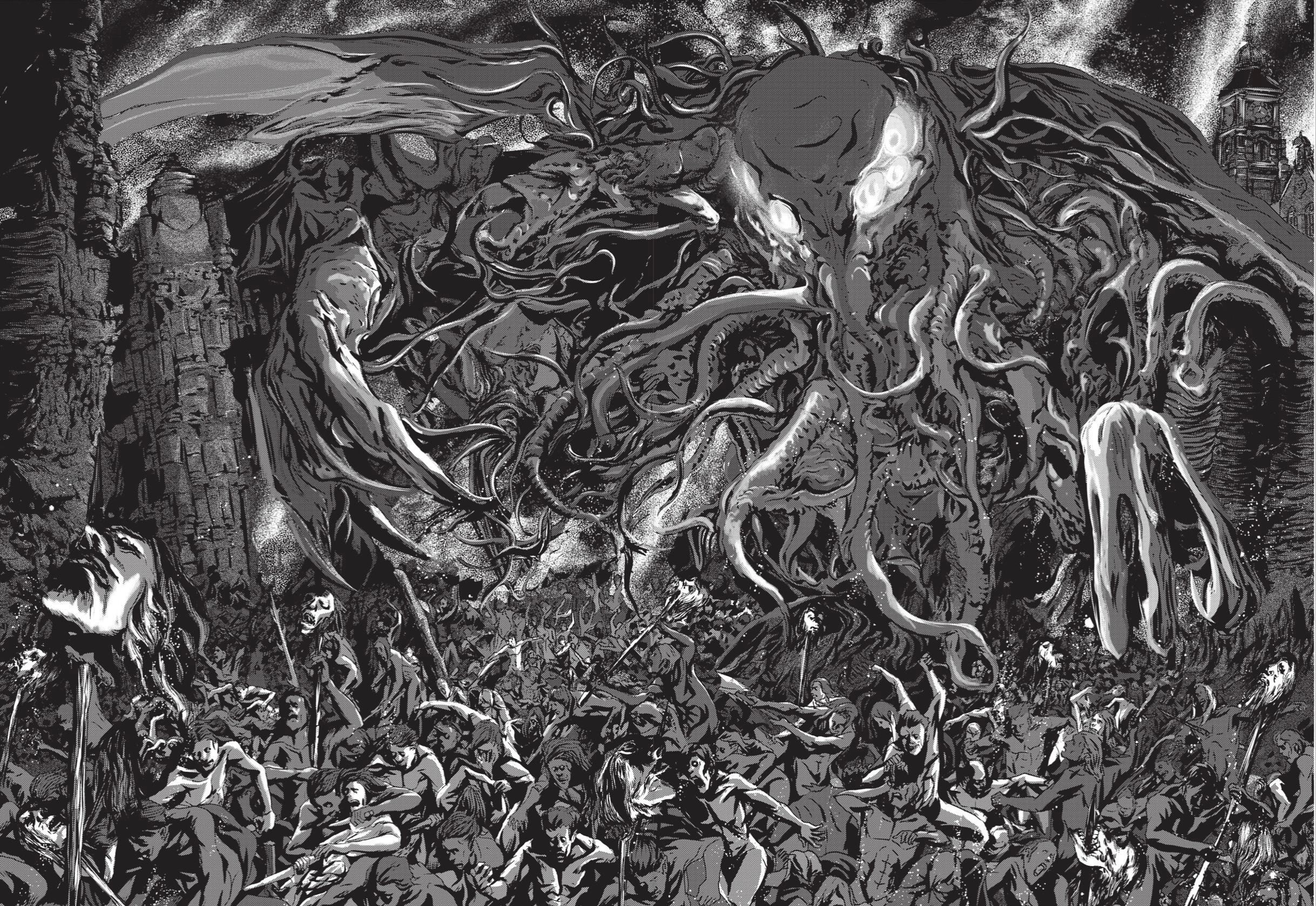
I will note that I truly believe that Tanabe’s work truly shines in chapter six, as his artistry is a true spectacle as the crew of the aforementioned Norwegian barge come aground to the sunken continent and accidently come face to face with the tentacled horror that is Cthulhu’s physical presence. Tanabe’s depictions leave an impact and almost makes one hear the primordial melody that drove so many characters in this tale to madness on hearing this Old One’s lullaby for awakening.
The macabre and disturbing imagery also does highlight Lovecraft’s ignorant bias as it appears that the cultures shown to be easily influenced by these primordial nightmares’ songs are those who are not the norm for a white Christian existence. This story is told in black and white, but it is anything but strokes of grey to showcase the importance of Lovecraft’s narrative and how we must work to separate but remember the origins of these stories of cosmic horror.
A true monster story, The Call of Cthulhu adapted by Gou Tanabe should be a book on most collectors of the cosmic horror’s shelf. The mixed importance of this narrative should be noted and is a haunting story of truly monstrous beings and with this volume allowing modern day readers to experience this terror from the early 1920s in gripping detail. To add, this is only one of several Lovecraftian publications that Dark Horse has published with the talented mangaka of Gou Tanabe. This reviewer would personally say that these books are the best way to explore the origins of cosmic horror’s founding stories.
| Overall Score: 8.5/10 In this amazingly-detailed retelling of the classic Lovecraftian story, Dark Horse Comics, along with the talent of Gou Tanabe, provide a riveting and monstrous tale of madness in this must-have manga adaptation of a core story in the history of the cosmic horror genre. |