In the annals of giant robot literature in Japan, there are several generally accepted stages or chapters that have been recognized amongst fans. The early giant robots are popularly depicted as the remote-controlled robos like Tetsujin 28 by Mitsuteru Yokoyama (released in the mid-50s) and Giant Robo from the mid-60s (the latter straddling manga and live-action tokusatsu television program almost simultaneously). These gargantuan machines are manipulated via remote by child protagonists who engage their mechanical friends in battle against various villainous opponents. The first giant robot in which a rider perches within a cockpit ensconced somewhere in the robot was Go Nagai’s phenomenally popular Mazinger Z starting in 1972, and the piloted giant robots would later become the dominant “species,” eventually morphing into the more “realistic” mech/mecha franchises such as Gundam, Macross, and numerous others.
However, it isn’t QUITE accurate to say that the first piloted giant robot was Mazinger Z. Earlier examples have been noted, perhaps including a WWII piloted giant robot manga Denki Dako (wherein the dialogue appears to have been written entirely in katakana!). Still, amongst popular manga, Mazinger Z was a gamechanger as far as the super robot genre was concerned. Nevertheless, one other robo-pilot manga was released pre-Mazinger Z that is largely forgotten today. Drawn by a prolific manga artist Fumio Hisamatsu, who was most known for the time-travel sci-fi adventure manga Super Jetta and the lost dinosaur world comic Adventure on Gaboten Island, Kyojin Atlanta (Giant Atlanta) was far from Hisamatsu’s only foray into giant monster/tokusatsu adjacent literature. Hisamatsu also drew adaptations of Godzilla properties (Mothra vs. Godzilla, an original series simply titled Godzilla), Ultraseven, The King Kong Show, and even the anime/tokusatsu hybrid Dinosaur Exploration Team Born Free. That’s not even counting his numerous educational manga volumes teaching Japanese and Chinese history! Perhaps it’s not surprising his giant robot tale has mostly been forgotten.

Serialized from April to November 1967, Kyojin Atlanta tells the tale of little Toru and his friend Kako (Toru saves her from bullying). Toru’s father is studying the lost city of Atlantis, and when dad goes on a trip to learn more about that land of mystery, Toru and Kako sneak into his luggage so they can tag along. However, their flight is waylaid by the residents of the real Atlantis—bipedal, buggy-eyed chubby guys with fantastic technology. They gift an enormous robot to Toru so he can use it to protect the earth—that being the titular Kyojin Alanta. Atlanta can be boarded through a tongue-like plank through its mouth, and Toru takes the robot through a test drive against a set of flying saucers and a starfish creature that the Atlantians had prepared so Toru could witness the robot’s powers (it can shoot rays out of its hands, fly through the air, and transform into a jet-like mode.)
Oddly, Toru’s piloting days within Atlanta are limited. Right after the boy gains the robot and takes it home (he hides it at the bottom of a lake), an unnamed evil organization steals the robot to use in order to… rob banks. Suddenly, and from here on out, Toru takes control of Atlanta by voice command instead of directly piloting, directing the machine to take down the would-be robber barons.
The following adventures are all one-offs, with no re-occurring villains—even secondary characters like Kako only occasionally appear. In the episode after the bank-robber caper, an enormous Buddha statue comes to life because it has an evil robot built inside. The inventor wants to use his insidious creation to pilfer religious artifacts. Toru calls on Atlanta, who quickly defeats the enemy robot through fisticuffs and head-on collisions. In the following episode, a submarine discovers a strange rocky structure under the sea that appears something like a fallen meteor. When the rock is flown over the ocean by a team of helicopters, a thunderstorm disrupts the transport, and soon we discover the “rock” is really the shell of some kind of enormous arthropod—which quickly menaces Kako. Toru calls on Atlanta, who flies the bug high into the air, where the sun fries the creature to a crisp.

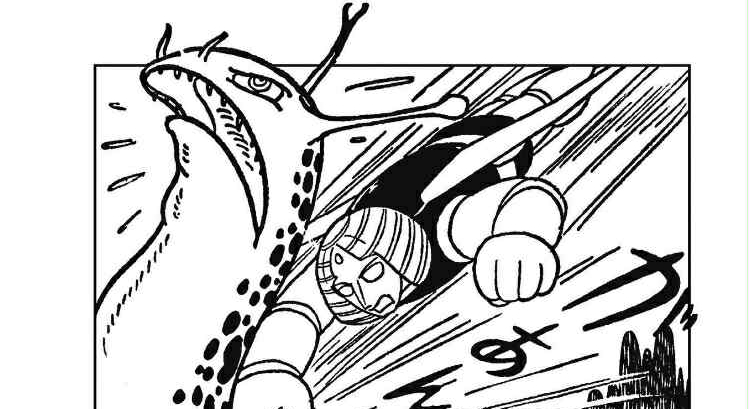
Next, Toru and company go on a hike/picnic in the mountains, only to be targeted by an evil scientist who calls forth a gargantuan spiked monster of dinosaurian aspect out of the earth, catching Kako on its nose. This quadruped spits fiery meteorites, which Atlanta deflects. Atlanta saves Kako with a well-placed punch, and when the giant monster uses its jet-propelled feet to go airborn, Atlanta retracts its hands so that its arms become cannons, then blasts the monster (which is actually a robot) to bits. Finally, in the last episode, Toru goes fishing with his father and discovers a giant egg. Atlanta helps recover the artifact, but the thing soon hatches, and an enormous slug goes on the loose. This slug has a sticky saliva attack, which it uses to blind Atlanta and incapacitate a tank. Atlanta, however, wins the day in the end by throwing a huge ball of salt at the monster slug, which dissolves the mollusk into a tiny, harmless version of itself.
Each of these episodes is over in a flash, without much creativity or particular thought put into the storytelling. None of the monsters are named, none of the villains either, and generally the monsters don’t have much for interesting powers, either. The fights are fine, but they are over in a handful of pages, despite the dynamic and exciting panel layouts and execution. Of course, these are written for children (the manga was published in Shougakkou Ichinensei, which means “Elementary School Year One”), and the text has NO kanji—even avoiding katakana for most of the comic. The manga artist also did another robot manga for the same publication the previous year, this time featuring a robot dog named Ginga, and it was arguably a bit more creative, with time-travelling high jinx added to the robot shenanigans.

What is most striking about Kyojin Atlanta, though, is just how similar the design of the robot is to Mitsuteru Yokoyama’s Giant Robo, the manga for which released one month after Atlanta. Both have very similar head designs, seemingly mimicking an Egyptian Pharaoh with their sloping, striped headgear and noble, humanoid faces. Both also have detachable hands for long-distance attacks. Both can fly. Atlanta, while starting as a ridable robot, later morphs into a robot-controlled entity like Giant Robo. Could it have been that the plans for Giant Robo were well-known and Hisamatsu created Atlanta as a sort of Asylum Films equivalent, a cheap knock-off to capitalize on the inevitable splash Yokoyama’s robot franchise might make?

It’s hard to say, but while the similarities and near simultaneous releases seem to suggest that something more than mere coincidence was afoot, perhaps something like Hollywood’s propensity for releasing nigh-identical films the same year ala Deep Impact and Armageddon or Antz and A Bug’s Life might have been at play. Whatever the reason, whatever the origin, Kyojin Atlanta is a brain-teasing curiosity, minor and slight, but with enough sense of fun and plentiful monster action to warrant at least THIS much more attention on the mysterious franchise.