In 1987, acclaimed anime director Mamoru Oshii released his first ever live-action feature in the form of The Red Spectacles. Initially conceived as a parody of the Super Sentai series, the film marked the beginnings of what fans of Japanese pop culture would know today as “The Kerberos Saga,” as the film would be succeeded by various manga spin-offs, and two film prequels Stray Dog: Kerberos Panzer Cops, and more famously Jin-Roh: The Wolf Brigade. But now, thanks to a highly successful crowdfunding campaign to remaster the film in 4K, and North American distribution from Small Sensations, this little-known gem of Japanese cinema has finally received the theatrical treatment it deserved for nearly the last four decades. And it hits harder today than it did all those years ago.
The Red Spectacles is set in an alternate history where the Axis took victory in WWII, leading to a techno-militaristic advancement in Japan. As a result of the mass uptick in crime, the Tokyo Metropolitan Police Department established a heavily-armed special investigations unit dubbed “Kerberos” (the Japanese romanization of “Cerberus”). However, in trying to carry out their duties, the Kerberos unit grew violent, and resorted to more extreme measures to enforce the law– this culminated when a public execution in the 90s forced it to be terminated.

The disbandment of the Kerberos unit would spark the Kerberos Uprising, where an elite officer, Koichi “Red Devil/The Final Blow” Todome (Shigeru Chiba), led a resistance to this act, alongside Midori Washio (Machiko Washio) and Soichiro “Ao” Toribe (Hideyuki Tanaka). The three find themselves pinned down by bounty hunters in their pursuit of fleeing the country, and while injured, Midori and Ao plead Koichi to go on without them, as he promises to return for them years later.
Fast forward three years later, Koichi returns to Japan– everything he once knew or loved are no more (even soba stands!), for the country had been reshaped into a surreal, dream-like labyrinth constructed and enforced by agent Bunmei Muroto (Tessho Genda), who is tasked to bring all Kerberos members to justice. In pursuit of his own justice, Koichi explores the barren streets, searching for his allies– only to be challenged by his undoing.

Do not be fooled by the set-up and the effortlessly cool and iconic imagery of Yutaka Izubuchi’s Reinforcement Gear– The Red Spectacles is a weird movie, and that is meant in the best way possible. The opening scene sets itself up to be a guns-blazing action thriller, only for it to completely shift into this wildly cartoony venture where Koichi is beating up hitmen with impossible strength, and getting himself into comical heroics; all for it to break down into a collapsing character study of a man who has lived in his own head, and must face the ramifications of his actions. Additionally, like his contemporaries, Mamoru Oshii pulls from French new-wave cinema; namely Jean-Pierre Melville’s Le Samouraï and Jean-Luc Godard’s Alphaville, with how he utilizes dystopian sci-fi a means to find purpose in oneself in the face of confusion, uncertainty, and betrayal. There are even echoes from Seijun Suzuki’s Branded to Kill in how the film latches onto absurdity to convey desperation during times of turmoil, juxtaposing eccentric characters who bear a sense of stoicism that feels profoundly more lonely than strong.
Thanks to Oshii’s experience in animation up to this point, these elements are all elevated by an execution of exaggerated performances, framing, editing, and Yousuke Mamiya’s cinematography that all give The Red Spectacles the feel of a literal live-action anime, while also putting its own spin on Orwellian aesthetics. Tremendous compliments must also be given to the brilliant 4K restoration job on a 35mm scan– without exaggeration, this is easily one of the most impressive upscales ever done, period.

In turn, much of the director’s signature hallmarks are present (to which I should note, viewer mileage may vary), such as long, occasionally still introspective takes, accompanied by a droning, hypnotizing, and other times poppy score by Kenji Kawai. Much of the bizarre comedy on display is very reminiscent of Oshii’s tenure on Urusei Yatsura, which is helped by the fact that a bulk of the film’s cast have collaborated with him on that show, with each member being an absolute standout in their own right– even the extras leave such a big impression. The constant game of cat-and-mouse (or cat-and-dog, rather) between Bunmei and Koichi is entrancingly fascinating and endearing, spouting Shakespeare and cautionary tales of injustice as if it were a eulogy for a buried, forgotten past. (Tessho Genda is an excellent dancer, by the way.)
Speaking of, in retrospect, the line-up of performances in The Red Spectacles feels almost unprecedented– even for an independent film at the time. Without going too deep into accolades and the laundry list of iconic roles, in case the names Shigeru Chiba (who the film was intended as a career vehicle for), Machiko Washio, Hideyuki Tanaka, and Tessho Genda do not ring a bell, they were Megane, Sakura, Sanshiro, and Rei in Urusei Yatsura respectively. Fans of the Transformers franchise will recognize Tanaka and Genda as the voices of Star Saber and Optimus Prime (aka Convoy). Genda is also the Japanese voice for Arnold Schwarzenegger and Don Frye’s Captain Gordon in Godzilla: Final Wars. On the topic of Urusei Yatsura, Fumi Hirano (Lum) even cameos as an airport announcer! (Seriously, look up Chiba’s voice work– you will be surprised.)
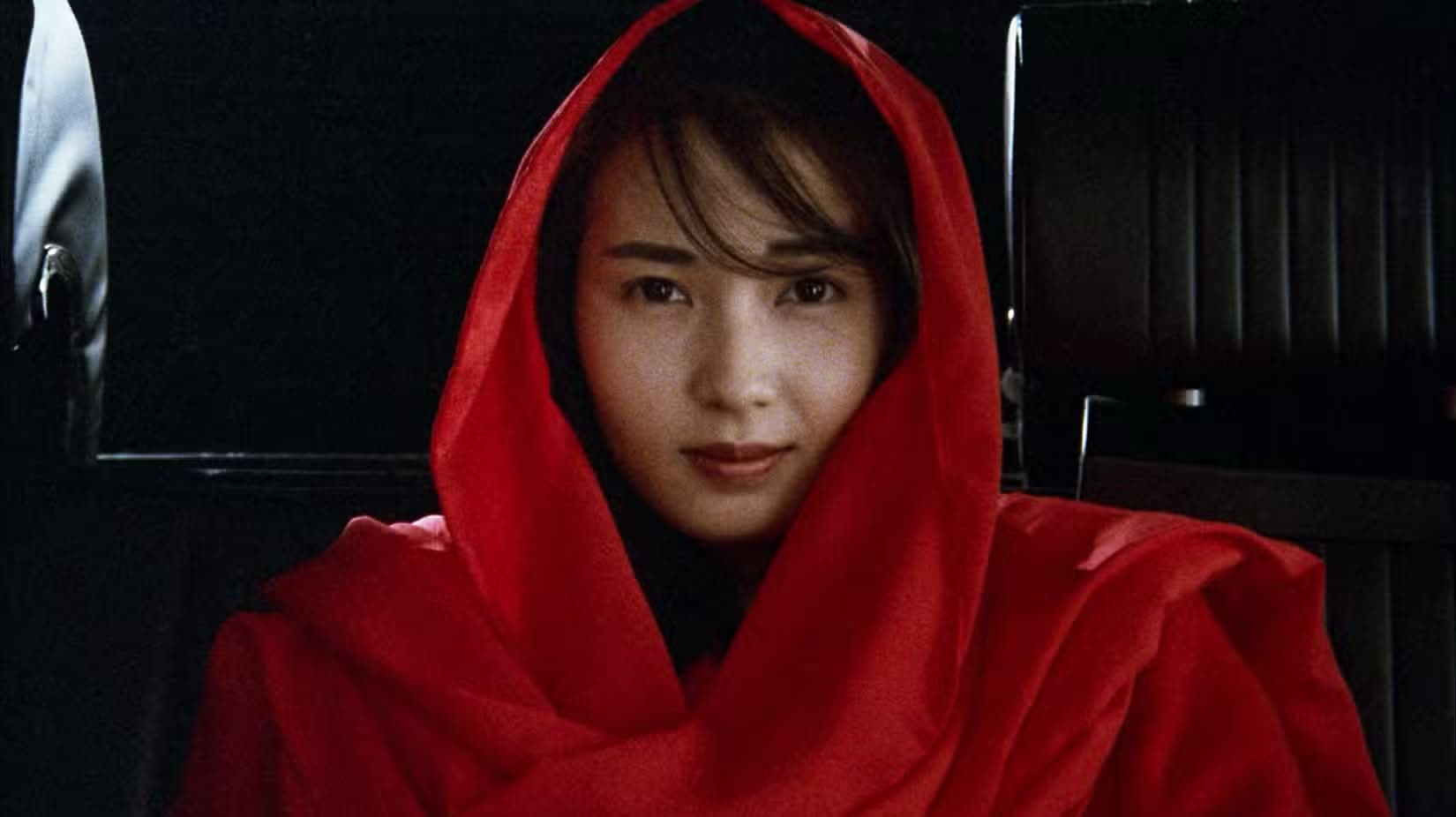
But, perhaps the most prolific actor in the film is Hideyo Amamoto as Ginji, a soba stand owner close to Koichi who gathers intel. Readers of Kaiju United will know him for his roles in King Kong Escapes, All Monsters Attack, and GMK, as well as Dr. Death in the original Kamen Rider. Also present is Mako Hyodo, a frequent Oshii collaborator, as a mysterious woman draped in a red hood who will make small appearances throughout the film. Many theories as to her significance have been debated– but the more common interpretation is that she, and other similar characters throughout the Kerberos Saga, are personifications of the protagonist’s dreams and desires. In the case of Koichi, he sought comfort and control, only to realize that his own ambition became his downfall.

This brings me to the next major point about The Red Spectacles that is often overlooked: it is one of Mamoru Oshii’s most vulnerable films, in the sense that the screenplay crafted by him and Kazunori Ito (yes, THAT Kazunori Ito) is a remorseful admission of ignorance during a time where Japan had been rebuilding itself after WWII.
For context, Mamoru Oshii was a member of the New Left movement in Japan. The idea of the New Left was that Japan should stand as its own nation, exemplified by their opposition of the US-Japan Security Treaty of 1951, and their push for Japanese intervention during the Vietnam War. It was also a critique of the Old Left and the Japanese Communist Party, as the New Left would opt for more extreme measures of activism. However, these acts would eventually spiral into domestic terrorism, which ultimately caused the party to fall apart by the mid 70s.
In Oshii’s case, many of the people who joined the New Left were less in it for the beliefs, but rather, status. There was a notion that to be part of the New Left– standing for something and taking action– was coded as masculine. It theoretically placed you above those seen as quiet and complacent. There was a false sense that their form of activism was about fighting back for control after being wronged, and so they aggressively pushed for change by any means necessary, even if it meant through fear. To impressionable teens, like Oshii here, this was viewed as cool, and, if you were lucky, attractive. It meant that you were a man.
Oshii himself would express these regretful sentiments in the commentary track on the physical release given to backers of the restoration’s campaign.
With all of this in mind, it is easy to see why a film like The Red Spectacles would have been poignant back then, and especially today, where it boasts a dedicated cult following. Too often, young people, and even adults, fall victim to supposed masculine ideals that are promoted by propaganda. We live in an age where people struggle to find purpose, and are pressured to fit within superficial boundaries rooted in identity– as such, there has been a rise in countless societal injustices that have led to things like public executions, because select vulnerable people allowed themselves to be swallowed by corrupt ideologies that put lives at risk, and systemic ethics into question. This is not helped by the gradual desensitization, and dare I say, attempts of the normalization of violence (state-sanctioned or not), and performative enforcement caused by governing officials taking advantage of the influence of social media.
Then you have Koichi– throughout the film, there are moments where he treats his countless predicaments as if they were action films. A small, skinny man who is somehow capable of pulling off near-superhuman feats with his own hands and a gun, and smooth talk his way out of situations to win the night. He clearly doesn’t take any of this seriously, only himself. He would even physically assault and strip a man in a public bathroom if it meant getting information on an underground soba stand– it makes for a funny scene, but it’s telling of what little humanity there is that lies within him. He literally perceives the world in black and white, coming home to fight a system that has only ensured that no more like him would erupt chaos in the streets again.
Considering his longing for a life that is no more, his full acceptance of the Reinforcement Gear becomes his titular red spectacles (think: rose-tinted lenses), a refusal to see the present through anything but the violent, romanticized hues of his past, building upon his delusion where he is the hero of his story. The Red Spectacles is a warning of what could happen to the mind when it continues to feed itself false beliefs about power and identity that are enforced by hate.

Much more can be said by unraveling the utter madness that is The Red Spectacles. For Mamoru Oshii’s first live-action feature, it still manages to surprise to this day, and with more weight as time goes on. It is more than the humble beginnings of a cult franchise, more than a small filmmaking venture from a beloved director– it is a prophetic call for justice, and cries out in an endearingly zany, bewildering fashion. Fans of Jin-Roh may find its tone jarring, and viewers may find it a bit long, but none of it takes away from how thematically rich this movie is when you look past its chaotic surface.
Before I close this off, I should note that Small Sensations’ screenings for The Red Spectacles do appear to be random, and are all one-night showing events. I was able to catch a screening at the Alamo Drafthouse in Cedars here in Dallas, TX on a near last-minute notice.However, Wamono Nights will be hosting a screening at the legendary Texas Theater in Oak Cliff on March 23rd at 7:30pm. If you can make it, tickets are available now!
Otherwise, definitely keep an eye on your local theaters for this one!
Between this and Jin-Roh getting 4K remasters, can we get one for Stray Dog to round out the trilogy?