
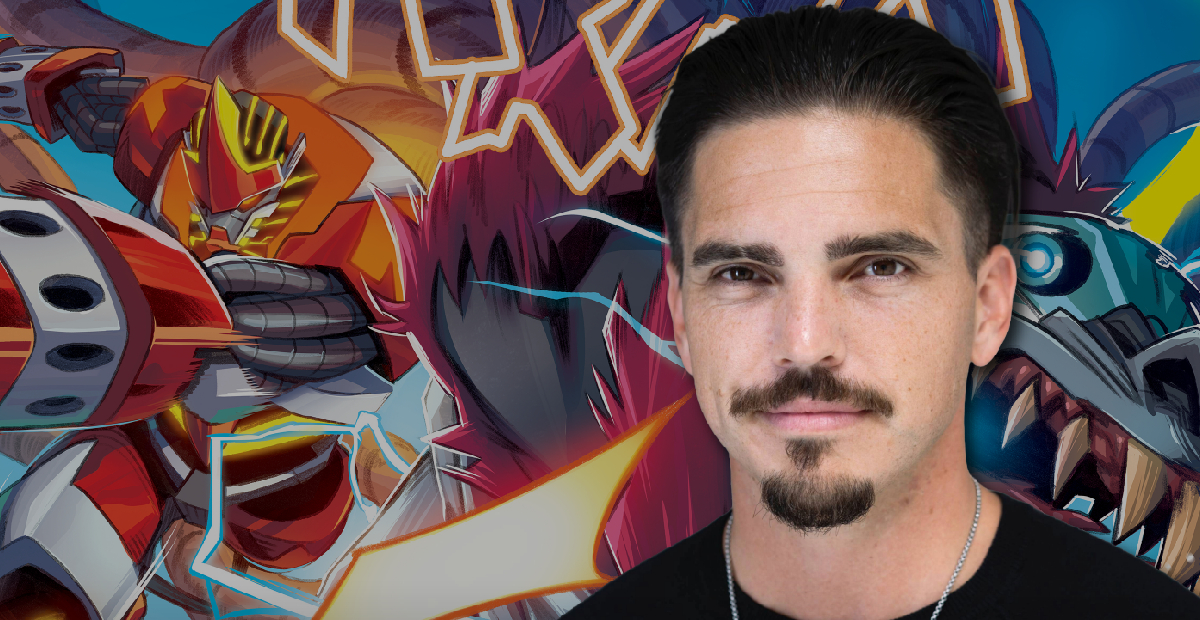
Marcus Walker: Kingslayer Protocol is the latest kaiju comic to hit the Kickstarter market, and it has done so with a tremendous splash, funding itself in less than 24 hours. Written by Chris Yates with art by Simone Ragazzoni (Power Rangers), the book has gone on quite the journey to reach readers, but it is finally time for kaiju and mech fans to experience what Chris and Simone have been developing. Poised as a book for fans of Ultraman: Rising, Big Hero 6, and Power Rangers, and an overall story with stakes that includes young readers rather than talks down to them, it’s no wonder why it was recently endorsed by the Netflix live-action One Piece showrunner. Kaiju United recently had the opportunity to speak with Chris Yates to discuss the book, family influencing storytelling, and most of all, doing what you love and crushing your goals.
Jacob Lyngle: Hello, KU! I’m here with Chris Yates, the writer of Marcus Walker: Kingslayer Protocol. Chris, for those people that are not familiar with who you are and what you’re all about, do you want to give an introduction?
Chris Yates: Absolutely. I’ve always been a huge comic book person ever since the early 90s, where I grew up with Batman Returns, Teenage Mutant Ninja Turtles, and films of that era. And on top of that, there was the tsunami of anime and manga in the early 2000s, and getting familiar with various types of storytelling from Japanese culture. Fast forward to around 2012 or 2013, I was in college getting a master’s degree in coaching and a bachelor’s degree in American studies and film. I wanted to do comic book movies and really see this trajectory through, but I was also a track and field person with a scholarship, so the bills were getting paid by me throwing a big metal ball. (laughs)
Not to pivot too hard, but I kind of had a moment in life where my mom got very sick and she was diagnosed with stage four cancer. After that pivotal moment, she was basically like, “Hey, I know you don’t want to do coaching. I would like you to go to Hollywood; I know that’s what you really want to do. You have my blessing.” So basically, I just emailed the recruiter at United Talent Agency and said, “Hey, I’m 29. I have a master’s degree, I know how to take orders, and I want to do comic book movies.” And they replied with, “Great, you can start on Monday.”
During that time, I kind of made myself known at UTA as the assistant who knew comic books. I kind of figured out who’s the who’s who of comics in terms of agents. And then luckily enough, I was able to find that person, who subsequently introduced me to people such as Stephen Christy at Boom! Studios, the people at Dynamite Entertainment, and other bigger names. Eventually, I moved over to the Talent Acquisition Team at Disney, and worked there for about three years until some unfortunate layoffs happened that included my team.
Long story short, during that time, I had kind of like a moment of reflection, and I came up with two things: What are the two things that I would regret if I were to die today? Not to be too morbid, but what would be those outstanding life regrets? Because I was very lucky to find myself where I was in life at the time: I had graduated; I had worked at Disney; I kind of had done a lot of bucket list things… so what was left? I ultimately decided that my two things were that I wanted to marry my girlfriend at the time (and now I am married), and the other one was I wanted to make a comic book. I never saw myself as a writer, but I knew I had to get this idea out. After asking around with some of my peers and mentors, they told me to just sit down and write. Just do it. And here we are, after all of that time.

©Crush Your Goals
JL: You have said that Marcus Walker was a story about two brothers. Was that influenced at all by your own life and your own brother, or is that just the story you decided to tell that in your eyes, makes a good narrative?
CY: In full transparency? Not to air too much of my own dirty laundry, but yes, it was 100% a family choice of my own. The things that we attach ourselves most to are the things that feel the most to us; it’s that connective tissue. This is my first time writing a comic, so I just wanted to put myself fully into this. How do I write that story? My brother, who is nine years younger than me, had a different way of dealing with grief, because he was 16 and I was 25. During that process, I took on that kind of motherly role in terms of trying to keep the familial connective tissue together. I thought I was doing a good job. I hope I was doing a good job. But then at times, you know, in hindsight, it’s like, “Did I do a good job? Was I wrong?”
We’ve had our differences, my brother and I, so this story was kind of me trying to go through that creative process of “How do I tell a story that is a part of me, but is also entertaining to the reader?” I don’t want to do a slice of life book, because that’s just not the type of book I want to read. Nothing against that genre, it’s just not something I gravitate towards. But one of the things that my brother and I always loved was those Saturday morning cartoons, anime, Power Rangers and so on. I’m showing my age completely here, but that is 100% how I got into the kaiju, monsters, and tokusatsu kind of stuff. Deep down, I thought to myself, “I think I want to make this story, but I don’t know how I’m going to do it.“
Sitting down and developing this project, I feel like I had a story I could tell that is somewhat of my family, and I can put it into this big, bombastic, over-the-top, kaiju-esque story. It’s maybe something a little bit different because as we know, with mecha stories, usually the main character is the pilot, or they see themselves as the pilot. Our main character, Marcus Walker, is not the pilot. He is the brother to the pilot. And the funny thing is, Marcus doesn’t necessarily feel like he’s the pilot of his own life. He is the main character, but he doesn’t feel like the hero because he thinks his big brother or his family is, and he’s kind of cast aside due to some family drama and dynamics. We wanted to take that idea and make something organic with it.
JL: The visuals in this comic are very manga-inspired. You mentioned earlier that you grew up watching anime, were there any specific ones that inspired the visual tone and aesthetics of Marcus Walker?
CY: I think the first few that come to mind when it comes to mecha stories has to be Gundam Wing: Endless Waltz and Mobile Fighter G Gundam; things like that. I remember having those toys as a kid and just being like, “Heavyarms is just kick ass! I don’t know why this giant robot has wings, but it looks cool!”
I think, in terms of anime and Toonami specifically, I mean, there’s obviously Cowboy Bebop, and of course, Dragon Ball Z. Trunks was my guy growing up! Many fans of my generation remember staying up way past your bedtime, and it’s like 2 AM, and your mom and dad come in and are like, “What the hell are you doing up?” And you reply, “I need to see why they’re powering up for two episodes of filler!” (laughs)
For manga, Evangelion is a very obvious one. Another one that might be a little different. That may not be the obvious one is, I love Claymore and I love Demon Slayer. Those are just unique takes, as Claymore is like Witcher and Berserk and then Demon Slayer feels like a similar type of tale, but through the Japanese storytelling lens. I think those are the biggest manga, anime, or overall Japanese culture influences that I could give you.
The aesthetics of Cowboy Bebop were important, too. That film grain, the jazz soundtrack, just how all of it makes the story feel alive. I tried to incorporate that because again, even though manga and comics were a huge influence, music was actually just as much as an influence on me. I love Beartooth; I love Bring Me the Horizon; I love Ice Nine Kills. I kind of love that modern metalcore sound. I call this book a kinetic sci-fi comic, right? The music definitely influences the way I wrote certain scenes with Simone [Ragazzoni].

©Crush Your Goals
JL: What may entice kaiju-oriented readers to check out Marcus Walker? What is the draw for them?
CY: That’s a great question. I think the best answer is to see how the kaiju world unfolds, because again, I didn’t want to do the same kind of pilot main hero type of story. We’ll get there eventually, if we’re so lucky to have this continue. But I think for the kaiju fans, I wanted to create a world that felt lived in. I could be wrong, but the stories I’ve typically seen is that you just see the heroes, but you don’t see the civilian day-to=day life. For example, with the picture of Marcus at the train station, he’s flipping through his world trying to have a normal life. You would try to live a normal life, even though there’s giant monsters and giant machines, right? We tried to position a world where a specific thought permeates – “What does the average person look like in this world? How could you have a 9-to-5, but also know that there’s kaiju alarm drills on the regular?”
To be very specific – we definitely have some big bombastic fights – but I won’t spoil how we bring our kaiju nor our villain into the story. But the angle we went for is how to fight the kaiju and how to potentially solve the kaiju problem with a unique take. That is hopefully one we will set up for future stories. I did not want to start a story that a lot of people have already seen, like, “Oh, this is how the kaiju came to Earth. They came through a teleporter. They came from space.” It’s been done a lot. I did not want to retread that.
One of the things I heard from comics writer Jason Aaron when he was promoting Once Upon a Time at the End of the World was that he wanted to write a horror slice of life romance book set in a post-apocalyptic world. But, while that concept is cool on paper, he clarified, and was like, “I want to write this book, but I don’t want to talk about the apocalypse.” I feel the same way. I want to write this book, but I don’t want to talk about how the kaiju came, at least in this first volume, because people can kind of put two and two together. It’s just, hey, this world is just filled with monsters and machines. Just take it what it is for right now, and then we’ll get there eventually, because I very much wanted to make it about the characters. As they say, you’re either a world builder or a character builder. I very much, in this first outing, found myself to be a character builder, because I wanted people to fall in love with Marcus, Caleb, and the rest of the cast.

©Crush Your Goals
JL: According to the Kickstarter, the book is for fans of Big Hero 6, Ultraman: Rising, and Power Rangers. Would you say the book is more young person friendly, such as media from your time at Disney, or would you say that it’s more of an old-school style story that is for everyone?
CY: That’s a great question. I think it’s the latter. I have to give an honest answer, because I mean, I show my hand. I loved Disney movies [growing up]. That’s why I kind of went there. But I just feel like I’m kind of tired of movies or TV shows or media talking down to kids (and me), because they‘re like “You’re this, you’re that, blah, blah, blah.” I hated that crap. So why would I like it as a kid? I watched things I shouldn’t have watched [when I was younger]. I loved things that treated me as the equal. And so, I very much went into the mindset of “I don’t want to talk down to Marcus. I want people to feel like they connect with Caleb or Marcus or whoever in the story, but in the process, I want them to feel like this is talking to them and not down at them.“
We don’t do anything completely vile or vulgar or anything like that. I loved Indiana Jones and the Temple of Doom because it made you go “Holy crap… that dude’s heart just came out of his chest!” or “Woah! His face just melted.” And I kind of love that; It’s straddling that PG-13 line where you feel like there’s some blood, but there’s not a lot.

©Crush Your Goals
Simone [Ragazzoni] and I initially had 12 issues; we condensed it down to six. The first Kickstarter [which is live now] is Issue One and Two combined a giant premium sized version, and we have an idea of where we want it to go. But if fans like it or don’t, we want to kind of pivot as accordingly, but we want them to feel like anything could happen. You don’t know if certain people are going to make it to the next issue or not. So to answer that question, I think it’s very much that we just want it to be real. We want to make Marcus Walker as long as we possibly can, but we also don’t want to hold your hand and say, like, “everything’s going to be okay,” because that’s a lie and that’s not real life. I know it’s comics, but I tried to put as much of myself and our team into that as much as we could.
JL: I’ve talked to various creatives about their works through these interviews, and something really interesting pops up in each talk. There’s two camps of creators. One of them says this [piece of media] is a love letter, unabashed. The other side has said, “Yeah, there’s influences, but I wouldn’t call this a love letter. I would like it to stand amongst other works in the genre.” Where camp do you belong to?
CY: Here’s how I can answer it… and I can kind of tie the music element into it. When bands promote their new album, the fans are like, “What do you think about this album?” and the band is like, “Oh, it’s our best work ever.” Are you saying that just because it’s your new album, or do you really feel that? It’s one of the things I love when some bands are saying that… it’s like, you tell me! I think it is a love letter, and I would also love for it to stand on its own, but that’s maybe not my call to make. That is something I feel like once people read it, they will be able to make that decision for themselves. I can absolutely be like, “It’s going to stand on its own,” and maybe that’s not the case, because it’s my take. I wrote it and I am biased.
But all I can say is that I just had so much love and respect for these genres and for these titles, that I wanted to be a part of it, because I hold them in such high regard. And if I should be even within the hemisphere of them, we should be so lucky. I tried my best with my team to create something unique. I mean, every story’s kind of been done at some point or some variation. And so, we are taking a creative swing where we’re pitching it as like a mecha and kaiju-inspired comic where our main character isn’t a pilot. So it’s like, that’s a swing, but it’s not the biggest swing. But at the same time, we are trying to do something different.

©Crush Your Goals
JL: When working on Marcus with Simone Ragazzoni, what was that collaboration process across the language barriers like? You of course had his manager, but what else goes into collaborating on a project like this?
CY: The very honest and real life answer I can give you is… I had been dating my girlfriend at the time for about a year. And the thing with her is that she’s French-Canadian, so French is her first language. I do not speak French; I don’t speak any other language besides smart-ass. (laughs) We just have a great connection. She’s very intelligent and speaks multiple languages. When we first started dating, we had to learn how to translate things. So basically, at the end of the day, between my girlfriend and my collaborator, it was very much a lot of Google Translate and DeepL translate, with me going “Hey, here’s what I’m thinking,” and hoping it translates.
Enzo, Simone’s manager, would also translate just to make sure. But then we kind of got in a rhythm where I would write the script because we’d be like, “Hey, here’s what we’re thinking. This is what we discussed,” and I’ll write it down. And for Simone, he wanted the panels written in a different color. So on the script, I would write the panels or the script breakdown in red, and then the dialog in black, and then the sound effects or onomatopoeia in blue. So for him, he would just take all of the red text and then make that translated into Italian. I was like, “Hey, this is a roadmap, this is a blueprint. I’m not here to dictate you on how to draw. We worked on this script together, but this book sings because it’s your artistry. So I don’t want to get in your way.”
I tried my best to put a cinematic eye to it, but I told Simone, if you think it’s terrible and you want to rearrange it and do it even better, go for it, man. In full honesty, I think in the past three years, me and Simone have never gotten into a fight. I think we’ve maybe had one back and forth between each other. It wasn’t even disagreement, but just like, “Well, what do you mean?” “No, what do you mean?” You know, kind of just a misunderstanding that boiled down to the manager being like, “Oh, the Italian meaning is different.” So ultimately, I was like, “Oh, yeah, we’ll go with his. His is much better.” I think that’s the best way to do things: Just having extra patience and letting your creative partners do what they do best, and not micromanaging them. I mean, you’ve seen the pages. They look gorgeous. I couldn’t have told him to do that great work aside from mere panel descriptions I wrote. I gave him a very minimalistic version of what I was thinking. Nine times out of ten it always came out better because he did his own version of it.

©Crush Your Goals
JL: I am admittedly new to the inner workings of the comic book industry. One prominent feature of the Kickstarter is that there is a lot of variant covers as an incentive. Is that a common thing for the comics industry, or is that just a big selling point for your Kickstarter?
CY: For the comic book industry, I think variants are a very common thing, because it is a way to kind of inflate numbers. It’s the kind of “we all know it, we all acknowledge it,” industry knowledge that we kind of bend the knee to, because you want to see people do different things and other cool stuff, right? Simone and I were very specific in how we wanted to do our covers, because I can say very intently that every single piece of this campaign was sort of done with intent direct.
We have five covers that you can actually buy outside of the digital ones. The digital cover is a variant that is not the A cover, it’s a homage to Sean Murphy’s Tokyo Ghost. But, for the lineup of different comic covers, we have Simone’s art as Cover A, and then we have variants by Sean Murphy, Kevin Keane, and Siya Oum. All of these creators are friends of mine.
We don’t have metal or foil covers, nor t-shirts or keychains. Not to say those are bad, but I don’t buy those things, so I don’t expect our potential backers or fans to buy those things. People are scattered across multiple streaming devices, video games, life and their wallets, too. And so, we just kind of wanted to be respectful to that because it’s like, again, if I won’t buy it, I can’t expect other people to buy it either. We very much wanted it to be about the story. If you like all these people that we believe in and our friends of ours, we’re going to offer those things to you. And, if you really believe in it, we’ll offer it to you guys at a discounted price as well.
For example, another thing we’re doing is the artist edition, which as we said, is for big fans of manga; it’s the only version where you can get Sean Murphy’s cover in black and white, and it’s also going to have some half tones. So when you look at it, it’s going to read and look like a manga, but it’ll be an English side reading. So, all of that to be said, we are very purposeful in our variant covers and our reward tiers, because we just didn’t want to overdo it.

©Crush Your Goals
JL: What do you enjoy about Godzilla or other kaiju centric franchises? What about it speaks to you?
CY: When you say that, it immediately takes me back to being around five years old when the Mighty Morphin’ Power Rangers movie came out, and I had all those toys. It’s this kind of youthful spirit, and looking back, it’s men in poorly made suits and things like that, but it was real to us. And that’s the beautiful thing. Like, it doesn’t need to be, but it can be high art, but it can be what it it is, or what the creators want it to be. I mean, Ultraman: Rising like, good God, you try not to cry at the end of that movie, but then you realize what it means about family, father and son dynamics, and passing the torch to your children. I think there’s kind of a whimsical nature to it that I just think is so fun and just kind of exciting. I mean, it can be pretty brutal, dark, and bleak. But for me, I think it’s the fun, whimsical nature of it that reminds me of youth. I want to say happier times because I’m happier…I’m 36 years old and I’m talking about kaiju stuff still… but I think it just has this kind of special place in my heart where it’s like, this is a part of your youth, and this is what built you into the story storyteller that you are.
JL: Where can we find more information about Marcus Walker and/or keep updated with all the things you are doing?
CY: If people want to follow Marcus Walker: Kingslayer Protocol, please back or save the Kickstarter campaign. If you want to follow along on socials, you can, mine is cyg47. That’s my handle for almost all platforms. And if you want to check out Simone, please check out simoneragazzoni on all social platforms. I’m very excited to get this book out to the world!
JL: Chris, thank you again for sitting down with me. Very full circle moment for you and me.
CY: Thank you. I can’t wait to hopefully do this again for the next iteration of Marcus. And then you can kind of see and talk and whatever spoilers or not spoilers. But again, this has been super fun, and I’m just very grateful for the time.
Marcus Walker: Kingslayer Protocol is now crowdfunding on Kickstarter with just a few short weeks left on the campaign. The book was fully funded in less than 24 hours, with kaiju and comic book fans alike backing the project with great passion. For more on Chris Yates’ journey, we encourage you to follow his social media channels, and stay tuned for more comic book projects coming soon from the creator.

One thought on “Interview: Writer Chris Yates on Creative Narratives, New Kaiju Comic”