Former film critic turned filmmaker Park Chan-wook continues to solidify his status as a leading figure in South Korean cinema, with a substantial impact on contemporary 21st-century filmmaking. Ever since his revenge thriller Oldboy shocked and emotionally captivated critics and audiences, and his filmography has become more widely accessible, it’s easy to understand why he’s been recognized for his stylish genre-blending and exceptional storytelling. Looking back at his work over the past decade, it’s clear he is still going strong as an auteur, with acclaimed features such as The Handmaiden and Decision to Leave similarly earning high praise and recognition.
Now, Park unveils new tricks up his sleeve with his latest film, No Other Choice, a brilliant satirical black comedy thriller laced with some disturbingly relevant commentary on the modern job market. The source for adaptation is Donald Westlake’s novel The Ax, which tells the story of a laid-off manager who attempts to secure a new job by hunting down and murdering his competition. The director had taken a liking to this thriller that explores the darker side of capitalism. So, for his screenplay, co-written by Lee Kyoung-mi, Jahye Lee, and Don McKellar, Park would adapt the core premise and themes, reframing them within the context of South Korean society, with the paper industry playing a key aspect in the narrative. Though the film struck a chord with audiences at the 82nd Venice International Film Festival, No Other Choice would be met with a more mixed response in South Korea, a point that will be delved into a little later.

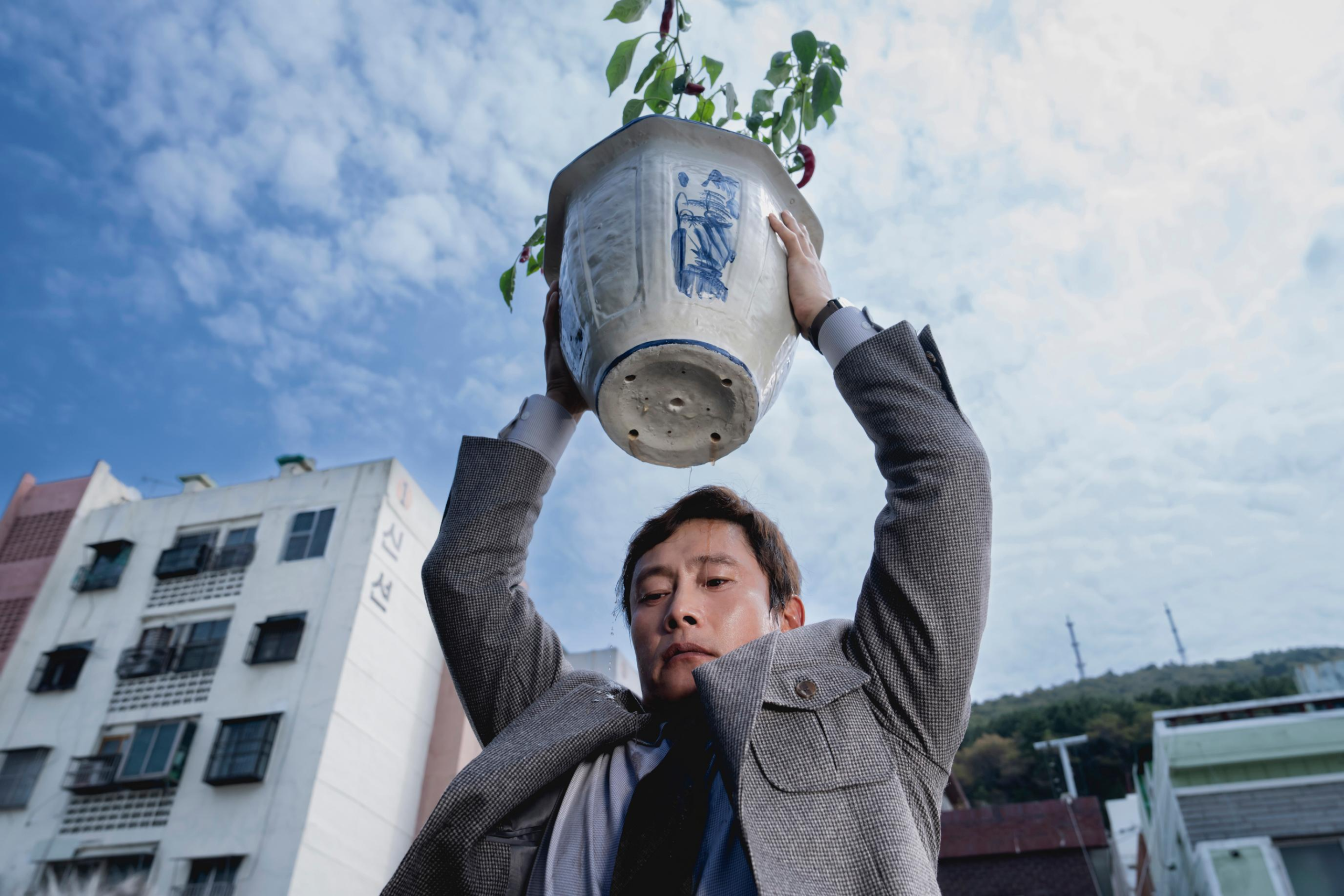
We are introduced to Yoo Man-su, an award-winning expert in the paper industry, who lives happily in a beautiful home with his wife, Lee Mi-ri, and their two children: their teenage son Si-one, who loves using the iPad, and their young daughter Ri-one, who is an antisocial neurodivergent cello prodigy. Tensions rise when he is abruptly laid off from the paper company where he has worked for 25 years, forcing the family to scramble to maintain their financial stability. Mi-ri proposes downsizing their lifestyle, which would mean moving out of the dream house they currently live in. Additionally, she takes up a job as a dental assistant, and they trim their costs by cutting her tennis lessons, their daughter’s cello lessons, and even sending their two dogs away to be cared for by relatives. In his desperate search for a new job and to ensure his family’s survival, Man-su devises a plan to secure his future employment by eliminating his competition, literally.

Like many works in Park Chank-wook’s filmography, No Other Choice seamlessly blends genres within its narrative, solidifying itself as a crime thriller that’s also a black comedy. Dark humor has long been a staple of the director’s work, yet it’s arguably more overt here than before, with a major emphasis on satire and even moments of slapstick. The result is arguably Park’s funniest film to date, as the movie balances consistent hilarity while delivering comedic precision across multiple levels, from dialogue to visuals. Even in some of its more intense and shocking moments, the film will unexpectedly garner laughs. Despite becoming a murderer, Man-su is anything but a trained killer, frequently clumsy, and his plans often go awry, forcing him to improvise. On top of that, there’s a sheer absurdity in the lengths he’s willing to go to achieve his goal of stable employment as a paper expert amongst a ruthless economic system.
Simultaneously, the film is a masterclass in suspense, continually building to an unforgettable payoff that is unafraid to shock and disturb. Even when the comedy is ever-present, the intensity never lightens, and just when it seems to do so, Park will throw yet another distressing curveball at the viewers. One such case involves Man-su attempting to kill a target in a wooded area, only to be bitten by a snake and unexpectedly tended to for his wound, all while his wife, Mi-ri, Facetimes him. Perhaps the best example is a home invasion that goes disastrously wrong when Man-su enters armed with a gun to kill one of his competitors, only for a heated and violent confrontation to erupt. This scene not only manages to be shockingly funny but also excels as a thrilling sequence, enhanced by its phenomenal sound design, and serves as one of the pivotal moments in the story.
Before delving deeper into the core themes, it’s perhaps a good time to address why No Other Choice received a mixed reception in South Korea despite its critical acclaim abroad. In short, many South Korean audiences found its greater emphasis on comedy somewhat polarizing, even for Park Chan-wook; even more so, many found the movie too derivative of Bong Joon Ho’s critically acclaimed film Parasite in how it tackles similar subject matter. To put things into perspective, Parasite was more than just an international hit that globally struck a chord with viewers for its clever depiction of class warfare. While by no means the first film to tackle this territory, it was, and still is, a literal major cultural phenomenon in South Korea that resonated with audiences for its critique of class while delivering as an exceptional piece of entertainment. That being said, dismissing No Other Choice as a ripoff of Parasite is simply untrue and does a great disservice to the film and what it has to say.

From the outset, Park provides a clear window into Man-su’s family life with his wife and children, allowing the audience to empathize with them and sympathize with the protagonist’s initial efforts in trying secure stability for them. There’s a painful relatability to his humiliation as an everyman who’s so casually discarded by a corporate environment that took his labor for granted, the family stress not made any better by factors like mortgages and inflation. It’s clear he deeply cares about his family, and his devotion as a father/husband remains ever-present. Then, as Man-su’s chosen path grows darker and more horrific, he increasingly implicates his loved ones, both directly and indirectly, in his criminal activity.
The deeper he goes down the rabbit hole, Man-su’s ego grows, and his actions become increasingly self-serving, revealing deep insecurity and an escalating need to control. His paranoia intensifies so badly to a point he even believes his wife, Mi-ri, is having an affair with her suave but well-meaning dental coworker Jin-ho, a fear she ironically mirrors as her husband vanishes for long stretches to carry out his crimes. It’s even disclosed that Man-su had a history of alcoholism, marked by violent outbursts towards his wife and children, and a near-fatal incident nine years prior. With his extreme measures comes a moral decay and detachment that far exceeds justification as he transforms into a cold-blooded killer with an increased sense of pride in his pursuit of employment while increasingly embodying toxic masculinity and alienating himself from those he cares for, with Mi-ri emerging as the stable parental figure in their childrens’ lives. Through it all, he continually insists that he has “no other choice.”

The film’s very title, No Other Choice, is a phrase repeatedly echoed by Man-su and other characters, underscoring the theme of constrained individual agency amid a manufactured system that prioritizes capitalism. This phrase has many layers with its role in the narrative. At the beginning of the film, the American executives who acquire the paper company Solar Paper under the guise of restructuring fire numerous employees, including Man-su, and dismiss his desperate pleas by claiming they have “no other choice,” as if it were inevitable. Subsequently, Man-su adopts the same phrase in his pursuit of a new job in his field, preferably at Moon Paper, using it as a mantra to justify his actions in the corporate rat race and suppress any moral conviction as his behavior escalates, highlighting his delusion and hypocrisy.
Furthermore, “no other choice” emphasizes the cold, calculated decision-making that large corporations often hide behind within the capitalist system. For Man-su, it reflects his dehumanization, as his moral compass becomes overridden in the pursuit of success in the competitive job market. The greatest irony is that other choices were indeed available for Man-su, as Mi-ri suggested, but his desire to preserve his social standing and a high-status job proved too strong.
With No Other Choice, Park Chan-wook and his co-writers deliver a scathing critique of the modern job market through satire that’s not only funny but deeply unsettling. Though a black comedy, the film is also a tragedy, leaving a lingering sense of sadness, given the protagonist’s moral degradation that alienates his family from each other and the way contemporary capitalism leads community members to become enemies, pitted against one another in a survival-of-the-fittest pursuit of success. Despite people literally discarding their humanity in the corporate rat race, Park underscores the reality that profit remains the primary concern of large companies operating within the system, leading to the erasure of anything that even slightly endangers that efficiency.
Adding to these thematic layers is the significance of the paper industry: paper is a high-demand product in South Korea and a cultural symbol of artistic craftsmanship and everyday resilience. Yet this material, a source of economic success, a valuable multi-purpose resource, and a means of bridging generations, ultimately becomes something else for Man-su after he is laid off from the paper firm, where he is replaced by advancing machinery. Working in this field is central to his identity. The paper ends up becoming a tool that signifies his dehumanization under contemporary capitalism, even using the material to create a fake job application to draw out his targets. Just as he was when the system cast him aside, his victims are rendered as disposable as the product, discarded when no longer useful, and a new job replaces what has been discarded. All of this comes together brilliantly with the film’s ending, which, though darkly funny, becomes increasingly unsettling upon reflection.
Though these human-made systems are viewed as primarily beneficial, the belief that they are flawless is a total facade, given that human labor is frequently devalued, and the push to replace workers with AI as technical advancements accelerate. At some point, audiences are compelled to step back and confront the harshness of corporate ruthlessness while questioning the impact of these systems. Even in the absence of a definitive, agreed-upon solution to this problem, the issue remains worthy of serious discussion.

With an excellent screenplay as their foundation, the actors go above and beyond in their commitment to their roles. Versatile performer Lee Byung Hung brings his A-game as Man-su, an everyday family man propelled into a spiral of desperation and crime. He imbues the character with necessary vulnerability, overwhelmed by fears for his family’s future and economic insecurity, while also revealing the moral flaws that come with his dehumanization. Moreover, he skillfully balances humor and drama, a difficult feat for any actor, yet Lee delivers with remarkable precision. Delivering an equally exceptional performance is Son Yejin as Man-su’s wife, Mi-ri. Coupled with her razor-sharp chemistry with co-star Lee that captured a loving marriage fractured by moral compromise, Son is firing on all cylinders here. Unlike her husband, Mi-ri remains a sympathetic figure throughout. She’s arguably the most rational character in the story, emerging as a strong, resilient woman who values family security while remaining a devoted mother to her children and, tragically, a loving wife even as she catches on to her husband’s actions. There’s an underlying sadness to her increasing complicity in Man-su’s crimes, even though she never wished for nor could have imagined events would unfold the way they did.
The couple’s two children, Si-one and Ri-one, prove to be more than mere motivational vehicles for the leads, leaving a lasting impression thanks to the convincing efforts of young actors Kim Seung Woo and So Yul Choi. Si-one, Man-su’s stepson and Mi-ri’s biological son, is a teenager clearly spoiled by his upper-middle-class upbringing and fondness for technology, but he’s not devoid of sympathy, especially as we learn of his stepfather’s past behavior. At some point, he even pursues desperate measures to help his family and tragically begins to realize what his father is up to, which deeply affects him. Ri-one could have easily been reduced to a caricature of a neurodivergent and antisocial child; instead, her portrayal is respectful and effective, presenting her as a gifted, innocent child who is vulnerable to the world around her. Additionally, Choi’s real-life proficiency with the cello is powerfully utilized in the film.

Rather than treating Man-su’s targets as disposable figures meant only for the lead to kill off and rack up a body count, Park goes the extra mile to flesh them out and allow for the audience to become invested in their stories, much like with our flawed protagonist. Si-jo, played by Cha Seung-won, is similarly an expert in the paper industry, though until he secures a new position in that field, he has been able to make a stable living as a shoe salesman. It’s easy for the audience to feel bad for him, given that he is shown to be a genuinely kind person who was tragically drawn into grisly circumstances. Choi Seon-chul, another expert in the field, has fallen on hard times following his layoff and divorce, though his impressive resume and online presence as an influencer make him a strong candidate; his success is something Man-su deeply envies and is intimidated by. Park Hee-soon similarly gives the character a sympathetic layer while also injecting comedy into his role with the character’s love of alcohol and partying.
However, among the people our lead targets, it’s Goo Beon-mo and his wife Lee A-ra who will surely leave the strongest impact on viewers. Making their presence all the more memorable are electrifying performances from Lee Sung Min and Yeom Hye Ran. Their chemistry as a dysfunctional couple, marked by insecurity, infidelity, and their eccentric personalities, makes them mesmerizing to watch, with Beon-moo portrayed as an unemployed paper expert who tries to drown his sorrows in food, alcohol, and music while A-ra is increasingly frustrated by his habits and her own inability to land a new gig as a veteran actress.

It goes without saying that Park Chan-wook’s movies are frequently cited for their striking visuals and editing, and this film is no exception. No Other Choice boasts masterful cinematography by Kim Woo-hyung, complemented by inventive editing, including clever scene transitions and the use of music in specific scenes. There’s also the lush color grading that frequently signifies the mood of what is happening onscreen, whether it’s pleasant or unsettling. Jo Yeong-wook’s music score effectively underscores the film’s tone, complemented by the clever use of Wolfgang Amadeus Mozart’s music for the film’s opening and closing. Also cleverly used are songs, including Cho Yong Pil’s “Red Dragonfly,” Kim Chang-wan’s “Let’s Walk On,” and Flavor’s “Hold On I’m Comin’.”
No Other Choice reaffirms Park Chan-wook’s enduring brilliance as a filmmaker while being destined to be remembered as a classic in the years to come. It’s the kind of movie that entertains while also inviting reflection on its subject matter. With its striking production values and brilliant performances, the film serves as a sharp critique of contemporary capitalism, highlighting the brutal competition for employment in an indifferent corporate system.