You love tokusatsu. You love henshin heroes. But you also love monsters, demons, and weirdos, and wish they got to be the real stars of the show. Sound up your alley?
Then allow me to introduce you to Akumaizer 3, a tantalizing treat for kaiju fans that most in the west have never heard of. With its 50th anniversary in the rear view, it’s long past time to raise our rapiers for one of the most unique toku shows to exist. Here’s why it could be your newest obsession!
What’s Akumaizer 3?
Akumaizer 3 (アクマイザー3, Akumaizā Surī) is one of the many Toei-produced tokusatsu shows created by the prolific Shotaro Ishinomori. It ran for a lean 38 episodes from 1975-1976, airing alongside Ishinomori classics Himitsu Sentai Gorenger (秘密戦隊ゴレンジャー, Himitsu Sentai Gorenjā) and Kamen Rider Stronger (仮面ライダーストロンガー, Kamen Raidā Sutorongā), and though it’s obscure outside of Japan, it was popular among Toei’s slate.
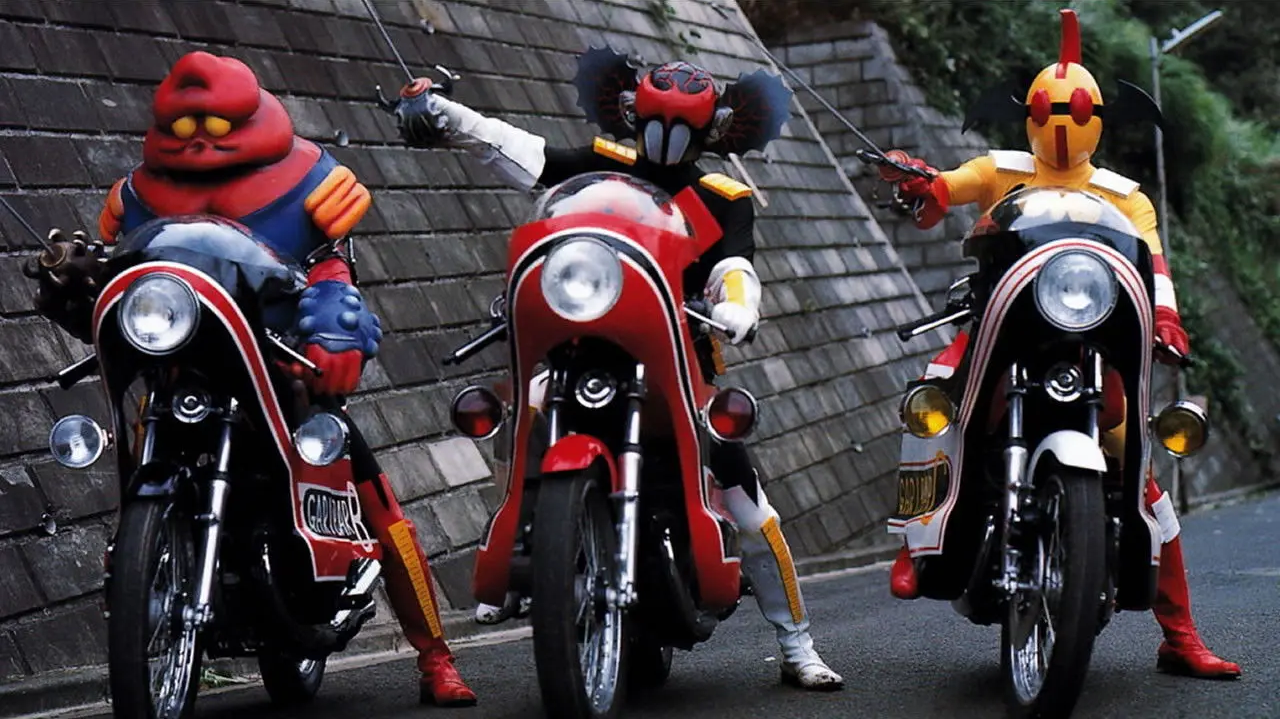
Capitalizing on the success of the color-coded team structure of Gorenger, Akumaizer 3 has the familiar trappings of a Toei toku show: helmet-and-spandex-clad heroes sporting fashionable ascots, all wielding a distinct array of weapons and vehicles to fight fascist Nazi analogues by way of foam and rubber monsters in a quarry.
But despite the skeleton of a typical series, Akumaizer 3 was influenced heavily by rising interest in the occult in 1970s Japan, along a perceived slump in the transforming heroes craze. As a result, we get the main thing that sets this show apart: fully-suited demon monster main characters, and a marked de-emphasis on humans.

All-suited, all the time
The Akumaizers are a trio of demon cyborgs from the Akuma Clan in the “Downworld” – basically Hell in a Hollow Earth (shout out to MonsterVerse fans) with its own government, laws, and infrastructure. When the leaders decide to invade the surface world and kill any Downworld citizens who disagree, a trio of demons defect and side with humans instead.
And thus, Akumaizer 3 is born: Xavitan (ザビタン, Zabitan), the black-clad good-hearted leader with big spikey Mickey Mouse ears; Evil (イビル, Ibiru), an old-fashioned yellow-and bat-wing-clad cynic who freezes at the sight of his own reflection; and good ol’ Gabra (ガブラ, Gabura), the red and blue gentle giant and water balloon with a head that looks like poop, and who stole his “friend to all children” catchphrase from Gamera.
They have no real human counterparts, no henshin sequences, nor are they robots built by
humans. They are literal demons from Hell augmented with robot parts, and the suited guys you
see are their true forms.
This idea of a “masked drama” was a new one for Toei at the time – Space Ironman Kyodain (宇宙鉄人ョーダイン, Uchū Tetsujin Kyōdain) was another attempt the following year – but Akumaizer 3 remained unique with the demonic, monstrous origins. They are weird little freaks through-and-through, complete with the angry mobs and children who fear and misunderstand them, while the Akumaizers themselves bemoan being born in these scary bodies – familiar territory for fans of kaiju, or even things like Ninja Turtles, X-Men, and Gargoyles.

©Toei Company
For audiences who clamor for more focus on Godzilla and less on the humans, but then struggle when monster-only stories are not emotionally resonant, Akumaizer 3 strikes a seemingly impossible balance. They look more like toku heroes than they do kaiju, but they’re also designed more like toku villains than they are heroes (see: the skull face on Xavitan’s torso, or that Evil’s official name is literally Evil.) Even in toku shows with suited monster or anthro heroes, there’s usually at least one beautiful human heartthrob on the team – not so for the Akumaizers.
Because of the focus on suit-only characters, production specifically sought experienced anime voice actors. Xavitan is voiced by Makio Inoue in his only toku role, but he’s best known for playing the title character in Captain Harlock for two decades and Goemon Ishikawa XIII in Lupin III until 2011. Kōji Yada (Evil) would go on to voice General Talan in Space Battleship Yamato and Dr. Gero/Android 20 in Dragon Ball Z; Jōji Yanami (Gabra) would become the narrator for all Dragon Ball iterations until 2015.

©Toei Company
But kaiju fans know how important suit actors are to making even the most static monster costumes feel alive. While the Akumaizers have the benefit of being humanoid, this stacked cast goes above and beyond at making them each feel distinct and real. Xavitan was Toshimichi Takahashi’s first ever suit acting role, one he was reluctant to take, but his success here led to him playing tons of major villains across Kamen Rider, Super Sentai, and Metal Heroes. Other notable suit actors include Tetsu Masuda (Evil), who played various Rangers across multiple Sentai seasons, and even Space Sheriff Gavan himself, Kenji Ohba.
All for one and one for all
With a show centering demons in masks that don’t move (except for changes to their eyes when they go into battle mode), the creative team smartly worked to build emotional attachments with the audience. Part of it relies on the show’s origins in, believe it or not, Alexandre Dumas’ classic story The Three Musketeers.
Like the Musketeers, the Akumaizers are swashbuckling freedom-fighters who stage a revolution against their oppressive monarch. Their signature weapon is a rapier (at least when Evil isn’t pulling out his machine gun) and instead of typical toku martial arts and wrestling-inspired fighting styles, their swordfights feature thrusts and footwork more akin to a fencing match.
But it’s the nature of chivalry that translates best from Three Musketeers, as Xavitan’s self-established code to protect innocents and offer second chances is what brings the three together. He wins Evil and Gabra to his side by showing them kindness, and takes a stand against the horrific actions of the oppressive leaders from his own home just because it’s the right thing to do – making his character resonate as much today as he did back in 1975.
Xavitan is one of the most emotional toku heroes, too – he loves his mom, he cries a whole lot (like, they literally show tears coming from his helmet), and he’s unafraid of sharing his feelings. It’s not from a core trauma or tragic backstory, either, and what could have been a tragic backstory instead happens in episode two…just to reinforce that he’s a good guy at his core.

©Toei Company
A thriving world of demons and freaks
From there, the series is mostly episodic with a smattering of mini-arcs ranging from heartfelt and serious to comedic and silly. A couple of reporters and a mildly annoying kid sidekick fill out the human cast, but they’re rarely the focus (the lone human woman, Jun, even disappears two- thirds of the way in.)
The most memorable recurring character is instead Darunia (ダルニア) voiced by anime legend Rihoko Yoshida, a pink demon with beam-shooting anime eyes and long blond hair who announces her arrival with flowing flower petals. She’s a mysterious Downworld international affairs officer who drops in like Tuxedo Mask to occasionally help, complete with her own complicated backstory and motivations. In fact, she eventually becomes the Akumaizers’ unofficial fourth Musketeer (the similarity between “Darunia” and “D’Artagnan” is not a coincidence.)

©Toei Company

©Toei Company
There’s too much to talk about with this series, frankly. The theme song is a banger. Our heroes commandeer a flying ghost ship that can transform into an open-mouth angler fish-like airship decked out like the American flag with a detachable giant golden human ghost arm (it makes exactly as much sense in context). Halfway through the series, Xavitan gains the ability to disguise himself as a human journalist played by Sô Takizawa in a fun Clark Kent/Superman pastiche. Gabra gets the power to transform into an ostrich-like creature, because why not?
Many of the villains turn out to be related to the good guys in some way – old friends, siblings, parents, even ex-lovers – hammering home the sacrifices the Akumaizers are making in their quest for peace, and showing that demons have the same complicated relationships and inner lives that humans do. This comes to a head at the end of the series when we’re introduced to the Demon Peace Party, even freakier looking monster freaks who are convinced by the Akumaizers’ kindness to stop Downworld’s invasion, and in turn campaign to change demon minds in the Downworld too. They represent the show’s best message about the pursuit of peace – that even the scariest, strangest, most unexpected creatures can make it happen.

©Toei Company

©Toei Company
A weird legacy for a weird show
The original run ends with a very poignant and bittersweet finale that itself is unusual for toku shows of that era. And for the most part, that’s where the story ends. The sequel series, Choujin Bibyun (超神ビビューン, Chōjin Bibyūn), sees everyday humans imbued with the souls of the original Akumaizers to become new henshin heroes (sporting unused designs for Kamen Rider suits), but it’s mostly a sequel in spirit only. The original intention was to have a more direct continuation of Akumaizer 3, but allegedly sponsors demanded the change to a more traditional format.
Since then, the Akumaizers have made brief appearances in the 21st century. In 2006, they returned in the serialized prequel prose story Akumaizer 3: ~Before and After~, part of the S.I.C. Hero Saga in Monthly Hobby Japan magazine that was used to advertise a line of diecast figures. That story, which delves into Xavitan’s parentage, is about the only real expanded universe materials to exist.
Today, many toku fans know the Akumaizers as, oddly enough, the big bads of 2012’s Kamen Rider × Kamen Rider Wizard & Fourze: Movie War Ultimatum, a crossover film that reimagines a few classic Showa heroes. This version of the Akumaizers (renamed Xatan, Eel, and Gahra) are deployed as pure evil demons, redesigned to be grotesque and with actions so plainly malicious that even the other villains don’t like them. It’s a confounding choice, and while the homage is fun, it feels strangely mean-spirited that their role is so pointedly antithetical to their origin.

©Toei Company
What’s next?
I’ll be totally honest – part of the goal in writing this piece was about passing on my obsession to other monster-lovers, like showing someone the tape in The Ring. But the other part is to share this gem in hopes that it could, by some miracle, lead to a full western release. Currently, only the first two episodes are available on Toei Tokusatsu World Official YouTube channel, but it’s otherwise never had an official release (and tragically, only 10 episodes have ever even been fansubbed).

©Toei Company
But hopefully that changes, because between its scattershot design aesthetic and a penchant for throwing everything at the wall, this is a real treat for anyone who likes their toku extra weird. And its story – that your origin doesn’t define you, that you can rebel and win against oppressors even if they’re your own people, and that the monsters and the freaks can be the good guys – is a great one for humans, demons, and kaiju alike.
References
Showa Ishinomori Heroes Retsuden (2013).
“Hero File: Choujin Bibyun” (September 10, 2013). Gakken Mook.