Giant Robots are awesome.
This undeniable fact has defined the genre of multiple media outlets for generations of fans like me, whether it’s movies, tv shows, or comics. As undeniable as the fact itself, the medium of television is what most pops into my brain as the primary introduction to giant robot fiction. To see something so immense and artificial being used for good or ill moving its fist across the screen to greet the face of an unfortunate monster has many a times healed that void in my imagination looking for something so niche. Comics are often a tough sell for something like that, at least for me, but this comic has pushed itself to the top of my exceptions.
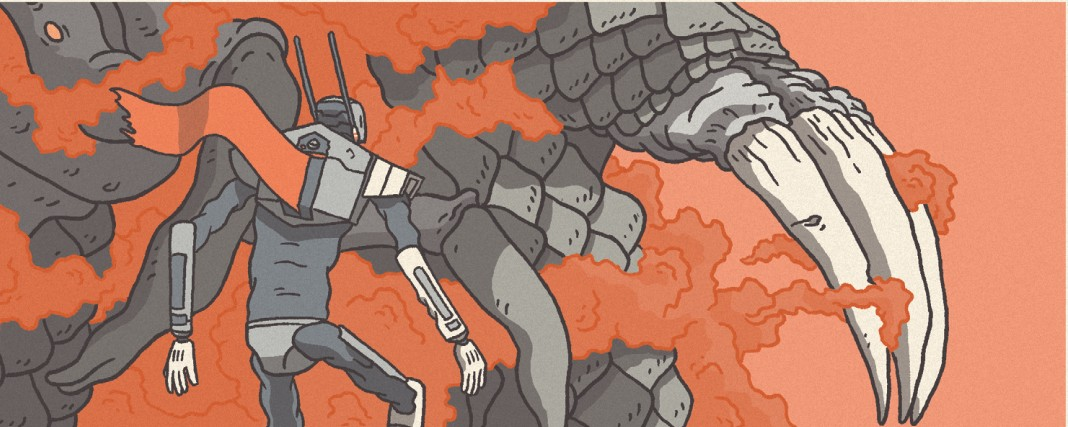
MODERN CARAPACE is an independent action-scifi comic written, illustrated, crowdfunded, and PUBLISHED by only one guy: Jacob Kuddes, a cartoonist based in Minnesota who has also done artwork for his friend’s fanzines covering lovable nerd culture like Star Wars and Pokemon. As for the topic of this article, Modern Carapace, this is a comic about a Park Ranger who protects kaiju from poachers using a giant mech suit. If that summary alone has you sold, I think you should skip to the bottom of this article and go find where you can read it RIGHT NOW. If it doesn’t, then we have a lot of ground to cover here anyway. Good thing we have two giant robot legs to work with! Three issues are already completed and available, but for this article I’m only going to go into the first issue, because I really want you to be reading the comic instead!

It begins like any other workday. We meet our hero, Esther, slowly drifting out of a dreamy sleep. Some impressively “camera-like” panelling work our eyes through the page like we’re following a longshot from a movie. This is a really cool way to open a comic. A staple mentality to have when making the artwork is that every panel is a frozen moment in time. The reader moves the images in their heads, but the artist makes that process easier for them. ‘Intrigue’ comes to mind. I’m immediately given a feeling of immersion. The strict color scheme doesn’t blur anything together because each panel leads from one to another VERY fluently.
There’s enough visual clues in each panel to inform us something about this character, her origins, her beliefs, what she cares about seeing most before going to bed, how well or unwell off she lives. The cracks left unfixed on the wall and the little figure on her bedside table give her so much depth without any words. And all of this while our eyes just glide through the page so easily, each image moving between each panel like we’re watching a movie. As we walk down the halls of her home by her side, we get a little back and forth between Esther and her artificial companion, Wéd. They give us little hints about the world they live in. This place is so hostile even the air might be dangerous.
Esther doesn’t seem phased. She’s been here long enough to know when it’s time to be concerned. She’s young but experienced. She doesn’t waste time gathering information as she makes her way to work, asking about equipment functionality. She’s efficient and direct. She doesn’t waste time with worry but she does not skip over fundamental maintenance. She only flinches when she learns the coffee machine is broken. Now things are serious.

Pushing that aside for now, the conversation moves to some exposition that shows us exactly how much thought has been put into this setting. Monsters in this world have an ecosystem, and the world itself has sandstorms. We get a hint of this from the dialog as we explore the caves Esther travels through and see a lot more silent but essential storytelling through the environment alone. Esther arrives at a dock where she meets person to person with her artificial companion who, stars above, is a ROBOT COWBOY!
Immediately, Jacob, you get one extra “BADASS POINT” for that. A very charming robot, at that. We get a comedic beat about Wed trying to behave like a person before we’re treated to a very eye-catchingly beautiful polyptych type page where the panels form up into a complete image of Esther docking into the pilot seat of her mech suit, the Tarantula Hawk. Esther is suited up and ready for work now.
Some more beautiful panelling leads us towards the surface of this world, where a nice creamsicle orange ground contrasts with the clear blue sky. I could almost hear an anime-coded opening theme playing in the background of my brain while going through this part. If I asked Jacob what kinda music he’d imagine for a movie or a tv adaptation of this work, I wonder what he’d say. A little orange lizard burrows into its home before the Tarantula Hawk bursts out from the ground and into the title page, with a font very reminiscent of ye old medieval English tomes. The Tarantula Hawk and her pilot are like a lonely knight errant, here to do noble and thankless work. Also the mech has a cape now, which I didn’t see them put on before but I am thankful for the addition anyway. Another “BADASS POINT” for that alone.
A moment of quiet gives us a break between scenes. A whole page without a single word forces the reader to fill in the gaps with our own ambience. Mine populated the silence with whistling wind and the trudging foot-falls of the robots’ relaxed stride. We see footprints on the ground where a monster might’ve stepped. We follow them along with Esther and find a (very) relatively smaller creature trapped inside what looks like an artificial container. She frees the little guy and gets spat on the chest as thanks. Cute! What happens next doesn’t need a sound effect to let us know that trouble is around the corner. Our hero looks to the horizon and sees another humanoid shape. It’s a mech suit like Esther’s, but it’s not here to help.
I have to add in, I really like the design of the bad guy’s robot legs resembling something you’d see an amputee runner using for their prosthetic legs. Look up Oscar Pistorius to see what I mean. The fight between our hero and this newly revealed bad guy faction ends quickly. The one who shows up here is not the only one in this place. Another bad guy gets the jump on her with some kind of sonic ray gun, disabling her movement. The first bad guy does the same to the smaller creature, securing it for containment. Esther is not a superhero piloting a super robot, she’s just one person standing against impossible odds for the protection of beings that deserve to live freely. These kaiju aren’t monsters, just really big animals in a strange world.

After the tussle, we get a heartfelt flashback before we meet our main antagonist, a guy who’s eerily laid back for someone leading a team of poachers. To us, this might be a life and death situation teetering on the edge, but to him it’s just Tuesday. He begins his exposition about who he is and what all this violence is for. He paints it in a light that puts him and Esther on the same boat; they’re both just doing their jobs. Nothing here is personal. Except, to Esther, it is VERY personal. The bad guys here are very aware that what they’re doing is messy at best, what they don’t understand is that the person standing between them and their next meal ticket is a person who has skin in the game.
After quick thinking and a bit of help from a much bigger monster, Esther gets the upper hand and we finally get our epic dust up between giant robots on a world of kaiju. Sand storms, martial arts, verbal back and forths, all stuff I grew up loving while watching MEGAS XLR. In a case reminiscent of Ultraman, Esther has to win this fight quickly. Her robot runs on a certain component that’s quickly going bad. When all is said and done, I can’t complain about any action scene where a giant robot is riding on the horns of a giant monster. So I won’t. The fight ends with every animal saved and reunited with their parents. All seems well, for now. The creatures vanish into the thick of the sandstorm, leaving our hero to rest alone amongst the debris. We get a quiet farewell to our protagonist, and what almost feels like a 4th wall when she closes us off: “I’ll rest here in the meantime. Esther out,” a clever “to be continued” without the narration.
Speaking of, I both love and don’t love the lack of some narration to give context to the reader. I love it because it makes the story feel more organic. We’re just visiting this character in the middle of her life to see what her day to day is all about. I love that. I don’t like how it doesn’t give much context though, because it makes the issue seem lacking of any real hook besides the premise. I worry that readers might fall off from the lack of a story here, even though there absolutely is a story here for those who keep looking. What is this place? Why do these creatures mean so much to Esther? Who are these benefactors hiring poachers to catch monsters? The mystery is intriguing, but I wonder if the lack of a narrative voice still has enough breadcrumbs to follow along for the future. For myself, I dislike the lack of information for the story, but I love it for the atmosphere. Maybe I’ll eat my words when I read more of Jacob’s work (but only with ketchup).
Making comics is hard. Making anything is hard, but I only know that abstractly. I know for CERTAIN that making COMICS is HARD. Trying to make one by myself years ago fresh from art school was a really harsh lesson I had to learn about self boundaries and acknowledging my limitations. I’ve since become better at making my own work, but not without a lot of help. I can’t express enough how impressive this comic is, not just as the work itself but just thinking about the work put into it by ONE GUY, and this is just his FIRST comic!
Just imagining all the work he’s put into this by himself brings me back to those endless sleepless nights planning out each page only to come up with new ideas that could erase entire weeks worth of work. For that alone I would rate Jacob’s work here a 10 out of 10 without a hint of irony. But for most readers, it’s the comic alone that must speak for itself, and even still I would rate that work pretty high. The characters, the world, the amazing attention to detail, the artwork itself, this is a really amazing comic and I am very excited to see what this garden of work is growing into.

As I’ve mentioned maybe once or twice before, this comic is a very independent project with only ONE MAN at the helm. If you want to read his work, you can find it in the links below as well as the Kickstarter for his next project. For those still on the fence, I hope this article might’ve tipped you in the direction of giving it a read. As I’ve said earlier, I’ve only dived into just the first issue of three that are already available, leaving you, Kaiju United reader, the opportunity to discover where the story ends up going. Speaking for myself, I just can’t wait to read more from Modern Carapace!