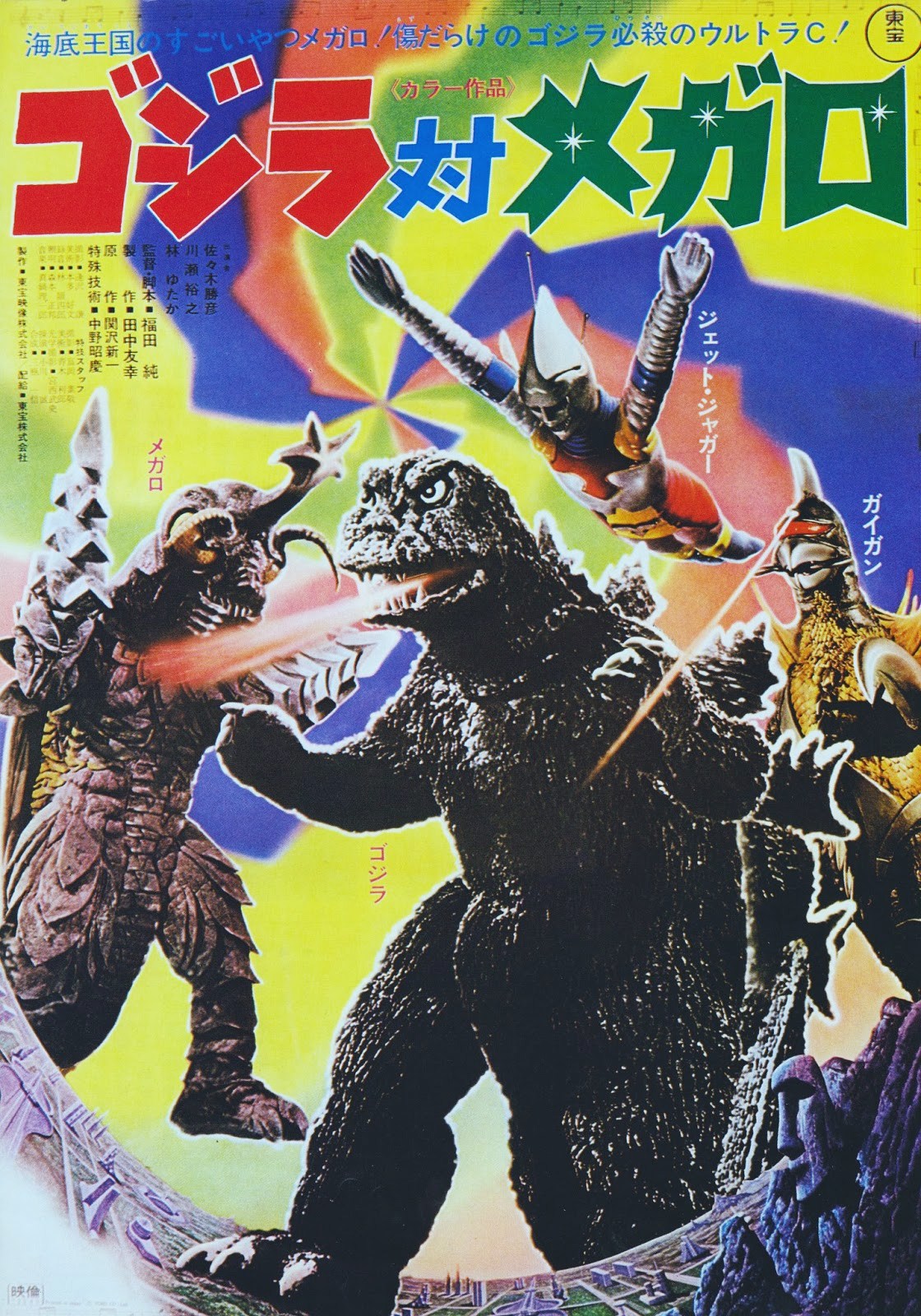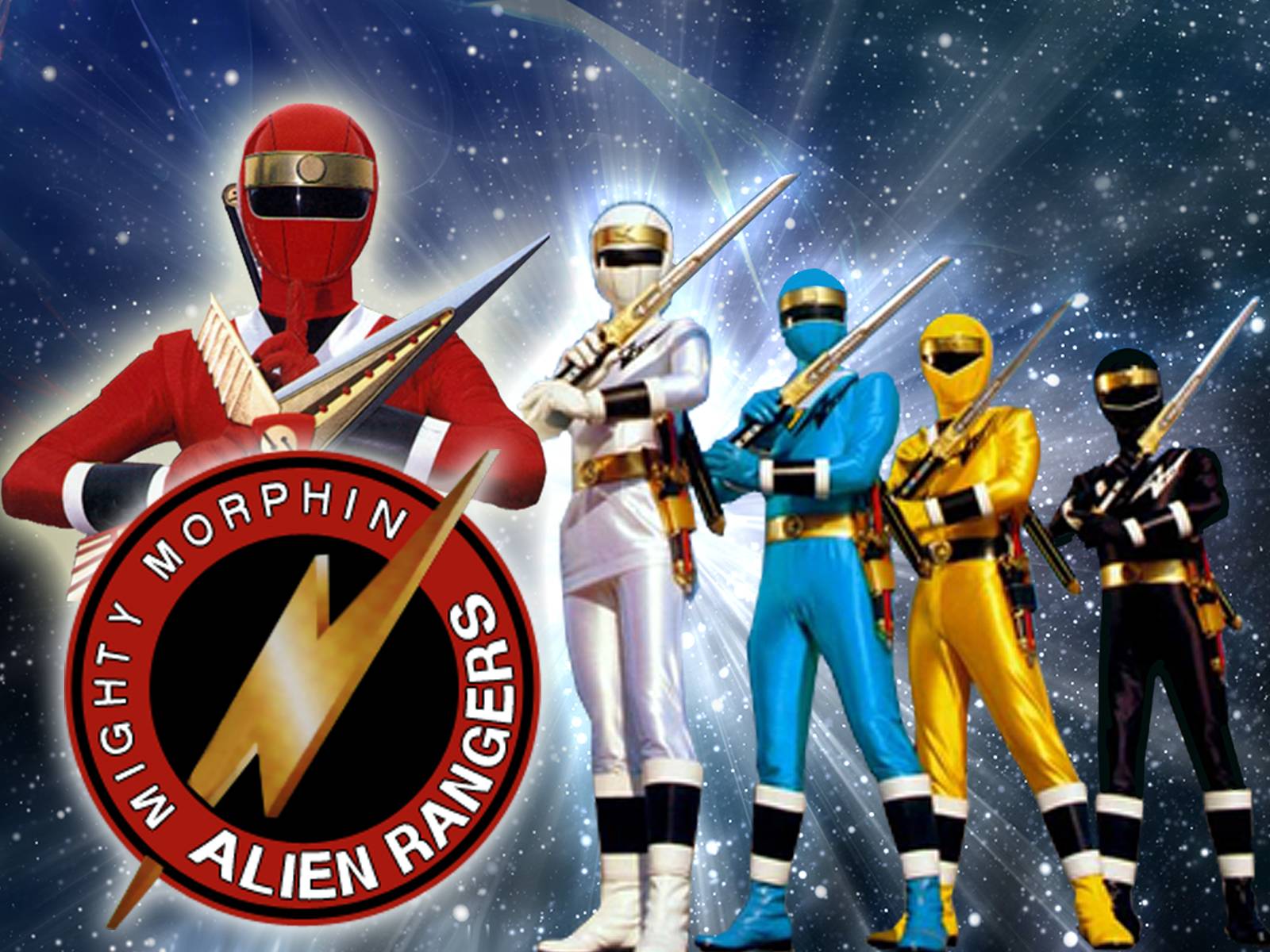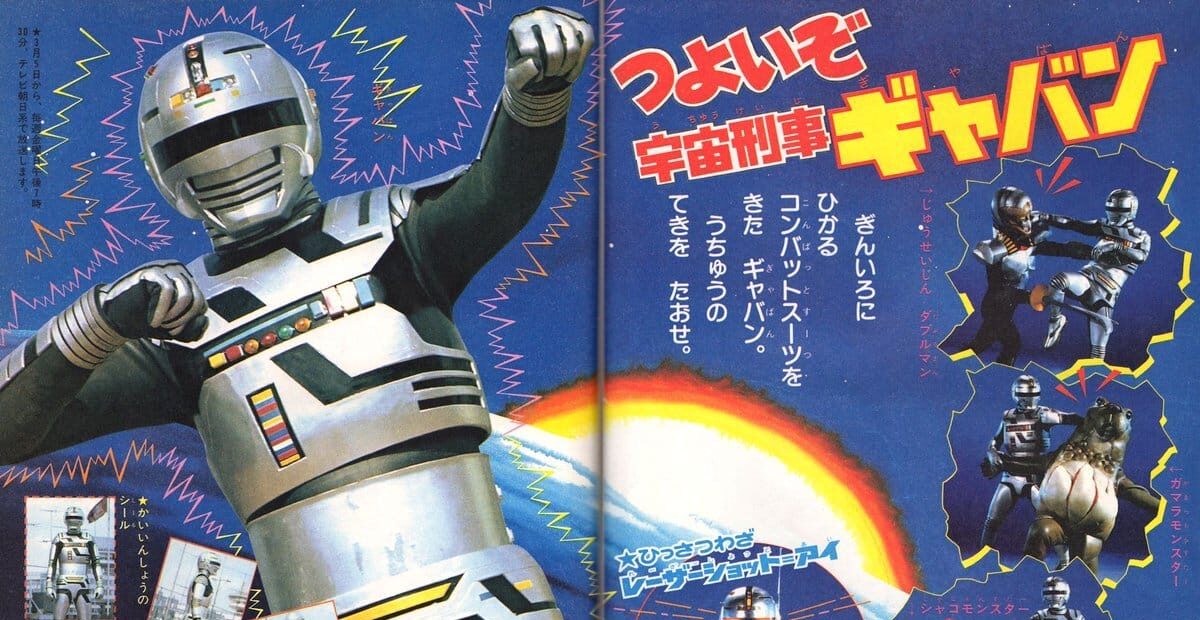
By 1981, many pillars of Tokusatsu had all but vanished from the landscape of Japanese pop culture. Godzilla lay dormant (at least for a few more years), Gamera was buried, Ultraman vanished, and Kamen Rider seemingly took one last ride into the sunset (with the exception of a yet-to-be-aired 1984 television special). Audiences were less interested in the transforming superheroes that graced television, and were more invested in sci-fi space operas akin to the massively popular Star Wars. Toei was still producing Sentai, with Taiyo Sentai Sun Vulcan (太陽たい よう戦隊サンバルカン, Taiyō Sentai San Barukan) being the sole live-action tokusatsu series on air at the time1, but they felt they needed a new (and fresh) solo superhero to replace Kamen Rider and capitalize on the science fiction craze hitting the studios at the time. That new hero would not only prove to be a hit, but kick-off an entire franchise (well, actually TWO franchises). Gleaming with shiny silver armor, complete with an array of cool gadgets, a spectacular spaceship, a compelling cast of friends and foes, and, oh yeah, A LIGHTSABER?!?
Enter: Space Sheriff Gavan.
I wrote an editorial earlier this year detailing my journey to becoming an Ultraman fan. Since embracing the Ultra franchise, I’ve also branched out to other Tokusatsu series including Garo (牙狼〈GARO〉), Gaoranger (百獣戦隊ガオレンジャー, Hyakujū Sentai Gaorenjā), and Kamen Rider Black (仮面ライダーBLACK, Kamen Raidā Burakku, as well as Kamen Rider ZEZTZ (仮面ライダーゼッツ, Kamen Raidā Zettsu) and Kamen Rider Kiva (仮面ライダーキバ, Kamen Raidā Kiba). But one series I was hesitant of jumping into was Metal Heroes. My knowledge of Metal Heroes mostly consisted of remembering Big Bad Beetleborgs from childhood, and then later in life watching the series Saban used for Beetleborgs, Juukou B-Fighter (重甲ビーファイター, Jūkō Bī Faitā). Now, I liked what I saw of B-Fighter, but it was a little too similar to Sentai for me. I’m also more of a lone hero kind of guy. I love plenty of teams, don’t get me wrong, but there’s something more appealing to me about one warrior versus the world. It wasn’t until I did a little more digging that I discovered that the Metal Heroes had actually started out as a brand called Space Sheriff.
I was intrigued but what really peaked my interest was tuning into the Twitch channel Sci-Fi Explosion during one of their Toku Thursday streams (Shoutout to Derek B Gayle and Chris Cummins, you guys rule.) What I witnessed was an awe-inspiring, dynamic, bombastic action sequence of a Metal Hero surrounded by a plethora of armed gunman, as well as creepy monster bad guys. The special effects, the choreography, I was flabbergasted. Turns out this was from a movie featuring a later metal hero named Jiban. I instantly sought out the blu-ray for Jiban, but I also remembered seeing a metal hero with a lightsaber. A few clicks later, I also owned the blu-ray for Space Sheriff Gavan.
Space Sheriff Gavan (宇宙刑事ギャバン, Uchū Keiji Gyaban) aka Space Cop Gabin, first aired on March 5th, 1982. The series was produced by the late Susumu Yoshikawa, and the lead designer was Katsushi Murakami. There were several preliminary names giving to the hero that would become Gavan. Space Detective Z, Gingjiro, and Ginbird were amongst the early names, but it was ultimately decided on Gavan because of the popularity of French actor Jean Gabin2 (who was quite popular in Japan). The other reason? Well, because Gabin was a foreign name, it was easier to copyright. Go figure.

©Toei Company, Ltd
The final piece of the puzzle (at least until we start actually talking about the show) was the leading man. Toei decided to put their trust in someone reliable, someone they had already worked with numerous times, and someone who could perform both in and out of a suit of armor. The legendary Kenji Ohba was the answer. Ohba’s toku cred dates all the way back to being a minor character in Gamera, The Giant Monster. Ohba, in a lot of ways, was Toei’s right hand man. He appeared in Android Kikaider (人造人間キカイダー, Jinzō Ningen Kikaidā), Akumaizer 3 (アクマイザー3, Akumaizā Surī), and in two Sentai series: (Battle Fever J (バトルフィーバーJジェー, Batoru Fībā Jei) and Denzi Sentai Denziman (電子戦隊デンジマン Electro Squadron Denjiman)). Long before he graced American silver screens in the Kill Bill films, Ohba was already a treasure.
Not long after receiving the Blu-rays, something inexplicable happened: Toei filed a copyright for “Super Space Sheriff Gavan Infinity (超宇宙刑事ギャバン インフィニティ, Chō Uchū Keiji Gyaban Infiniti).” I could not have timed my purchases better. Toei was resurrecting their Space Sheriff line just as I was diving in. And then it hit me. We can make this into something really interesting for Kaiju United. So, after that very long-winded setup and backstory, here’s the hook.
I will be going through Space Sheriff Gavan bit by bit, for the first time, and documenting my journey with all of you. This includes guest appearances, and films, all leading up to the new show, Super Space Sheriff Gavan Infinity. The goals of this series are: one, experience a new (to me) Toku series, two, educate not only myself, but also those interested in the Space Sheriff zeitgeist, and finally, purely and simply enjoy the ride, and I hope readers will come along with me.
In fact, if you would like to follow along on this journey with me, there’s a couple of ways to do so. First, there is the aforementioned Blu-ray set from DiscoTek Media. However, it’s out of print and is not cheap on the secondary market. Thankfully, Toei has uploaded all of Gavan on to its Toei Tokusatsu World Official YouTube channel. And, in a recent development as of editing this piece on 12/14/2025, you can also officially find Gavan on Tubi! Tubi continues to be a safe haven for Toku fans. So, the show is very accessible!
That’s all for now. I hope you’ve enjoyed this “prologue” of sorts and stay tuned to my coverage of Space Sheriff Gavan. The next installment will cover the pilot episode. Thanks readers, and remember, GAVAN WILL WIN!
References
- The Art of Space Sheriff Gavan. (2025, April 6). Japan Hero. ↩︎
- Japan Hero. (2025, September 21). The history of Space Sheriff Gavan [Video]. YouTube. https://www.youtube.com/watch?v=Kt4tagVf87I ↩︎