Title: Giant Monster Mid-Air Fight: Gamera vs. Gyaos Manga Story
Author(s): Nisan Takahashi
Art: Keiji Nakazawa
Publisher: Shonen
Pages: 36
While the world of kaiju/tokusatsu movie manga adaptations is populated with many largely unknown artists (sometimes, as in the case of the King Kong Escapes manga, they are quite literally unidentified!), nevertheless, even the biggest comic artists of Japan occasionally turned their pens toward monster movies. The godfather of manga himself, Osamu Tezuka, drew an early adaptation of the original King Kong; he also created Ambassador Magma/The Space Giants, which was adapted into the first color tokusatsu TV series, beating out Ultraman by two weeks. Shotaro Ishinomori, known as the king of manga because of his astonishing contributions to the medium, drew an adaptation of Matango… and then went on to create two of the most influential tokusatsu TV series of all time, Kamen Rider and Super Sentai, among others. Today, I would like to take a look at a third profoundly influential manga artist who dipped his toes into monster movie manga adaptation: Keiji Nakazawa, the creator of Barefoot Gen, and specifically his manga adaptation of Gamera vs. Gyaos.
For those unfamiliar, Barefoot Gen was a semi-autobiographical retelling based on Nakazawa’s own life and experiences losing his family in the Hiroshima bombing and surviving the aftermath. While the manga (stretching across ten volumes) builds and dramatizes certain aspects of post nuclear life in Japan to exaggerated extremes, it’s difficult to exaggerate the horror of the experiences he went through—several of his family members were killed in the blast and wreckage from the bomb. His pregnant mother gave birth from shock, soon losing the child, and she succumbed not so long after. Nakazawa witnessed human beings with their eyes extruded, intestines ripped out, glass skewering their bodies, flesh burned away, and more. It was with those memories that Nakazawa produced some of the most influential and shocking manga stories of all time; Barefoot Gen dared to explore and protest the nuclear bombing of Hiroshima head-on, providing a visual tongue-lashing against America’s bombing strategy, but more shocking still for Japan, including no-holds-barred condemnation of Japan’s role in the war, even extending to Emperor Hirohito. The manga became wildly controversial in Japan, but also incredibly popular, eventually spawning two movie adaptations, and a fervent international following.
Before those days of fame, however, Nakazawa produced several tokusatsu manga adaptations. Most famously, he drew an adaptation of Son of Godzilla, which I covered in a review for G-Fan some years back. That same year, he would also draw an Ultraseven manga, as well as today’s topic for review, Gamera vs. Gyaos for the generically-named Shonen magazine (just try googling “Shonen magazine” and see if you find anything about this rag). Despite having been largely forgotten today, Shonen ran some heavy-hitting manga series back in its heyday, including Osamu Tezuka’s most famous work, Astro Boy, as well as Tetsujin 28, or Gigantor in the West. The latter manga, penned by Mitsuteru Yokoyama (who later went on to create Giant Robo/Johnny Sokko and His Giant Robot), also featured war-related storytelling, with the titular Tetsujin 28 being a super-weapon created by the Japanese to win WWII (not so far removed from the plot of Undersea Warship/Atragon, come to think of it.)
The manga adaptation of Gamera vs. Gyaos was published as a furoku, which is to say, it was published with an issue of Shonen, but not within the pages itself. It had its own binding, its own cover; it looks like a separate publication, and tends to be sold apart from the Shonen issue with which it was originally packaged. In this case, the furoku is pretty big, too—not too far removed from the size of your average American comic book issue. Some furoku publications were much smaller, such as the Gorath manga adaptation by Fumio Hisamatsu, which was closer to the size of a personal calendar book and so featured simpler, squished panel layouts. With the larger format came the ability to play around with more dynamic and inventive page layouts. Takahashi also published his adaptation of Son of Godzilla with Shonen in the same fashion that same year, but when I reviewed that book for G-Fan some years back, I was reliant upon a reprint in smaller format. Not so here: I have an original Takahashi Gamera vs. Gyaos book, and so I can experience it mostly as a fan who would have enjoyed the book nearly sixty years ago (as of this writing).
The reprint of Nakazawa’s Son of Godzilla did not come with advertisements or anything except the pages of the manga itself. With this original publication, there are several pages of advertisements included, as well as a few pages of straight promotional material for the monster film itself. On the inside front cover for the manga there is an advertisement for Chiisai Toubousha (“Little Fugitive”), a Soviet-Japanese co-production from Daiei in which a Japanese street musician joins a Russian clown on a trip to the Soviet Union in order to find the musician’s sick father. This latter film was part of a double-feature with Gamera vs. Gyaos when they were both released in 1967. The back cover includes advertisements for a Marusan Daimajin toy (both a remote control version for 650 yen and a soft vinyl for 350—so cheap!), and the back cover is reserved for a color advertisement featuring Nitto toys of Gamera, Barugon, and Gyaos—as well as a list of Ultra-kaiju and Nikkatsu’s Gappa. These treasures were even cheaper, with remote control versions selling for 500 yen, and the straight action figures going for only 200! In current yen to dollar exchange rates, that would be like getting a kaiju figure for a little over a dollar, or a remote-control version for around three bucks.
Before the manga begins in earnest, the publication also includes four preliminary pages of promotional material. The first page is simply an advertisement for the movie with information about the film and its staff (set beside the advertisement for “Little Fugitive”). The next two pages include full-color promotional images focused on the monster fights along with comments about particular sequences, such as the spinning hotel trap set for Gyaos, or the plan to entice Gamera to come and fight Gyaos by judicious application of a forest fire! A final page, set across from the opening to the manga, is about Gamera’s “secret strategy” and explores the terrible terrapin’s various attack methods. Along with images/publicity stills, the page includes two illustrations: one of Gamera, the other Gyaos. They are tiny little pics that come with stats about the monsters themselves (size, weight, etc.), and I do believe they were sketched out by Nakazawa himself as they match pretty well with the internal artwork from the book.
As far as the story goes, given that the manga is only 32 pages long, we get a grossly abridged version of the film, though with some more focused character moments and a surprising increase in human drama. As with the film, the manga opens with village elder Tatsuemon Kanamaru arguing with Shiro Tsutsumi and his crew, who want to build a highway through Mt. Momiji. Kanamaru refuses to sell because the land has been owned by his ancestors for 300 years and he doesn’t want to disturb their slumber. Kanamaru even threatens to douse Tsutsumi with a noxious liquid (toilet sludge, perhaps), but before further aggravated assault can occur, Mt. Fuji (which is also nearby) erupts. The resulting firestorm attracts Gamera, and shortly afterwards Gyaos appears as well. The monstrous vampire bat scoops up Tsutsumi’s assistant and eats him, then targets Kanamaru’s granddaughter, Sumiko. Shockingly, Gyaos gobbles her down as well, leaving behind nothing but a bloodied bow she had used to tie back her hair.
Gamera and Gyaos tussle, exchanging fire breath and energy beams before the sun rises and causes Gyaos to flee. Gamera attempts to dissuade the bat from departing but succeeds only in tearing off the flying creature’s left foot, which falls on the ground and melts away into slime. Later, the military stage an unsuccessful attack on Gyaos, and the nocturnal nightmare slices up a few fighter jets before carrying out an assault upon Nagoya, cutting Nagoya Castle in two. Gyaos leaves largely unscathed and returns to Mt. Momiji, provoking boy Eiichi (who isn’t named until page 18!) to slug an office chair in frustration. The office chair spins dramatically from the impact, inspiring Tsutsumi to hatch a plan to use the rotating lounge atop a nearby hotel as a trap for Gyaos. The idea is to use a massive pool of blood atop the lounge as a lure for Gyaos, then spin him into submission. If they can give Gyaos severe enough vertigo, they can keep him from escaping when the sun comes up, thus exposing the monster to lethal ultraviolet radiation.
The plan seems to be going well, with greedy Gyaos flying in for a plasma snack, only to be spun right-round-baby-right-round, like a record player. However, before the sun can come out and fry Gyaos, Kanamaru appears with spear in hand riding upon the revolving death machine. Kanamaru, obsessed with obtaining revenge for Sumiko, stabs Gyaos in the eye twice. The machinery spinning the hotel lounge about overheats as well, bursting into flames and causing the trap to grind to a halt. Gyaos takes the opportunity to slap the old geezer off the roof of the building before flying for safety. Amazingly, Kanamaru survives the fall, tasking Tsutsumi with Sumiko’s grudge and giving a verbal “OK” for that blessed highway construction before passing away.
The fires from the hotel spread all over Mt. Momiji, driving Gyaos out of his hiding place and attracting Gamera’s attention. The two monsters have a brief final confrontation, with Gamera tearing apart one of Gyaos’ wings before burning the monster to death with his flame breath. Gamera flies away in victory as our surviving human cast cheer him on. The end.
As mentioned above, the storyline remains overall very similar to the film version, including such broad strokes as friction over the building of the highway, most of the main set of characters, the opening battle, the monster bat losing his foot, the military battle, Nagoya destruction, the vertigo operation, and the final monster confrontation. Everything is foreshortened, however, and many sequences are trimmed or excised. Eichi never visits the cave accompanied by the hapless journalist. There is no sequence wherein Gyaos’ foot grows back, nor the experimentation on the amputated foot. Eichi never rides on Gamera’s back. In this version, Eichi does not hatch a plot to entice Gamera to return to fight Gyaos with a forest fire at the end; the fire is set by the out-of-control burnt-out spinning hotel. Of course, the family sequences with Eichi and Sumiko and their mother are also cut way down, and Eichi’s obsession with Gamera is not nearly as pronounced (though the kid remains a fan of the heroic turtle). The overt inclusion of the amusement park Fuji-Q Highland (these days, home of some of the world’s fastest rollercoasters, as well as a parodic Super Sentai team) which stood out so memorably in the movie is mostly gone in the manga as well.
Part of the changes come as a necessity with Nakazawa’s biggest innovation on the story: Sumiko’s completely shocking demise. I was legitimately taken aback when Gyaos eats Sumiko, who appears much younger here than in the film—Sumiko is an adult in the movie, caring for Eichi more as a parent. Her death, particularly since she is depicted as being so much younger, gives the story real punch that the original lacks. I cannot help but wonder if this change may have been inspired by Nakazawa’s own tragic past, given that he lost so many family members in the bombing of Hiroshima. He knew what it was like to lose precious siblings in times of war and may have channeled that tragedy into his manga here before going much further with autobiographical details in Barefoot Gen.
Nakazawa’s manga version also gives Kanamaru a much meatier and more dramatic role. While in the movie it seemed like the locals didn’t want to cede their land mostly as a hold out for more money, the manga version, here, Kanamaru has a strong personal reason not to turn over the land: his ancestors are buried there. This set up feels similar to Rodan Continues, a manga tale that follows after the action from the classic Toho kaiju film and features a bearded village elder resisting officials who wish to build a dam on their land—though in his case, he is spurred on as much by his god, Gomata, and a desire to protect the Gomata’s Stone. In that tale, too, the old man gives his life in the fight against the giant monster. Given the similarities between Rodan and Gyaos, it seems at least within the realm of possibility that the story of Gamera vs. Gyaos could have been influenced by that earlier kaiju tale. I have to say, though, Kanamaru’s means of attacking Gyaos, blindfolded like Stick from Daredevil, wielding a spear, while foolish in the extreme, also makes the old geezer one of the most spectacular monster-fighters in the kaiju cannon. Eat your heart out, Douglas Gordon!
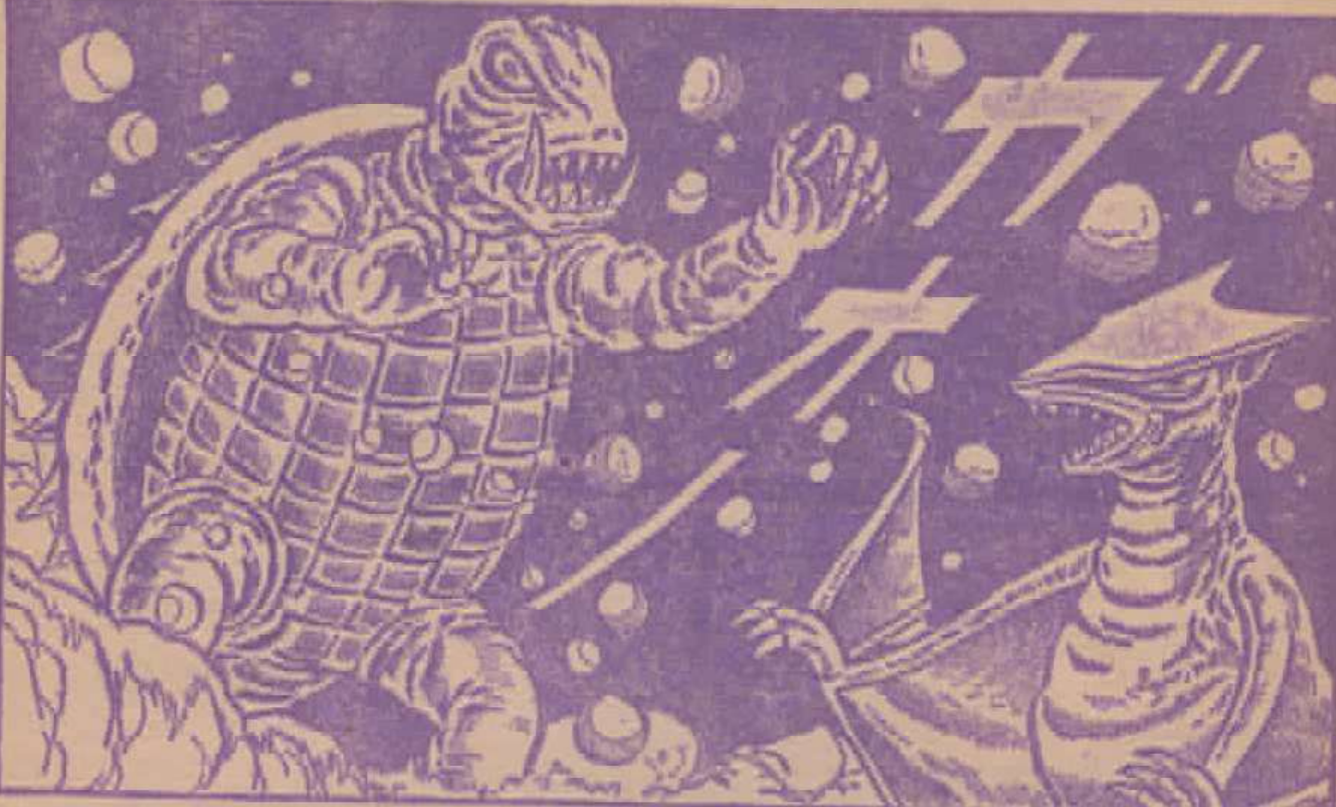
As with Nakazawa’s adaptation of Son of Godzilla, the art is solid, with special attention given to the monsters, and the human cast barely resembling their real-life counterparts. Both Gamera and Gyaos look fairly close to their on-screen interpretations, though perhaps not reaching the fidelity of Nakazawa’s take on Godzilla for his manga, which very closely follows the much-maligned Son of Godzilla suit. Both monsters exhibit impressive levels of detail and their battles do not shy from the blood and gore found in the film. Gamera bleeds, Gyaos is torn asunder and ultimately immolated by Gamera’s flames rather than the volcano in another step away from the film; this latter approach gives Gamera a more personal, directly applied monster murder method right out of Godzilla Raids Again.
As for the human cast, again, Sumiko gets the biggest change, shrunk into a child. Eichi isn’t as childish or silly and gets a ubiquitous old-school hat. Kanamaru is skinnier than actor Kichijiro Ueda, and manga Kanamaru gets great beard—following a well-trodden path of increased facial hair in the manga vs. the movie versions. Tsutsumi probably appears closest to his filmic counterpart, as actor Kojiro Hongo looks suitably dashing in the flesh as the character, and Tsutsumi on the page is rendered as a straightforward handsome hero.
A second manga adaptation of Gamera vs. Gyaos exists, being the second volume of a full eight-volume run of newly-commissioned manga books released to promote the Japanese release of Gamera: Guardian of the Universe (1995). This newer release illustrated by artist Yoshimi Hamada is much longer and more faithful to the film, with over a hundred pages to work with, and even includes Gyaos’ often overlooked fire-extinguishing gas abilities. However, bizarrely, Hamada’s adaptation of Gyaos does not include any mention of the highway construction subplot that was so important to the original, perhaps because in retrospect making the nature-smashing industrialists the heroes in a series about a monster that protects the earth feels incongruous at best.
Given Nakazawa’s incredible pedigree as one of the most influential manga artists from the Showa period, this classic movie manga is worth reading regardless of one’s feelings on the resultant adaptation. However, the art is crisp and clean, the action intense, and the story deviations inventive, surprising, and even emotionally-involving enough to enchant many monster movie lovers who might be open to experiencing their favorite turtle kaiju in a different medium. It should be said, there exists a reprint of this manga, though no official English version, and from what I have seen, the original crops up far more often on auction websites in Japan than the reprint. If you’re interested, it’s probably the easiest to come by amongst Gamera’s old-school original manga runs. Recommended.

Hayley Doland
Back in 1967 to tie in with the release of Gamera vs. Gyaos, a little mini manga retelling was released! This manga briefly summarizes the film, but adds some key differences. I am very grateful to KU for allowing me to get a look at it, but unfortunately it isn’t super great. This little story is far from bad, but I don’t think it’s anything the community is missing out on with it not getting a western release.
The story is an incredibly streamlined version of the classic film, but it lacks a good narrative throughline, feeling more like a sequence of events just to give the audience the action sequences without providing the substance found in the original film.. I do think parts of the story are really good, but the small length of the manga means that a lot of the depth the story could have had is removed for spectacle. A young girl is eaten when Gyaos first appears and this leads who could be the protagonist, Kanamaru, to vow for revenge on the Kaiju. While the idea of a man waging war on the Kaiju is really fascinating and fun, it all leads to him sacrificing himself to do nothing and burning down his home so Gamera can one shot Gyaos. The manga opens with Kanamaru defending his land from a corporation that wants to make a highway, but at the end he sells it anyway because “revenge” is more important and that just didn’t work for me. It’s unfortunate the story emphasizes kaiju action almost exclusively when its protagonist has such a compelling story that’s underutilized.
It’s a bit of a mess overall and the fight between Gyaos and Gamera definitely isn’t the highlight, only lasting one page and a handful of panels. So what kaiju action does it prioritize? Gyaos wrecking the countryside of Japan! I do think this part of this manga is pretty fun, though, as Gyaos gets to put on a display of kaiju destruction! The entire middle section of the story is just Gyaos destroying this village, and it’s really cool. Seeing castles cut in half, the countryside burning, and Gyaos doing what Gyaos does best, eating people. Seeing Kanamaru briefly mourn the loss of his family is really moody, even if not given much of a focus. The art is wonderfully classic, but the characters are really stiff when there aren’t a bunch of flames around.
I don’t think there is ever a reason to come to this over the film, but it’s a fun little thing to see just for the heck of it. It’s fun to see the histories of these classic movies and the tie in media around them, but they definitely have a low amount of effort and feel mostly like cash grabs. Overall, this is a fun little segment in Gamera’s history, but definitely not anything that memorable.

Russell Moran
The Gamera vs. Gyaos manga is a fascinating relic of the past. Combing through these pages almost feels like an archeological discovery from a bygone era. Unfortunately, that’s mostly the extent of its interestingness. You can tell that this is a promotional manga, and a very old one at that. The script is near non-existent, mostly characters just reacting to what’s on page with no real substance. There were a few things I found surprising about the plot, however. It’s not a 1:1 adaptation of the film but it shares many similar story beats (the spinning pool of blood, Gyaos severing its foot, the forest fire, etc.) The comic takes a rather darker approach, though. Gyaos devours a child, Sumiko. It’s not shown, but the effect is certainly felt. As if the horse devouring scene wasn’t horrific enough in the film, now a named human child is munched on. It is effect if not exploitative.
The other notable thing for me is when the Old Man skewers Gyaos with a spear. A pretty valiant, heroic, if not asinine act of courage. It ultimately has no real effect on the monster. The art is also nothing to write home about either. While you could argue that this is of a different time, and manga wasn’t what it would become, I still have to look at it at face value and also mention that contemporary manga of the time, like Tezuka’s AstroBoy, blow it away. I admit, that feels rather unfair, as this is an obvious quick, cash grab tie-in to a film.
It’s somewhat reminiscent of the “Animanga” format used to much effect decades later. Like Dragon Ball GT was an anime original story not featured in Akira Toriyama’s manga BUT was later “comicilized” by taking frames from the show and making a comic. This isn’t as “cheap” as that, but it is definitely giving off similar vibes. The monsters look fine; I do take quite a bit of enjoyment in seeing old art (regardless of the quality) and it does warm my heart to see Gamera and Gyaos in this style. Gyaos, while probably overused in the grand scheme of things, is one of my favorite kaiju and I think this adaptation is faithful to its original incarnation. There’s something so innocent about this comic, which is wild when you consider the darkness of it. Overall, this is a wonderful time capsule. I had a lot of fun reading through it, but it’s little more than a novelty and/or a collector’s item.
Afterward: I loved seeing the Daimajin toy ad at the end!

Zach Schimmel
Gamera vs. Gyaos!!! This was a really fun read! Oddly enough, the rough quality of the scans oddly added a lot to the flavor of reading this old book. If it weren’t for the translation script I had to look at in conjunction with the actual scans, it would’ve made for some very immersive reading that could’ve taken me back in time. Promotional material like this is very fascinating to look back to, especially when considering how young the Gamera franchise was back then.
Writer and artist, Keiji Nakazawa, was only 6 years old when a nuclear bomb was dropped on his home in Hiroshima. He was a mile away from ground zero, but the distance did nothing to protect him from the life changing tragedy that the bomb had caused to him and several other thousands of lives. With nothing but a miserable upbringing to look forward to, Keiji learned from his father’s passion for art, and from there he turned his passion into his trade. Gamera vs Gyaos was one of the many short pieces of promotional art he worked on before eventually being given the creative freedom to make “Barefoot Gen”, a personal story about the bombing he experienced. It is undeniably his most famous work.
For a man of his talents, he did NOT have to go as hard as he did for this glorified advertisement, but for what he had to work with I think he did a considerably good job. The story is very tightly written, giving us some surprisingly gritty drama (an old man mourning his lost loved one) midway through a very short manga with a focus on giant monsters fighting.
On the fighting itself, the artwork and paneling is shockingly good. I haven’t seen such a well choreographed fight in a comic for some time and it was eyebrow raising to see it here. I watched the movie with a good friend of mine years ago – and I think that version of the story holds up better than the manga does – but for how short it had to be, I felt like they really knocked it out of the park!
Jacob Lyngle
There’s a great deal of history and information that kaiju fans in the West have seldom had access to over the decades. Some of these are books containing information about the production of the beloved films, others are autobiographies on suit actors, directors, and producers behind the scenes and their fantastical lives. However, the most perplexing in my opinion (especially with how popular anime and manga overall have become globally), is the lack of translated kaiju manga being brought overseas.
Of recent note, the only licensed kaiju manga have mostly been relegated to unique, modern titles such as GAEA-TIMA: The Gigantis, Kaiju Kamui, and even the English translation of Gamera -Rebirth -: Code Thyrsos. It’s quite rare for these tie-in manga stories from Godzilla, Gamera, and Ultraman, especially those of the classic golden era of the 1960s and 1970s, to receive an official release in English and in the United States. Thankfully, community members like Nicholas Driscoll have been collecting these manga and informing the wider world of their existence and contents, even going as far as to review them to demonstrate their worth as more than just tie-in fodder. Mr. Driscoll was gracious enough to allow KU to view one of the manga in his collection along with a direct translation he had done, so that we may fully experience one of these stories as they were meant to be read.
Our first tale ended up being an adaptation of Gamera vs. Gyaos, titled Giant Monster Mid-Air Fight: Gamera vs. Gyaos Manga Story, written by Nisan Takahashi and illustrated by Barefoot Gen creator Keiji Nakazawa. At a first glance, the book itself is a wonderful time capsule, providing us with advertisements for the movie, various vintage toy ads (my favorite part, honestly), and more. It’s such a great look at a bygone era, and it makes the reader think about what being a little kid who loves monsters must have been like back then.
The story itself is nothing to write home about, but is effective enough for a 40-page tale that brings Gamera face-to-face with the ferocious and fearsome Gyaos. The book itself strays pretty far away from the film, instead opting to tell a self-contained story within its pages. While a basic story with some pacing issues, I think for what this piece of media is, it works fine. I enjoyed the childlike atmosphere that kept things whimsical, yet had moments of darkness that the Gamera films were always good at showcasing. Media for children back then didn’t quite play it as safe as it does now, teaching kids that there is always going to be darkness in the world, but there will always be a light that will help us through it, whether that’s a friend, a loved one, or a gigantic turtle with rocket jets shooting out of its shell.
The art, while not the greatest of its time, is also rather charming. I loved how Gyaos looked in specific panels, with some specific illustrations reminding me of the classic Marusan sculpt of the creature. It definitely looks more kid-friendly and “chibi,” for a lack of a better term, but when things get nasty, that Gyaos is just as scary and mean as it is in the movies. I would say that this artist is not quite my favorite amongst the various big names from this time, but it is certainly an interesting piece of history from the career of Keiji Nakazawa that should undoubtedly be discussed more frequently.
If you’re looking to get your hands on some obscure media from Japan that you won’t find anywhere else, I recommend it for the hardcore fans. Otherwise, I am unsure if it is worth the (assumedly) steeper collector price for those unfamiliar with the language. While I am a fan of this period of kaiju history, especially the weird and whimsical manga (have you seen the one where Godzilla flies into space?!), it’s sadly likely that it will continue to be relegated to the nerdy corners of kaiju fandom where it will be appreciated, but not on a grand scale. Hopefully this can change one day, and we can get more fun tie-in manga like this one imported to the United States! Perhaps an omnibus of classic Gamera tales?