
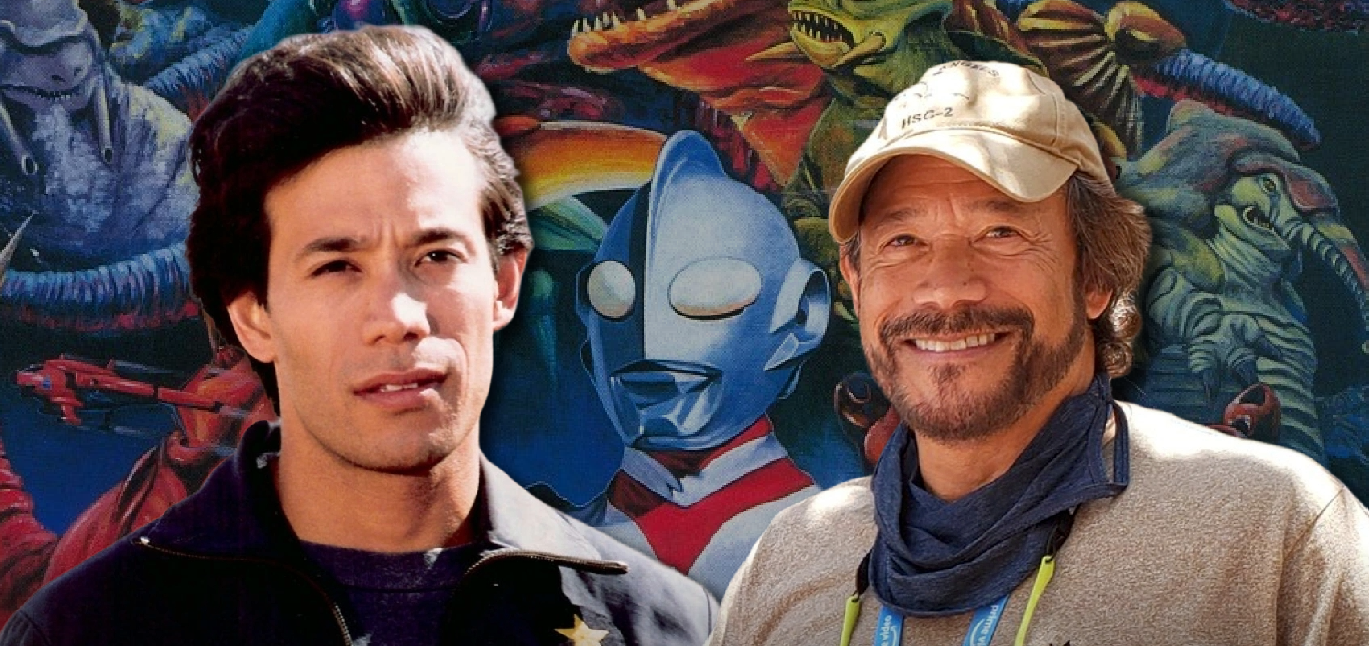
Jack Shindo.
Ultra fans of a particular generation know that name by heart. An entire new wave of fans was introduced to the historic franchise through 1990’s Australian adaptation and its airing on television internationally. Although not as iconic as some of the other Ultras, the being known as Great has won over the hearts and minds of fans garnering and maintaining a loyal cult following over the decades since the show concluded. The first ever non-Japanese human host in the Ultra series, Jack Shindo encapsulates everything early 1990s, and the man who brought him to life, Dore Kraus, is always a fan favorite at kaiju conventions in the United States. Kaiju United recently had the opportunity to sit down with Dore, gaining insight into his role, his unwavering passion for wine, and his overall outlook on the complex and fascinating thing we call life.
Jacob Lyngle: What’s going on, Kaiju United? We’re here with Dore Kraus, best known for playing Jack Shindo in Ultraman: Towards the Future! Dore, for those who are unfamiliar with your work, do you want to give a quick intro?
Dore Kraus: I’m a simple man. That’s all I am. I mean, I’m like everybody on this planet; we’re all here. We’re finding what we need to do. And we hook up with different situations…it seems like I’m always in the past all the time, especially regarding Ultraman. So, I was very, very lucky to represent a Japanese superhero, especially being a gaijin, because that’s kind of unusual. But I think the fact that my mother was Japanese helped to secure the position. But it was an interesting journey. And it continues to bless me to this day. So I’m very happy it happened.
Jacob Lyngle: I did want to start with some of your early life. In a discussion with Vantage Point Interviews, you mentioned that your parents said to you, essentially, that you were born to act. I thought that was a very interesting thing to say. What do you think those traits are? Do you think people just have it?
Dore Kraus: Well, there are a lot of influences. I mean, for instance, why does a person become a police officer? Usually it’s because their father was, their grandfather was, or their family was a law enforcement family. But, obviously, there are many people who don’t have that situation. So I think, I believe that a lot has to do with your belief in yourself or your insecurities, and I think you overcome them by, you know, doing things, such as acting or even becoming a police officer.
And they make you go through training and makes you feel more powerful. So you feel better about yourself. That’s not always the case. I think there’s a lot that goes into acting. I think a lot of it has to do with insecurities. And I had plenty of them growing up, as we all do, you know? So I had to overcome those things.
I think that’s why I had an interest in acting. And, it connected. I also, too, was a heavy martial artist when I was younger. I still practice today, but that was another reason that I was always bullied when I was a child, because I was Asian, actually. It was more prevalent in the times I grew up. Today, it’s a little different. I think everybody’s very sensitive and political about, you know, saying anything about somebody’s race or sex or creed or anything like that.

©Tsuburaya Productions
Jacob Lyngle: Before Ultraman, you kind of became a world traveler. For example, you have a plethora of experiences in Singapore, and you went to Australia to find the guy who introduced Bruce Lee to Ip Man, which I think is a really fascinating thing to hear. What was it like tracking him down?
Dore Kraus: It was fairly simple because the legacy of Bruce Lee really blessed a lot of people. And definitely, he [William Cheung] was extremely blessed by being associated with Bruce Lee. He actually is the one that did most of the training of Bruce Lee. According to him, Ip Man only had Bruce Lee for a very short time in Hong Kong. And the reason why is that Bruce Lee wasn’t a likable person at the studio. He used to cause a lot of problems. And, people started to hate him, and they didn’t want him there, so they told Ip Man, “Get rid of him, or we’re quitting.”
And they were his income, you know, that’s how he survives. So he told his oldest student, William Cheung, who was the person we’re speaking of, to take Bruce and train him at his house. And essentially, that’s what William Cheung did. So you see, he took Bruce Lee under his wing and taught him. I’ve even read a letter he showed me in which Bruce Lee stated that William Cheung was one of the greatest martial artists to ever live. He’s an interesting guy; I was blessed to be able to train with them full-time.
Jacob Lyngle: Were there any major lessons or teachings that you gathered from William [Cheung]? Even just specific moves?
Dore Kraus: So much! You know, you have traditional Wing Chun, but you also have a Wing Chun with footwork. Apparently, according to him, he was the only one who was taught this footwork, along with the traditional forms of Wing Chun. Whether or not that’s true – I mean, I believe it, but it created a lot of controversy with another school. There’s another big school in Hong Kong, and a lot of problems occurred because of that. There was actually a Turkish martial artist who actually kind of ambushed William Cheung in Germany while he was giving a seminar. I wasn’t there, but I heard that he came into the gymnasium where he was training German students and challenged him. Basically, this guy was six foot two, lifts weights, and he was like one-third or one-half of William’s age at the time. He was in his 20s, and William was in his mid-50s, I think. And he basically said, “I’m here to challenge you.”
William Cheung was in his kung fu sandals, and he was on a basketball floor. So obviously it’s very slippery. And, he basically just charged him and knocked him to the ground, got on top of him with all his weight, and just started to punch away. He did that for maybe 20 seconds, and then he turned to him and said, “Don’t ever tell everybody this, that you were taught the footwork, or that you’re the greatest Wing Chun guy.” He had a guy filming behind him, too. They ran out after the confrontation, and that was it.
So I mean, it was what it was. I mean, you’ve got a big young guy. And just surprising somebody that’s in their mid 50s and just jumping on you, of course you’re going to take him down. But that was part of that time when there was this, you know, this interaction between the two Wing Chun schools. And it was sad, but it’s part of man’s need for ego and control; it’s a part of human nature.

©Tsuburaya Productions
Joseph Acosta: Let’s talk about Ultraman: Towards the Future. How did you ultimately figure out about the role? Was there an audition process?
Dore Kraus: I had an actor’s agent. He’s the one who informed me that I had an interview. He said that it was for a Japanese superhero. And he told me the name, and he knew it well, because I think my agent grew up in Malaysia. He said, “You have a chance to become a superhero!” I kind of laughed after that and shrugged it off. But regardless, he submitted me, and they were very interested in meeting me. So they flew me to, I believe, the first time was Adelaide or Sydney, Australia. I did my interview. And then, I had to be flown back again to either Sydney or Adelaide. I don’t remember. But I had a second interview, and that was the final interview. And they made the decision.
It was interesting because I read and did the standard, auditioning things you do as an actor, but they asked me to perform some martial arts, so I was wearing a suit at the time, and it was a little tight, the suit. I did a jumping spinning kick and other moves. As I was in the air and I was doing the splits, I split my pants. And when I landed, I got this look on my face, and I was like, “Oh, man, I think I tore my pants,” and everybody started laughing.
That was one of the factors I think that helped, believe it or not. But, after that, I was waiting in this one room, and the door was open. It was at the studio, and I noticed there was a gentleman trying to lift a big box and throw trash away in a big trash bin. So I ran outside, because I was just sitting there, and I grabbed the box with him, and I helped him push it over into the big trash bin. The guy may have been in his 50s or 60s at the time, I don’t remember. And he turns around, he looks at me, says, “I guess you heard the news!” And I replied with “No.” And he goes, “Oh, I’m sorry, I blew it. My name is Gus, and I’m the Executive Producer. You’re hired as Ultraman.” I just kind of replied to him, “Oh, my God. I didn’t hear that,” and that was pretty much my unofficial announcement that I was hired.
Jacob Lyngle: I have heard that your favorite episode was the fifth episode, and I think that you’ve gone on record saying, that’s because of some of the physical work you’ve done. You’ve got to do a lot more in that episode. Is that true?
Dore Kraus: Yeah. I think the fifth and sixth, where I think I did have a fight scene with Stanley [Jay Hackett]; that started to bring a little bit more interest on my part. At that time, I was more interested in doing something like that, as it seemed to define the two characters more. You know, essentially, the climactic battle between the forces of evil and good, which is one of the major things in a big percentage of movies. I enjoyed that, and hoped it would continue to grow the characters, but it never would.
I really liked the guy who played Stanley; he’s a great, great guy. I enjoyed working with him, and we flowed very well with the situation together. I just learned, actually, that he sang the background music for Ultraman: Towards the Future, but they never used that recording for the actual show. I ended up listening to it on YouTube and got to hear him sing.

Image via David Tremont (ArtStation)
Joseph Acosta: How physically demanding was the role of Jack Shindo compared to what viewers might expect?
Dore Kraus: Not at all. There was really… it was more about late-night shootings that were exhausting. So it wasn’t a physically demanding role. It was just about the fact that we were shooting several episodes per day. So it was the exhaustion of just not knowing where you were. Many shoots took place till 3:00 in the morning. The exhaustion wasn’t about a physical exertion, just the exhaustion that comes with the standard filming schedules for television.
Jacob Lyngle: What about the Jack Shindo character stands out the most to you?
Dore Kraus: I had all these ideas that I wanted to utilize to create and develop the character of Jack Shindo, but the Japanese wanted it a specific way, and they had their definition of what the character should be. I think the battle between the Japanese and the Australians went back and forth a lot, so it really convoluted the character. Basically, I think the main essence of Jack was that I thought he really, really didn’t want to get involved, and he would try to avoid getting involved until the very end. And then, he would go around the corner, and he knew deep down, “Yeah, I have to do this,” and then would reluctantly bring out the transformation device and become Ultraman. I would say it was being developed over the episodes as time went on, but I personally never got to the point where I felt there was enough definition of who he was.

©Tsuburaya Productions
Jacob Lyngle Ultraman: Towards the Future has maintained a dedicated set of fans for over thirty five years. What do you think really resonated with some of the fans that you’ve met over the years and keeps them coming back to this series?
Dore Kraus: Well, you know, I think a lot has to do with the fact that Ultraman was actually designed for the Japanese audience originally. It’s based on much of the structure, whether it’s the kaiju or just everything about it. I think there’s more association, or more, there’s a kind of a… I don’t know how you would say it… a mesh with Japanese culture. Also, it was the first live-action Ultraman media in a long time, I think it was at least ten years or so. Plus, it was the first Ultraman that was in English, so a big chunk of the world, you know. Yes, there are subtitles in prior Ultraman shows, but to have a show that was in existence since 1966 all of a sudden come out and be English-speaking was just very unusual for the time.
On top of that, Australian English is different. So I think you have that combination of an English-speaking show that had the dynamics of the Japanese tokusatsu kaiju, and in that way, the English-speaking world was able to connect with it more. In addition, not everybody was Japanese; there was a combination of all races. In our team, we had Gia (Carides), who was Anglo-Saxon, you had Rick Adams, who was an African American guy, and you had Ralph Cottrell, who was from the UK, and then you had me, who was half Japanese and half Austro-Hungarian. You had all sides and all walks of life, so there was more input and more characteristics that people from around the world could associate with. I think the structure of the show was more complex than prior shows, too. Because of that, there was a little bit more interest in seeing those contributing factors.
Jacob Lyngle: Just bouncing off of that.. do you look back on it as like, “I did this thing many years ago. People like it. I was young. It was a job,” type of attitude that working actors can have, or is it a more fond “I am happy to be a part of Ultraman history” sort of thing?
Dore Kraus: Somebody who consistently is acting and consistently working in the acting profession, they would probably look more upon it as a job. At that time, I did, too. But when I finished and I left, I felt like I didn’t do what I was supposed to do. And that was my chance, and it was finished; my opportunity was up.
But you’ve got to move on. If you look back at what you don’t like about what you did, sometimes you get caught in a maelstrom or this whirlpool of your past. This negative energy can bring you down. It did happen to me for a while. And then I said “It was a job, and you have to move on”. It didn’t work out the way I particularly wanted it to, but that’s not the way it was. Any kind of work you do in the film business can be like that. The way I define everything in this business is that actors are another gear in the machine. I look at a movie or the production of a movie like a giant robot or automaton. We’re all gears of this machine. I mean, even people who do the wardrobe are one of the small gears turning, and the director and the executive producer are actually the larger parts of the motor that are turning, and if some gear malfunctions, it can affect the project. And then sometimes they just take that gear out and throw it away and put in a new gear. The end product of a movie really isn’t based on the performance of the one actor. You’ve got so many actors, you’ve got the director, you’ve got the story, the script. There’s just so much involved, and you’re just another cog on the wheel.
You just stand, and you do your job spinning and try to spin it as evenly and correctly as you can, in association to the writing and the director. And, yes, if everything works out, you can create a hit, but you could have ten of the greatest actors work together, and a great screenwriter and a great director, and you can come up with a product that’s terrible. So you just never know. But obviously, the better actor you pick or the better screenwriter you pick, the closer you’re going to get to a better product. Not always, but probably a little bit better.
Jacob Lyngle: This month, Ultraman: Towards the Future is getting an updated Blu-ray release, which means the show is now available on home video here, for the first time since the VHS days, I believe. An entire new generation of fans can experience the show that a lot of people ten years older than me or older have really enjoyed. How do you feel about an entire new generation of young people that can watch what you did and perhaps become fans of the work?
Dore Kraus: Well, it’s interesting that your image carries on even after you die. So, it’s kind of frightening because there are a lot of people out there who want to get rid of everything they own prior, or on the opposite end, they try to erase their lives, because they know they’re going to pass away. Unfortunately, when you’re on the big screen, you continue to carry through generations, and it’s not your choice. You created something that tends to continue, unless it’s so bad that nobody wants to see it. But most things are revisited because they’re preserved for a lifetime on the new types of media that you have. I mean, we’re all human beings, and we all react to things very similarly in many ways.
For instance, if you touch a hot pot and you get burned, you jump back. I do the same thing. Everybody does the same thing because it’s part of human response. The same thing applies to films, we all look at films and experience them. Sometimes we visualize or interpret things differently, but essentially, it’s burnt on the screen for us for ages. There’s always some kind of content that is connecting for many human beings because we associate with it or relate to it, and I think that’s the key in creating either film or television, where people can relate to something because of their experiences in life. That brings interest to the media and an association where the audience experiencing the art or entertainment will want to see it again. I believe that is the essence of that.

©Tsuburaya Productions
Joseph Acosta: Going back with what you said before about life and facing your own mortality, has your idea of success changed over time with that mindset?
Dore Kraus: Well, success is in the eyes of the beholder… or within yourself. To this day, many people talk to me, and they say, “Oh, you know, you did so well in life. You’re doing well!” And I will tell them that I feel like I’ve done nothing. I would say that first, in your viewpoint of what life should be and what is essential & important, is always going to be constantly changing. For me, I think the most important thing now is to give back to everyone, all the up-and-coming generations. That’s the essence of life, I believe. Now, in the past, I never even thought about that, but I think it’s very important to return what was given to you. But in terms of success, I mean, I don’t feel successful whatsoever. I just flow and I try to keep going on this planet and in time and space. I don’t know when I’m going to leave and depart this world, but I just have to make the best of everything. I never really think that I’m successful or about success – I just exist, and that’s my philosophy.
Joseph Acosta: You’ve done conventions long after the show has ended… I think G-CON was one of the first.
Dore Kraus: That was the first, yeah. And unfortunately, John Rocco [Roberto], he’s the gentleman who brought me over to New York on the very first one, has unfortunately passed away. So R.I.P. to him. It’s sad that a lot of people from the show are starting to pass away. I mean, Andrew Prowse, the director, passed away. Ralph Cottrell, too. But for conventions, John brought me to New York, and that was the first convention I attended. I believe that was at G-CON 96 or 97. At the time, kaiju and tokusatsu weren’t nearly as popular, and the attendance wasn’t as big as some of the later ones. Going back to what you said about the new generations being interested, I think it gets more and more attendance later on. It’s interesting… the last convention I did was in Japan in 2023, and I had hundreds of people lined up to see me. That was quite pleasant. It was extremely interesting interactions between the Japanese fans as opposed to the American fans overseas, as there were very surprising interactions at that show.

©Tsuburaya Productions
In Japan, I had this one gentleman come up to me. He had a photo of a young girl, maybe nine or so years old, and he wanted a photo of him and me holding that photo. And I asked him, who was that? And he said that was his childhood friend in school, and that she passed away from… I think it was cancer. He told me that she loved Ultraman, and he wanted to take this photo with me and her photo. And so that was extremely touching. It was a very beautiful moment.
There was another very interesting and touching story at the show, I can tell you. I had this one lady come up, she was using crutches, and I think she had polio. We started talking, and she asked me about fish, which I thought was interesting. So I started talking about fishes with her, you know, fishes in the ocean. I started to talk about the Coelacanth, which was an ancient fish millions of years ago, and they originally thought that it was extinct. And in 1930, off the coast of South Africa, a gentleman who was an archeologist who studied fish was walking in the fish market in South Africa, and actually saw this coelacanth. This man was selling it for food, and he realized what it was. That was the first documentation of the reemergence of the Coelacanth.
But anyway, I talked with this lady, and she goes, “Have you heard of this fish?” And she told me a name. I go, “No, I haven’t heard of it.” And she goes, well, I discovered it. And I go, “Oh, really?” and she then gave me her card. Apparently, she was a doctor or doctor of archeology or a PhD, and she worked for, I think, some kind of oceanic conservation group or something. We had a great conversation. And then she gave me a bag, and she said, “Take this.” I looked in the bag, and there were all kinds of Japanese snacks. And ironically, when I got back to the hotel that night, all of the restaurants were closed, and I didn’t eat for, you know, quite a long time. I was so hungry. And then I went to my room, and then I realized I had the bag of food that she gave me. So I opened it up, and I ended up eating all these great snacks and serendipity, so to speak. But I didn’t forget her or the gentleman who had that photo of that one girl with him. I love these interactions.
On the last day that I was there, my agent rented out or bought out a restaurant, and fans signed up to meet me and the original Ultraman host actor, who was [Susumu] Kurobe-san. He’s was about in his 80’s. Both he and I were in this restaurant with 50 Ultraman fans signing autographs and enjoying dinner all together. I was sitting with some people all around me, having fun, enjoying our meals, and just talking about everything. There was no bridge because of our language barriers, but we communicated and enjoyed the food together. It was wonderful. The only sad thing was that Kurobe-san, because of his age, had to leave within half an hour because he was just too exhausted. But regardless, we had so much fun. I deeply enjoy spending time with the fans, for sure.

©Tsuburaya Productions
Joseph Acosta: What do you think are the differences between the American English fans compared to the Japanese fans, based on your experiences at conventions?
Dore Kraus: Well, I only went to one convention in Japan, and that was so remarkable. It just overpowered any interaction I had with any conventions in the US. But I think that Ultraman is more… it’s like blood in a Japanese person. So I think, you know, Ultraman is flowing in their essence, and they can associate with it, because it’s part of them. I mean, in the United States, the culture is very different, but, you know, if you talk about Superman to an American, that is part of their blood and that flows in their body. So when they see Superman, they can associate with it more. In Japan, the association with any form of Ultraman is much more profound.
Joseph Acosta: Can we see you come back to a fan event? I know Kaiju Brooklyn is a newer show. That would be pretty great to have you!
Dore Kraus: My good friend of mine runs two big companies in Brooklyn. So that would definitely be a nice trip if it ever happened. I would love that. In the future, I will be doing conventions in Japan again, I think, later in the year, probably towards the end of 2026. I’ve been there many times, but I also associate more strongly because my mother was Japanese, so I have a connection with the Japanese. Unfortunately, my mother, because she was born in America, never experienced a lot of things in Japan. So essentially, she was raised as an American. But deep down inside, the way she raised me was more Japanese, I would say.

Joseph Acosta: What has surprised you most about the Ultraman fandom over the years?
Dore Kraus: Well, it just grows. Who would have ever thought that the show would continue to bring in interest and people? For me, it’s the growth of it and the fact that it’s sustainable and it continues to grow. And many of the ideas in the show about protecting the environment, etc., etc., tended to continue into many generations beyond when it was made.
Jacob Lyngle: I’ve heard through the grapevine that you’re into wine nowadays and have at one point owned a wine business. Can you tell me a bit about that?
Dore Kraus: I was involved in the wine business for quite a long time. I was in and out, you know, and I just have a passion for wine. I love wine; I love analyzing wine; tasting wine. And, it’s part of me, you know, it’s in my blood, like, Ultraman floating around in my blood. So, you know, whenever I go to the lab, and they take my blood, they, you know, say, oh, I see a little Ultraman in there and a little bit of wine in there. (laughs)
Jacob Lyngle: You are also an avid hiker. Are there any spots you recommend in California? Don’t give away the secret spots!
Dore Kraus: Oh, yeah! There are just so many. I mean, obviously, I spend a lot of time in San Diego, so there’s a place that’s not so far from me called Mission Gorge. Some really great climbing, great routes that have been hooked up to, and, even further out, you know, 30, 40 miles, there’s some seriously amazing places.
Joseph Acosta: How much preparation do you go into hiking? Do you just do it on the fly or something?
Dore Kraus: It depends on whether I’m climbing or hiking. There’s a difference. I mean, I have certain things I do. I train every day. So, I usually do between 7 and 12 miles at least every day, and that’s running with 40 pounds on my back. I know where I’m going, and I know what I have to do; I’m rarely going somewhere new and not knowing what I’m doing.
Jacob Lyngle: Are there any tips for us young folks about staying in good shape? Do you have a regimen or something?
Dore Kraus: Yeah, well, I’ll tell you this: Being in shape, it’s about consistency. You’ve got to look at your health and physicality more like a credit card. You know, if you continually charge, charge, charge, charge, charge, you know, it’s like you eat, eat, eat, and you don’t take care of yourself. You’re going to gain weight because that’s the byproduct of eating with all the calories. But you have to consistently do something every day or mostly every day in the end, just like paying off your credit. If you pay it off consistently, then you don’t run into the big problem at the end. And that’s like your health, too. Health is very interesting, because I spend a lot of time analyzing everything about it. There are definitely benefits to stuff like stretching and caloric cardio and everything, but it gets deeper than that. The essence of health, to me, is getting rid of things out of your body as quickly as possible.

So, things like sweating and going to the bathroom as often as you can to get out what’s inside you as fast as possible, and constantly moving every muscle in your body. And everybody says, well, I move every muscle in my body every day. And I disagree. Because if you think about it, how often do you lift your hand over your head? And most people rarely lift their hand over their head or their arm above their head unless you’re getting something high up, but it’s something that you could go weeks without doing. So that musculature in your shoulder, it atrophies and diminishes. So moving everything is very difficult because you have to know all the muscles and the structure of the body, and what you need to do to move everything. And so many, especially guys, you know, they go to the gym and what do they do? They do chest presses and biceps. Why? Because they want to look big. But in the essence of your health, it doesn’t do a lot for your health. I mean, why do you want a chest press of 600 pounds? I mean, are you going to have a kaiju land on you, and you need to push him off? (laughs)
You don’t need to do three hours a day or something. It’s actually better just the fact that you get out there and do it regardless, even if you’re tired and you need to get sleep. If you’re tired, you don’t need to do three miles; you can just do ten minutes of exercise. That’s phenomenal. You know why? Because you actually got yourself out and doing it, and that’s what counts. It’s not the three to four hours a day, it’s the repetition!

Jacob Lyngle: What do you think resonates with audiences so much about kaiju stories?
Dore Kraus: It’s interesting because kaiju is fantasy, and sometimes we need to escape through fantasy to escape the atrocities that we deal with every day. And when I mean atrocities, I mean just so many things that people face, as it creates a negative sort of downfall in their energy and who they are. And when you can escape, like watching a great movie you love, it takes you to another world and allows your mind and body to regenerate itself and heal. I think creating these large monsters, I mean, these things that are folklore-ish, are the things that cause our minds to wander and to go into new worlds. It’s a fantasy, and it’s an escape. And I think it helps us to deal with life.
That’s why I think now, with all the things that are occurring worldwide, I mean, look at the pandemic. I mean, who would have ever thought something like this would have occurred? I mean, it really revealed that you could have a man who’s a multi-millionaire and you could have a homeless man, and they’re in the same situation when the pandemic came, because you can’t escape from the tiny, microscopic virus, so it didn’t matter your place in life, how much money you had, or how powerful you were. Even a big guy like Arnold Schwarzenegger, who trains every day, couldn’t battle against that either. Nobody could.
It showed that we’re essentially all the same, you know, just like when we die, we all become skeletons. And, we’re all the same at that point. The kaiju or the fantasy helps us escape. But because it’s a Japanese fantasy, it’s a little different. It takes a little while or a little saturation around the world, or people become more regular, and then they understand it, and they can receive it and process it, and then they love it. But fantasy is fantasy. Monsters are the unknown. It’s like Nessie. Does Nessie exist? Does Bigfoot exist? Do flying saucers exist?. It’s always that unknown factor. And the problem today with the internet, phones, and computers is that there’s nothing to wonder about. There’s no unknown factor. There’s too much information. I think it’s just like a relationship with an individual. It’s better not to know everything about that person. Even if you’re married to somebody, you probably don’t want to know 100% about that person. There’s there’s things that are better to remain hidden. And I think that’s the situation here.

©Tsuburaya Productions
Jacob Lyngle: How do you feel about being a part of that 60-year legacy of Ultraman and being a part of people’s childhood memories?
Dore Kraus: Well, it gives me connection. I wouldn’t have the connection with people I have now if it weren’t for that. As you live your lives, everything comes into position, and you understand things better and why things occurred. It [Ultraman: Towards the Future] helped my life in many ways. And I feel like being part of that legacy, I mean, that’s something that’s probably going to live forever. So it’s going to long surpass my life on this planet. I was going to say I’d be looking down on the planet, but maybe I’ll be barbecuing and looking up. (laughs) I don’t know. But at the end of the day, I feel I was part of something unique. And not very many people get to do that. It’s an honor, and I feel I was very lucky to have been given that honor.
Jacob Lyngle: I hear you’re working on some project of some kind that’s hard to talk about, but can you let us know anything about it?
Dore Kraus: I was approached for a project which will begin filming towards the end of this year. It’s a secret project, so in other words, it’s on the down low. I was told not to talk about it, because nobody knows about it except for the film company and the people involved in the project. It’s pretty much locked down, but it’s in the 90 percentiles right now, so we’ll be filming overseas soon, I believe, in 2027 worldwide. That’s about all I can tell you. I was blessed with an offer, so we’ll see what happens!
Jacob Lyngle: Dore, do you have any final comments or words of wisdom you’d just like to say to our audience?
Dore Kraus: Well, in essence, I guess in regards to words of wisdom… let it be. You know, like the Beatles song. If you think about it, you can be a pessimist, you can be an optimist. But I’m neither. And the reason why I’m neither is that if you’re an optimist, I think you’re lying to yourself. Because not everything is great. And if you tell yourself everything’s great all the time, you create an illusion that everything really is that. And then nothing really is. But if you’re a pessimist, they say you’re a Debbie Downer. So you bring negative energy. You’re always down. You bring people down, you bring their energy down. So that’s just as bad. But I’m an agathist, and what essentially that is, is that regardless, in the end, I know everything is going to be okay. And that’s the way you have to be. You just have to know in the end, it’s going to work out.
Jacob Lyngle: Is there anything you’d like to say to the fans of Ultraman: Towards the Future or Ultra fans in general?
Dore Kraus: Keep your eyes and ears open and keep enjoying these new kaiju shows that are coming out now. Watch the evolution of Ultraman, because it is changing and there are more and more new concepts, more beautiful structures, and they’re just amazing. Enjoy them for what they are, and you know, don’t stop believin’. There’s another song for you!
Jacob Lyngle: Well said, Dore. Thank you. It’s been a wonderful chat.
Dore Kraus: I loved it, thank you. I was glad, and hopefully, we’ll maybe meet sometime in the future, maybe in Brooklyn. You never know.

Dore continues to be an avid hiker and wine connoisseur in between meeting his fans at kaiju conventions around the world. He is currently working on a mysterious project with details remaining under wraps at this time, but be sure to keep a close eye out for when the announcement goes public. To see Dore in action as Jack Shindo, Alliance Home Entertainment has just released a brand-new Blu-ray set featuring Ultraman: Towards the Future, the show that Dore starred in, and Ultraman Powered.



One thought on “‘Ultraman Great’ Star Dore Kraus on Life Lessons, Wine & Hiking”