Nowadays, everyone is at least somewhat familiar with the mainstays of science fiction fantasy cinema that are Godzilla and King Kong. Since 2014, their crossover franchise, dubbed the “MonsterVerse”, has continued and prospered, with 2021’s “Godzilla vs Kong” being heralded by fans as being a key proponent in the return of moviegoers to the cinema screen after the pandemic and its concurrent streaming boom. Likewise, these influential franchises and characters have flourished throughout the vast majority of the 20th and 21st centuries, with their iconographies being permanently ingrained into the public psyche.
The more attuned cinephile will be liable to tell you how Godzilla architect and special effects supervisor Eiji Tsuburaya drew heavily from the original King Kong in his creation of Godzilla. In fact, he even owned a personal copy of the 1933 classic, a rarity for the period. It goes without saying that King Kong, as directed by Merian C. Cooper and Ernest B. Shoedsack, is one of the most influential movies of all time, and it is in all regards the prototype for the giant monster formula. In much the same vein, Godzilla, directed by Ishiro Honda and released in 1954, defined for many the kind of atomic age science fiction commonplace in the era.
However, the translation is not quite so simple as going from Kong to Godzilla; there in fact exists a bevvy of influences, descendants, and precursors that bridge the gap between the eighth wonder of the world and the King of the Monsters. Chief among them would be 1953’s “The Beast From 20 ‘000 Fathoms,” directed by Eugène Lourié, and with special effects by Ray Harryhausen. That name ought to be recognisable to anyone fluent in the discourse surrounding monster cinema, for he was the man who defined much of the voice of special effects in the West throughout the 1950s up until “Star Wars” changed the game in 1977. Harryhausen was the student of Kong animator Willis O’Brien, and, like his mentor, a pioneer in the employment of stop motion animation. And, despite having already made a loving King Kong homage in 1949’s “Mighty Joe Young,” it must be said that “The Beast From 20 ‘000 Fathoms” set the precedent for the rest of his career.
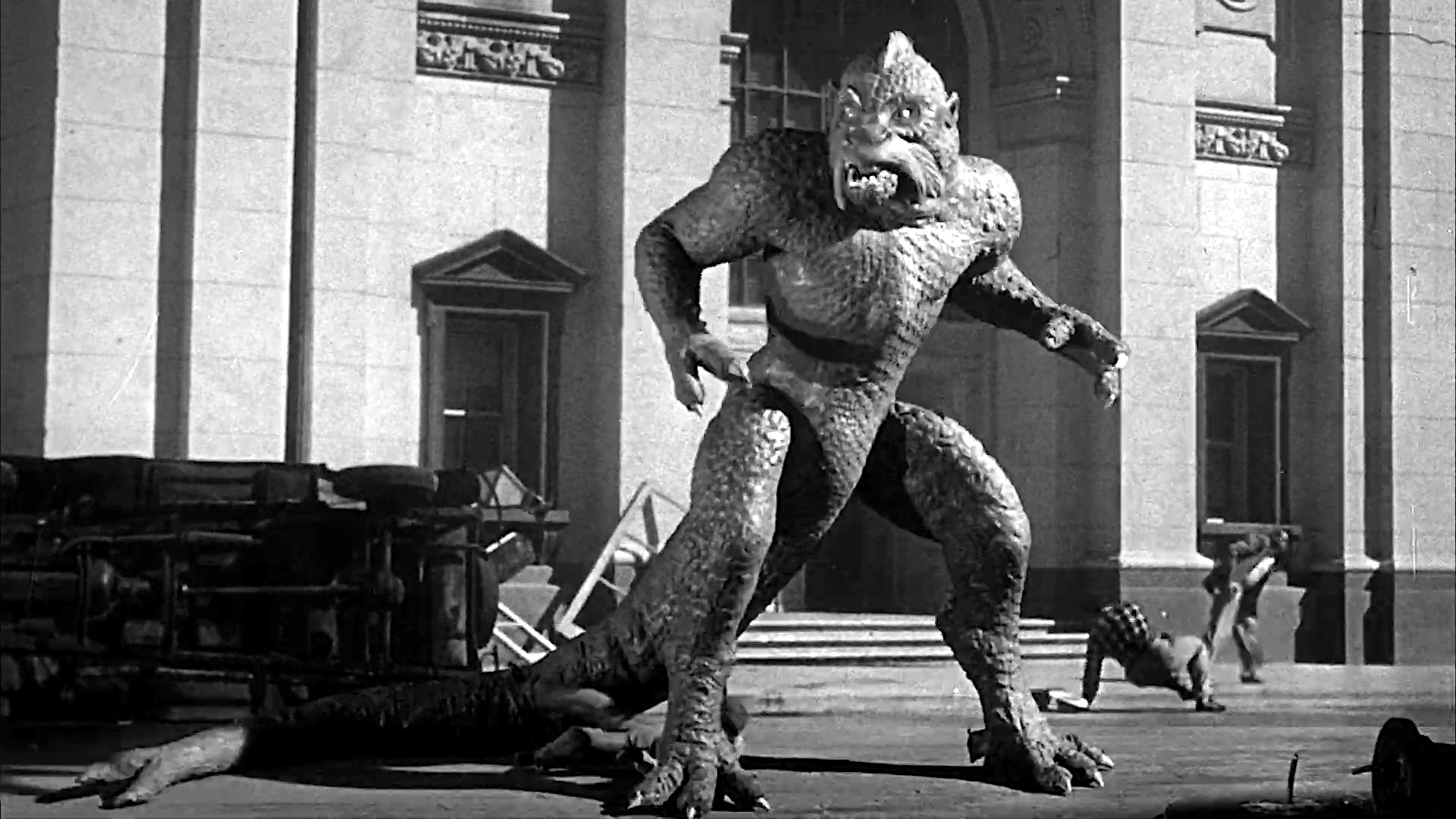
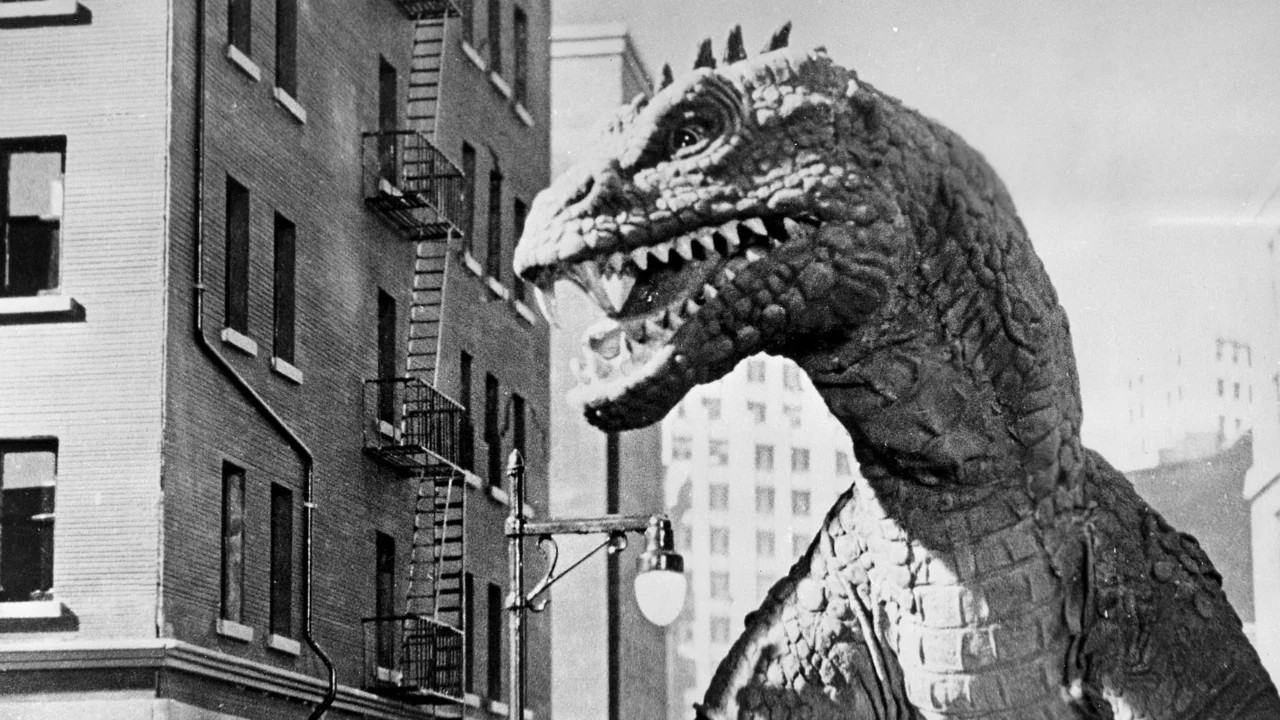
The film itself follows the discovery of an ancient prehistoric creature, known as the Rhedosaurus, under the Antarctic ice, having been awoken by atomic testing undertaken by the United States Military. The sole survivor of the creature’s discovery, Professor Nesbitt, played by Paul Hubschmid, returns to mankind to implore them to prepare for its inevitable arrival on American soil. At the same time, the creature travels by ocean, destroying ships on its path towards the Western world, along the way, toppling a lighthouse in the film’s most iconic scene. Nesbitt is able to employ scientists Lee Hunter (Paula Raymond) and Professor Elson (Cecil Kellaway) to help him prepare for its arrival. The last stretch of the film sees the forlorn relic of a forgotten monstrous era make landfall in its former mating grounds, now the United States, as it stumbles its way through New York City, leaving behind it a path of destruction as the military and our scientist protagonists wrestle with a means of stopping it.

At the time of its creation, monster movies were all the craze of the era, giant ones too, one need only look the other creations of the period, “20 Million Miles to Earth” (1957) and “It Came From Beneath the Sea” (1955), saw Harryhausen return to the kaiju precursor, whilst The Giant Claw” (1957), “Tarantula” (1955), and “Them” (1954), thrived alongside, or died in their lofty aspirations). Even director Eugene Lorie would return to the sub-genre later in his career with “The Giant Behemoth” (1959), “Gorgo” (1961), and ” The Colossus of New York “(1958). It doesn’t take a genius to recognise the abundant similarities between Godzilla and the plot of ‘Fathoms. Indeed, Harryhausen himself disregarded Godzilla outright, proclaiming it an obvious knockoff of his work. Both films focus on the resurrection of a serpentine prehistoric animal via the usage of atomic energy, which subsequently comes ashore to terrorise the land-dwelling humans it so carelessly stomps underfoot. Even the Antarctic origin would become a staple of kaiju cinema, seen again in “Godzilla Raids Again” (1955), “Gamera” (1965), and “The Deadly Mantis” (1957).
However, it must not be understated how thematically similar ‘Fathoms’ is to King Kong, also. After all, it was his reverence for that movie that drove Harryhausen into the film world, something he had in common with the aforementioned Eiji Tsuburaya. Both creatures are beings of the natural world, something dissimilar from the mutant Godzilla, and both were taken from said natural order by the machinations of a belligerent mankind. Whereas Kong was literally abducted from his home in the allegorical slavery of his original feature, and put on display for an audience, the Rhedasaurus was awoken to find itself the last of its kind. Unlike Godzilla, there is no malcontent in the lost animal at the heart of Lorie’s film. Rather, like Kong before it, there are strong echoes of tragedy in the creature; it is lost, out of time, and abused by those around it. Harryhausen’s animation renders it a frightened, albeit highly dangerous animal, rather than a force of pure destruction, a la Godzilla.

©TriStar Pictures
In fact, it could be argued that Roland Emmerich’s 1998 American remake of Godzilla bears far more similarities to Lorie and Harryhausen’s film than it does to its alleged source material. The Godzilla of that film is far more of a lost animal, making its way to land to lay eggs, before finding itself embroiled in a conflict it didn’t ask for. That Godzilla flees from the military and possesses none of the expected anger or deliberately destructive pathos of the 1954 original. Like The Beast from 20 ‘000 Fathoms, it exists as a tragic being, plucked from out of time and out of place by the cruel hand of mankind. It is demonstrative of the differing ways in which the Japanese and American studios interpret their monsters. In Japan, monsters are descended from Godzilla and his wrath, whilst in America, they are the lineage of Kong’s tragedy. The Beast exists somewhere in the middle, tying these two overarching ideas together like a kaiju-sized tether.
‘The Beast From 20’000 Fathoms” may not be as iconic as the other two films to which it owes its iconography, and it may well indeed have been ripped off in the creation of Godzilla only a year later, but it stands yet as a worthy entry in the Kaiju mythos, by and large, predating all that we would consider staples of the niche genre. Would we have Godzilla without ‘Beast?
Rodan? Mothra? The MonsterVerse, or even American monster movies in general? Who knows, but viewed today, it remains a display of visual excellence, and more than undeserving of its oft-forgotten banishment to obscurity. It lives in the shadow of Kong and Godzilla, never quite arising to either in terms of iconography or quality, but it says much that the Rhedosaurus has remained something of a cult icon over the many decades, and it’s almost shocking that a remake has never been attempted. It’s a movie that all monster movie fans should check out as a piece of essential kaiju history. The missing link between King Kong and Godzilla. The monster middle child.