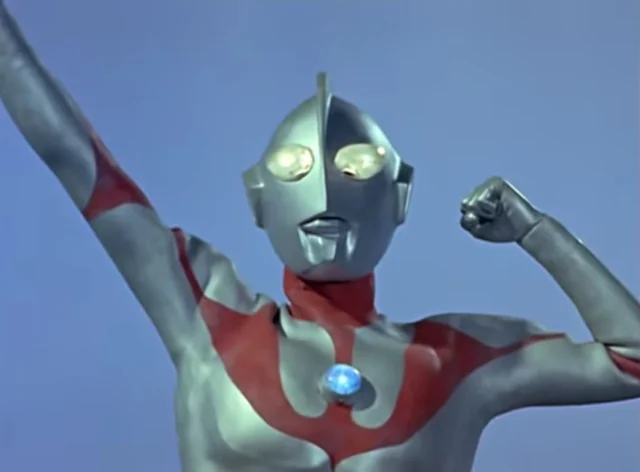
Ultraman has had many guest directors over the years, Ishiro Honda (famous for starting Toho’s Godzilla series), Noriaki Yuasa (notable for most of the Showa Gamera franchise) and even Takashi Miike have lent their talent to Ultraman over the past six decades. My favorite director to lend his talent to the series however is Akio Jissoji. Jissoji isn’t a huge name like Takashi Miike and his films are even more niche than the Kaiju genre itself. Outside of the Ultra series, Jissoji primarily directed weird and experimental dramas, most notably “The Buddhist Trilogy.” Jissoji got his start writing scripts (that unfortunately never got used) for early episodes of Ultra Q, and before signing on to Ultraman, he directed a documentary titled “Modern Protagonist: The Father of Ultra Q” about the work of Eiji Tsuburaya. Finally, though, Jissoji got his big win: directing the stage show “The Birth of Ultraman,” which our Editor-in-Chief Jacob Lyngle talked all about when the site first launched!
To put it plainly, Akio Jissoji was always there, ever since the beginning of the Ultraman series, and deserves to be seen with other greats in the Kaiju genre. A few weeks ago, KU had an article on the best episodes for a newcomer to Ultraman, and unsurprisingly, half of Jissoji’s episodes made it on the list! I will go over the six episodes he wrote and/or directed for the original Ultraman series, and I hope I can encourage Kaiju fans, and even film fans in general to explore the Kaiju media Akio Jissoji brought to audiences in Japan! The main goal here is to highlight his style and technique;. I won’t go over every plot detail or even “review” any of the episodes, I just hope I can bring people a taste of the artistry these episodes contain and maybe this can help sway someone who looks down on Kaiju media to give them a watch!

Episode 14: The Pearl Defense Directive
The first episode of the mainline show by Akio Jissoji focuses on Akiko Fuji, our sole female member of the SSSP (also known as the Science Patrol). The basic plot is that Akiko wants to buy some pearls, but for some reason the price has skyrocketed. She launches an investigation with her team and they discover a monster that is eating the pearls. The plot is pretty standard Ultraman fare – a big monster causes trouble and the SSSP goes on the offensive. What makes this stand out from a typical episode of the franchise, however, is the dynamic and visually striking cinematography. There are a lot of scenes shown through mirrors or window reflections, the lighting is dreamlike during the day and even more surreal when focusing on the pearls themselves. The music is eerie and atmospheric, which lets long shots of pearls underwater stay with the audience. My favorite point of most Jissoji episodes and his overall directing style is camera movement; the way it arcs around characters or how dolly shots pan back as characters run is just amazing, and a true step up from the traditional way that kaiju scenes are shot..
Shortly after the arrival of the Kaiju, we are treated to some magnificent shots of the creature in the top right or left corner of the screen just in the distance. This use of camera angles and sometimes having characters in the foreground emphasizes the creature’s size to a higher degree than usual. At night, the monster glows similar to the glow of a pearl, giving Akiko an emotionally poignant scene as she vents her frustrations of the Kaiju stealing the glow of pearls from humanity.
I do have to say though, Akiko being the protagonist and kind of relegated to “she is a woman and likes jewelry” as her entire depth in this episode isn’t the best. There are hints of “men writing women” here, but it also isn’t mean spirited and I think it’s more of a case of following the norm of the times, and not personal beliefs about women, although the ending is kind of a classic “women shop too much” joke that isn’t great. I would like to think the plot came first and the character focus came second, and in that case, the right character was picked to lead this story. The character writing is definitely not the focus here either, it’s about the monster and the SSSP’s battle against it. Something really well done is the stakes. The Kaiju specifically targeting pearls allows for a scene where it charges towards a bunch of women on the beach who have their jewelry around. Seeing civilians in direct danger is always a highlight in the series, because it emphasizes the importance of our heroes’ fight. I especially like this part, because to me seeing a Kaiju cause Pearl prices to rise isn’t incentive enough to kill it.
Overall, this episode is mostly standard for the series to this point, but it is edited and shot expertly and is a really good example of technique and craft over script. It’s pretty clear from this debut of Akio Jissoji that he’s finding his footing between an experimentally artistic depiction of this world and the standard Ultraman formula of “SSSP fights a monster, loses and Ultraman saves the day,” but for a first go, this episode is an admirable effort. I don’t think it’s the prime example of his work on the series, but it’s definitely one of my favorite episodes in the show!

Ultraman Episode 15: Terrifying Cosmic Rays
This is probably the least remembered Jissoji piece. My biggest issue with this episode is completely a personal thing, and that’s its focus on being a “kid’s” episode. The series is always aimed towards being family friendly, and that’s fine, but episodes that put a child at the forefront above our usual cast of characters just don’t click with me the same way. I think others might feel the same way, but don’t count this episode out… it’s surprisingly great! To get into an actual analysis of the episode though, it’s pretty wild. The plot centers around a group of kids drawing their own Kaiju based on the monsters of the show’s past. The protagonists of this episode go to a shipping yard and draw a giant picture of their Kaiju “Gavadon,” which comes to life due to the titular “terrifying cosmic rays.” Gavadon gets to evolve throughout the episode in an incredibly fun way to make the kaiju more interesting.The kids keep upping their game, making the Kaiju bigger, stronger, and more resilient as they try to thwart the SSSP themselves, just because “kids will be kids.” It’s a pretty fun premise and I think it’s at its best when we see the horrors the Kaiju brings to our recurring characters. Just because this episode is pretty child-oriented doesn’t mean it’s lacking the brilliant craft Jissoji always brings to the table. The gimmick of the episode is that these cosmic rays, which create the Kaiju, are only ever produced when the sun is up. This means as the sun sets the Kaiju eventually disappears and as the military ceases their attack we get scenes of peace. This concept allows the lighting and cinematography to shine. When Gavadon sleeps during the sunset, there are gorgeous shots of the creature near waterways reflecting the sun. The Kaiju has Jissoji’s signature sense of scale as it looks in the background, but interestingly, what I love most in this episode are the shots of the SSSP. Any time we see them in this episode, they are framed at the bottom of the screen, showcasing the size of the environment. On the contrary, when Gavadon is on screen, those same locations are seen incredibly small next to Gavadon’s massive size. It’s a fun idea for an episode, allowing a single Kaiju to evolve over the course of its runtime, while also putting the SSSP in a position where attacking the Kaiju makes it more aggressive, which challenges our characters to think of new ways to fight the monster, because the SSSP can’t just leave Gavadon alone; as it slumbers, the Japanese economy crumbles..
This almost feels like “Shin Godzilla” in the sense that we see the SSSP working with the government to stabilize the country during the presence of a, basically man made, Kaiju. Terrifying Cosmic Rays culminates in Gavadon’s rampage after the kids encourage it to attack Japan. Ultraman appears to save the day, and in a great twist and reversal of typical tropes, the kids are cheering for the monster, not Ultraman, which is something that many monster fans might relate to.. The defeat of the Kaiju has a melancholic tone without ever making the Kaiju sympathetic, which is a crazy accomplishment from Jissoji. The closeups of the kids’ depression as their Kaiju is beaten by Ultraman stands out in the series; these kids mourn Gavadon. To cap it off, Ultraman makes Gavadon into a star and personally tells the kids every July 7th they will see Gavadon in the sky. The Kaiju’s constellation drops a tear, and then we are back to the kids creating their own Kaiju drawings once again. Needless to say,this episode is for the Kaiju kids out there!

Episode 22: Overthrow the Surface
This is when Jissoji really gets to shine! This is my favorite episode of his in the series, although I won’t lie, a huge portion of that is because it introduces one of my favorite Ultra Kaiju of all time, Telesdon! This episode is a pure science fiction thrill ride, and to top it off, it’s shot like a film rather than a show. Right from the start, the episode has some moody shots setting the tone. We are introduced to Anne, a member of the SSSP overseas, and she gets a pretty big buildup, even taking Hayata to Paris.. A big part of the tension in this episode is knowing that Ultraman actually can’t and won’t be here for the majority of the crisis we are about to witness. My favorite aspect in particular is how slowly it tells its story, allowing the mood to permeate before any sort of danger presents itself. Jissoji takes the time to showcase the danger as well once it happens, long shots of characters in computer rooms being unable to contact anywhere outside of Tokyo. The camera sits with the characters as they walk around headquarters trying to find the source of the interference.. The way the episode opens on Anne’s perspective as well allows for the reveal that she’s somehow not in Paris all the more shocking. Our usual comedic relief, Ide, decided to investigate Anne and figure out what’s actually going on. There’s this amazing confrontation scene where Ide finds Anne in a quarry and tries to catch her. We hear Telesdon roar,and as Anne runs, the camera does this amazing and impressive dolly around with her car taking off and Ide following in pursuit.. There’s so much tension here, and seeing the typical jokester Ide in a very serious light and being completely competent at his job feels extremely fresh.. He spends a lot of time on his own investigating, giving us a tense highlight full of great moments for a character that typically wouldn’t be found in a scenario like this without it turning into a meta comedy where the comedic relief being a fish out of water is the bud of the joke, such as in Jun Fukuda’s Ironfinger.
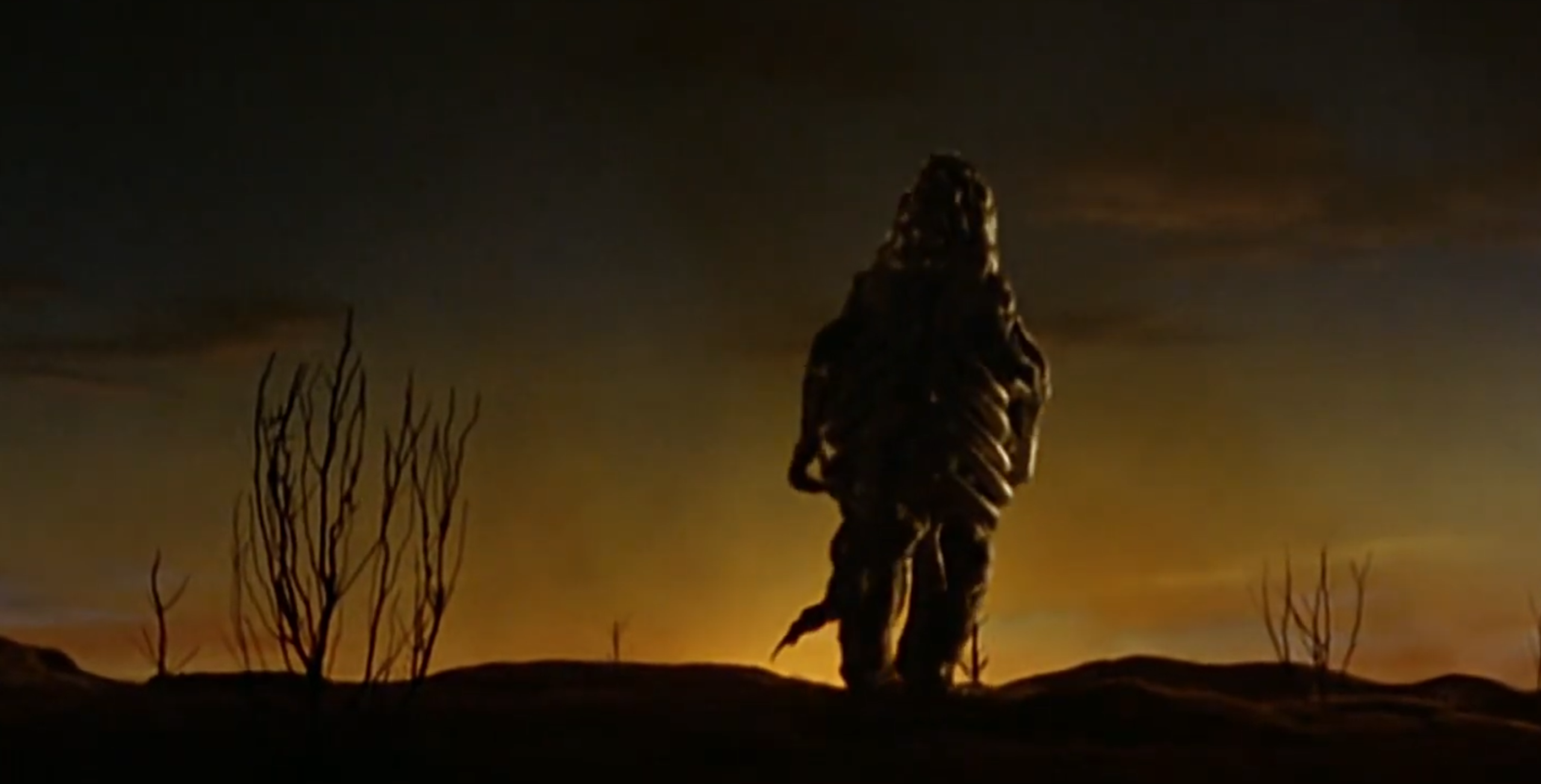
As Ide discovers that Anne has no eyes under her sunglasses, Telesdon rises from the depths. This scene uses sound and lighting to amplify the terror. There’s this eerie fog and the music takes a back seat for a low heartbeat style thudding that becomes the ground rocking from Telesdon. This sequence is my favorite Kaiju rampage scene in possibly the entire franchise. The fog and debris of falling buildings cloud the screen as the silhouette of Telesdon tears down the skyline. There are so many shots from street level of Telesdon causing his mass destruction. This episode feels so much more cinematic than any of the previous episodes, and the effects somehow feel higher quality. Telesdon breathes fire and it’s an actual flamethrower built into the suit! It would make sense for this suit to also feel a little nicer since the Kaiju would return in “The Little Hero” episode, which utilizes the supernatural creature Geronimon to revive some earlier beasts. This wasn’t planned however, but worked out due to the suit being in better condition than some others, such as Red King. Finally, after the amazing Kaiju scene we get to see what actually happened to Hayata: He’s imprisoned underground by a subterranean civilization. What follows next is simply astounding.
The episode becomes monochrome here, but not black and white. The color is a weird diluted greyish brown color, and the lights are almost sickening, lining the ceiling and illuminating the shot, yet the scene remains mostly dark. We get some great shots of Hayata chained down, seeing him from above and looking so small while surrounded by the mole people. This episode feels like it would be more at home in Ultra Q than Ultraman, but it doesn’t neglect the people who want to see the titular hero. The mole people attempt to hypnotize Hayata so they have control of Ultraman. And just as it seems to be working, and Ultraman changes, his light blinds the eyeless mole people in a dazzle and he fights Telesdon! Ultraman is the antithesis of the mole people and that’s such a powerful image in that scene! I wish this episode could have been expanded into a full film, just so Ide could get more development and not just kind of disappear after the mole people reveal. I also think the episode suffers a little bit of cohesive ties, as it takes its time to set a tone and produce great sequences, but never commits to linking them together perfectly. This episode is a great example of what can be done with Kaiju media, unfortunately it suffers a little from the limited runtime of a television show. Overall, this is quite possibly my favorite episode in the series, and it absolutely deserves to be watched by any science fiction fan!

Episode 23: My Home is Earth
I recently rewatched this series with fellow writers and followers of Kaiju United, and all of us were astonished by this episode. This was most of the watchers’ favorite episode and it’s really easy to see why. This episode is incredibly emotional, as it showcases a Kaiju that hits incredibly close to home and has the most tragic and emotionally moving monster in the franchise, Jamila. This episode starts with some good worldbuilding to set up our story: Planes and boats keep going missing (although we see what happens to them, they explode mysteriously), but in an interesting twist, all the victims are specifically representatives to the international “Peace Conference.” The SSSP is asked to investigate if the cause is an alien invasion. The show cuts to a police car at night running wild with some great shots of the siren and a moody interior with the driver. The car and driver eventually crash when a loud roar and blinding light come at him and Jissoji lets the audience sit with the death for a surprisingly long time. I always love getting longer, more drawn out sequences in this show, and the writers having the confidence to build mood and atmosphere when there are only 20 minutes to work with is always great.
Going back to the SSSP, it’s revealed there’s an invisible space craft and our protagonists launch their attack. This scene has a very similar feeling to the original Rodan film from Toho, as the sky is lined with a streak and the SSSP Vtol rocket chases it down. Lots of wide shots of both objects create an incredible sense of scale and dread simultaneously. The Vtol fails to take down this invisible rocket, and there are some good character moments here as the team tries to figure out what planet this rocket is from. The shots during this slower moment are really impressive; our characters are framed behind objects or with blaring lighting behind them and I really love the dynamic way Jissoji always shoots his characters. Finally, the SSSP finds a way to see the rocket and they take it down.
The reveal of Jamila is one of the best in the franchise. The SSSP is on the ground in a foggy forest as the great beast towers over them, its sounds otherworldly and unnerving to listen to. As our protagonists shoot at the surprisingly quiet Jamila, all the Kaiju does is flee. Jamila gets away and the SSSP is now doing a search at night with the lighting in the dark forest setting the mood for the shocking revelation our heroes are about to find out.. One strong searchlight shines on our cast as they talk over the radio to finally learn the truth of Jamila: The Kaiju isn’t a monster, he’s a human who was neglected during the space race. Jamila was sent to space in a satellite and never returned, somewhere along his journey he became a monster and now seems revenge against humanity for abandoning him. Ide sees himself in Jamila and refuses to fight, the music swells in a melancholic way, and each member of the team gets a shot showing their own inner turmoil at the thought. But orders are given, and orders must be followed. The SSSP is ordered to kill Jamila in secret as the monster he has become is now too big of a threat, yet the moral ambiguity behind killing something that was human at one point is too catastrophic a topic for it to ever enter the public’s conscience.
This episode is truly a stand out and in my mind, essential viewing for any Kaiju fan, not just required viewing for Ultraman. This is one of, if not the most, sympathetic monsters. Despite the monster being sympathetic and a victim, this episode still frames Jamila as the bad guy, and it’s so well executed. Jamila is murdering people and waging war on mankind, and while the audience understands why, he must be stopped. The rest of the episode makes the battle with Jamila a full on war. People are evacuated, tanks line the forest, and we even get to see Jamila destroy a small village in classic Kaiju fashion. A child is out in trouble as he tries to save his pet pigeon from his burning home, and this leads to a somber moment where Ide confronts Jamila, yelling at him, “Have you lost your human heart?” The audience sits with Jamila as he watches the village burn, and immediately he attacks the peace conference. The SSSP finally discovers Jamila’s weakness, water, and uses it to try and stop him when Ultraman finally appears. The battle is brief, and Ultraman uses a new power to come out victorious, but it feels bad. Ultraman essentially tortured Jamila with a spray of water, and the music expressed that this isn’t a happy ending.
Bin Furuya, the suit actor who plays Ultraman, reportedly said this script felt “heavy and emotional” during the first read in an interview with a Japanese publication. Furuya also said that this episode is a key factor in why he doesn’t believe Ultraman should be dismissed as mere children’s entertainment, and he’s absolutely right. This episode has so much emotion and depth that it’s hard to believe it’s an episode of a superhero show and that it’s only 20 minutes long. The writer, Mamaru Sasaki, drew on memories of Japan’s defeat in WWII, when he started to question his own ideals and the uncertainty of Japan’s future. Jissoji blends his style with Sasaki’s script in such a fantastic way, giving audiences one of the greatest works, not just in the Ultra franchise, but in Kaiju fiction as a whole. The final shots of Jamila’s funeral nail the somber tone, as the sun is setting and mankind is paying their respects to a monster; a monster that should not exist, but did so because of our ignorance. A cross encapsulates the sun in its silhouette, giving us time to reflect on this horrific tragedy as the SSSP creates a memorial for Jamila. The ending quote, with the pairing of Jamila’s painful roar, leaves us with the biggest message of them all:
“It’s always like this for victims… only the words are elegant.”

Episode 34: A Gift From the Sky
This is Jissoji’s penultimate episode in the first series, and while being a great time, it’s far from his best. This episode is a lot more comedic than the last couple and feels even more blatantly formulaic than his last two entries. That isn’t to say this episode isn’t good, as I think it would be wrong to say that the series is only good when it’s being overly artistic, but it definitely doesn’t feel like Jissoji’s other episodes. A Gift From the Skyis themed around things falling from the sky, and unfortunately, it never depicts this with the gravity it should, even when showcasing a suicide by jumping off a building. The immediate follow-up to the suicide is Ide falling out of bed, which is portrayed as fun slapstick. Going from a tragedy of losing a human life to a joke about watching someone be hurt gives the episode the ironic twist of not having much gravity. The monster of this episode, Skydon, is incredibly heavy, and even its battle with Ultraman is done in a very comedic way where Ultraman can’t even move the massive beast. The episode does subvert some expectations, letting Ultraman show up earlier than usual, only to lose the first time around. Most Jissoji episodes are easily identifiable while watching the series; they always stand out and feel distinctly different from the rest of the show, but this episode just doesn’t. I don’t think this is a bad episode, as I said earlier, but it’s entirely focused on punchlines and no substance, in my opinion. The characters don’t get much to do, the gimmick is that nobody can lift the Kaiju and it just visually looks like any other Kaiju-centric episode of the show, never featuring engaging or stand out cinematography. However it’s really silly to see all the ways the team (and Ultraman) try to lift the Kaiju. From strong wire to a propeller hat it just never seems to work; he’s way too heavy.
Another subversion is the SSSP, which is usually courageous, being reduced to comedic and exasperated heroes. The team is consistently trying to solve this case as fast as possible just so they can relax. The episode also overstays its welcome; every time the issue is solved some random thing happens to cause it all to start over. The climax where Hayata tries to transform with a spoon is comedy gold, though. It feels weird that of all the filmmakers who worked on the original series it was Akio Jissoji who did the only comedic episode, and while it’s got some great jokes, comedy isn’t his style for a reason. To open the episode with a suicide and end it on a bird pooping on Ide is a really bizarre juxtaposition that doesn’t quite stick the landing.

Episode 35: The Monster Graveyard
This is the last episode of the original 1966 series directed by Jissoji, and it’s arguably the most iconic. The titular Monster Graveyard has become a bit of a recurring place & idea in the franchise and even gets to be fully seen and embraced in Mega Monster Battle: Ultra Galaxy Legends the Movie as a significant plot point. This episode opens with Ide and Arashi in the spacecraft Vtol exploring the “Ultra Zone” in space. While here, the two discover the defeated Kaiju Ultraman threw into space such as Neronga and Antlar. Seeing the Kaiju finally at peace as they float through space is weirdly depressing. The Kaiju have no place anymore, and yet they still live, drifting eternally. The crew makes it clear that, despite the troubles these monsters gave them, they don’t deserve this fate. The entire sequence is shot smoothly, with the Kaiju floating by while being semi-translucent and the scene emphasizes stillness. It’s a nice contrast to the usual high energy or high stakes the show gives off. Finally our two characters see a new kaiju, one that may have been banished from an alien world.
Once Ide and Arashi give their findings back to the SSSP, we are treated to some claustrophobic closeups of characters as they discuss the morality of defeating Kaiju. This episode does such a fantastic job at painting the monsters as victims, but ones that were required to be removed for the good of the people. Our team comes up with the idea to hold a monster funeral, an idea that I think is amazing for this show. As a kid I always loved monsters, and to see them get paid the respect they deserve as living beings, makes the show altogether feel less mean-spirited. Yes, Kaiju are a problem, but their lives aren’t any less valuable than our own.Hayata ultimately gives a short apology to the souls of the fallen and even transforms into Ultraman to pay his respects. The funeral itself is done in Buddhist customs and our protagonists wish for their souls to find peace. This sequence goes by fast, but showing pictures of a large number of dead Kaiju and letting the audience sit, even if briefly, with the traditional ceremony really sticks out. It’s a hauntingly somber moment in an otherwise action-filled franchise. From here, it goes sci-fi, as a lunar rocket launch is commencing. This scene features long shots of radar, increasingly rapid cuts to the scientists involved in the launch, and dials turning as the radar pings continue. The whole scenario almost feels like a horror film, or like some of the most tense sci-fi you’ve seen, close to the radio control scenes in “Close Encounters of the Third Kind.”
After it appears everything went well, the radar picks something up, and we see that new Kaiju seen earlier on the rocket as it descends. This unceremoniously interrupts the monster funeral, prompting the SSSP to take action. Once they do, we get to see this new creature, Seabozu, and it’s aggressively depressing.. Seabozu sulks along, arms dangling as it seeks large things to climb. The Vtol shoots it with missiles and the Kaiju merely lets out a wailing moan that sounds like someone crying mixed with a foghorn. The Kaiju makes its desire clear; it wants to return to the Monster Graveyard and exist in peace.
This story is incredibly moving and seeing Seabozu stand on the highest building in the skyline and cry in agony for its eternal, afterlife home is heart-wrenching. There is no exciting Kaiju destruction, nor no triumphant kill of the Kaiju; this is a somber and introspective episode. There is a scene at sunset where Seabozu is wandering through the wilderness with a quiet piano playing as the music, and seeing the Vtol shoot at it while it cries is undoubtedly a tearjerker. Jissoji shows that even a lower quality Kaiju suit than the original Godzilla doesn’t inherently mean silly and shallow. Finally, the SSSP decides that killing Seabozu is unfair and cruel, and they decide to send the poor creature back to the Monster Graveyard.
The Monster Graveyard showcases empathy and compassion over action and violence in our actions and how we may be able to resolve morally complex scenarios with peace and resolve our conflicts without blowing things up. Seabozu staring at the night sky and reminiscing about home is incredibly powerful. This scene showcases many Kaiju deaths throughout the show, and explains that the Kaiju in the graveyard are lucky to finally be free of a tortured existence, hated by humanity. The plan to send Seabozu to space doesn’t go to plan, and Ultraman has to intervene. This fight is mostly shown through a slideshow of stills, and I think that’s to help the audience feel like Ultraman is being less cruel. The sound effects and timing of the cuts makes the fight feel incredibly fast and tense even without moving footage. Ultraman eventually knocks Seabozu out and flies it to space, but he runs out of time in the process. Now Seabozu knows Ultraman will take it to space though, and the SSSP creates a rocket that looks like Ultraman to rescue it. At this point in the series, humanity is learning to win without Ultraman, they themselves rising to the occasion and becoming “Ultra” as the Ambassador of Light wants them to be. This episode specifically helps move that story along, even while being another episodic chapter of a “Monster of the Week” series. Ultraman and humanity find a way to save Seabozu together. This is an episode about empathy and caring about others no matter how big, powerful and scary they are. In retrospect, The Monster Graveyard being one of the most iconic and loved Ultraman episodes makes complete sense, especially in a community that loves monsters.
Akio Jissoji has had a lasting effect on this franchise, and I think a lot of his style makes it into the best the franchise has to offer, whether he directed it or not. Jissoji showed that a formula doesn’t have to feel the same. In each of these episodes, the SSSP battles a Kaiju, loses, and Ultraman has to save the day, and yet, these are all tonally and visually distinct. Jissoji took filmmaking techniques and condensed them into a 24 minute episode of a show that rivals many theatrical films of the time. These episodes, in my opinion, can stand with the likes of Western contemporaries, such as Star Trek, as some of the best science fiction around. I think an added element to the power these episodes have is that they’re 24 minutes long, which is half the length of a Star Trek episode! Akio Jissoji may not have created Ultraman, but he definitely helped shape it into a varied and dynamic series that, despite being a television series and not made for the big screen, can absolutely rival the highest drama of the Toho Kaiju cinematic catalog. I think any sci-fi or Kaiju enthusiast should see what Akio Jissoji did for the Kaiju genre, and that he should absolutely be seated with the greats like Ishiro Honda and Shusuke Kaneko when discussing the greatest directors to ever work on the genre.