When people think of Academy Award-winning director Bong Joon-Ho, they typically think of his 2019 film Parasite, which won both Best Picture at the Oscars and the Palme d’Or at Cannes Film Festival. They may also think of his critically acclaimed crime thriller Memories of Murder. Perhaps they think of his most recent film Mickey 17, starring such famous names as Robert Pattinson, Steve Yeun, and Mark Ruffalo. What many people may not think of, however, is that in 2006, Bong Joon-Ho wrote and directed his very own giant monster film with The Host.
The Host came out at an interesting time for Kaiju films. Godzilla: Final Wars released two years earlier, seemingly ending the massive franchise in Japan. In the United States, giant monster films were becoming less and less frequent, with directors focusing mainly on remaking slasher films from days gone by or focusing heavily on new, blossoming franchises. Most monster films typically fit into a franchise, with monsters like Godzilla and Gamera dominating the minds of fans of the genre. It wasn’t typical at the time for a Kaiju film to come up with a completely original, nameless monster. The Host went against these powerhouse industries, instead creating its own monster. It was a completely original story created by the mind of an auteur; an arthouse director. The film focused significantly more on the human drama of the events rather than the spectacle of the monster. All of this in 2006, before popular monster films began to make these changes that we see now.

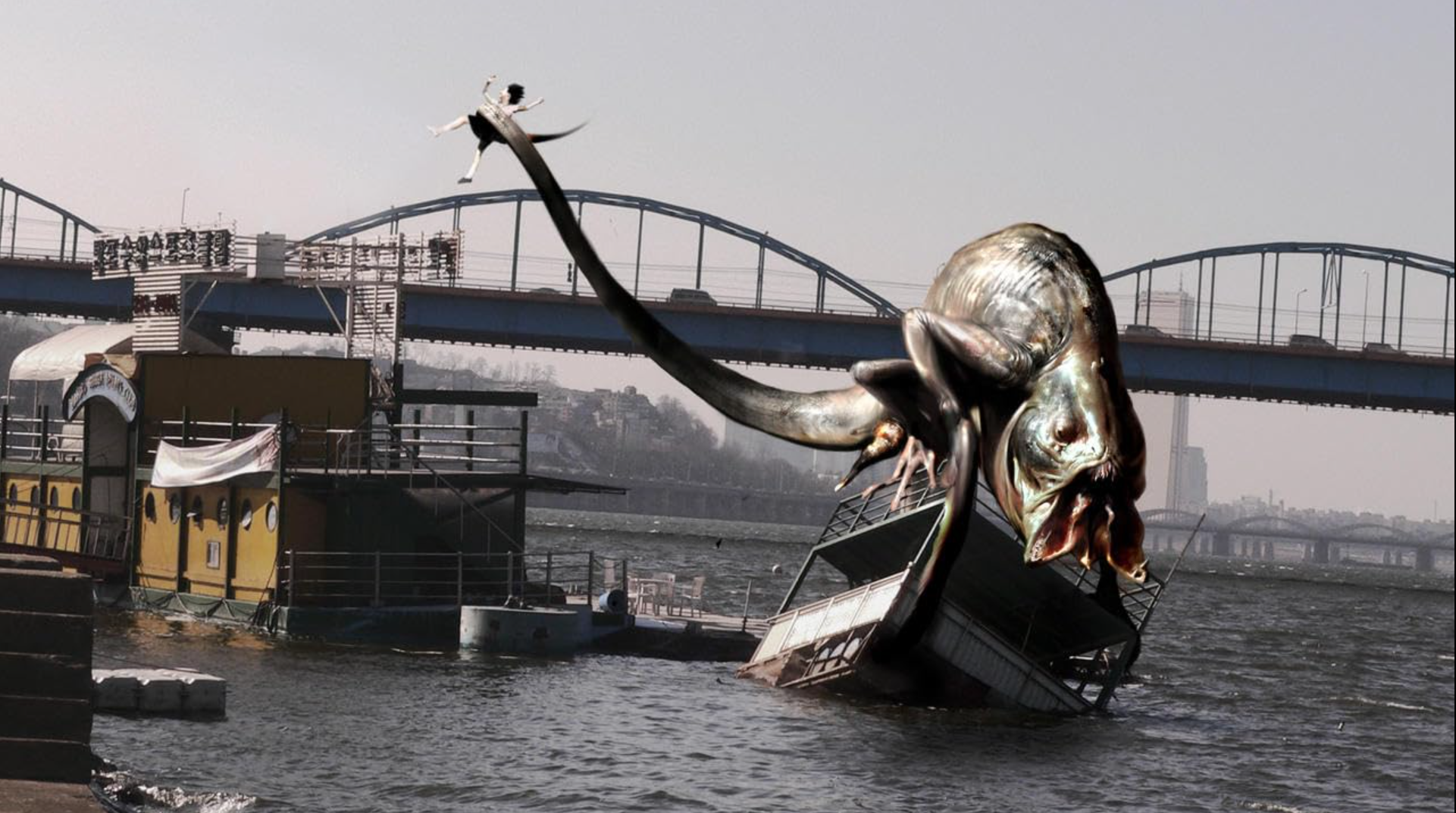
The film itself follows Park Gang-du, a lowly food stand employee working at the Han River. After some exposition in the beginning, watching American military scientists pouring chemicals into their drains, the audience gets introduced to the secondary terror of the film: Gwoemul (or “monster” in Korean). Gwoemul appears in the middle of the day in the Han River, attacking any innocent bystander that it can get its hands on. The monster, in its rampage, ends up taking Gang-du’s young daughter, Hyun-seo, in the process. However, Gwoemul does not end up killing her like the rest of its victims. Instead, the creature simply takes her away from her father. The rest of the film follows Gang-du, his siblings, and his father as they try to find a way to defeat the creature and get Hyun-seo back.
Not only is The Host a generally solid monster movie by the simple set-up and plot, but what made it so influential and amazing is the way in which it played with the audiences general expectation of what a monster movie and what a horror movie could be like. Gwoemul’s first attack was with no build-up. There was no discovery scene where scientists found this terrifying monster before its rampage began. Instead, it started in the daylight, allowing the audience to get a clear view of it before understanding what it is capable of. Bong Joon-ho has even stated his resentment of waiting until the end to see the full monster, saying “I really hate the creature film convention that says you have to wait until the end to see the monster…I really wanted to break that convention, so I show the entire creature early in the film.” There was no holding back in this film, either. The themes were incredibly heavy, harping much more similar to 1954’s Godzilla as opposed to much of the fun destruction happening during the Millenium Era.
The film also put a large emphasis on the human characters in relation to the monster. While this was not entirely unheard of at the time, it was in a much different way than most. Unlike other films in which a team of scientists band together to find a way to defeat or research the creature, the Park family was hunting this creature, wanting to punish it for taking away Hyun-seo. Lead by frequent collaborator Song Kang-ho (Parasite, Memories of Murder) and supported by Byun Hee-bong (Okja, Memories of Murder), Park Hae-il (Memories of Murder, Decision to Leave), and Bae Doona (Sympathy for Mr. Vengeance, Linda Linda Linda), the director has assembled an incredible team to guide the audience through the terror within the movie.
The horrific Gwoemul was designed by Korean creature artists Chin Wei Chen and Jang Hee-chul, all in collaboration with Bong Joon-ho. The director states that the design of the creature itself is inspired by real mutated fish with curved spines that have been found in the Han River before. The Host, while a creature feature, intends to stay incredibly true to life. The film acts as more of a warning than anything else. This creature was brought to life with spectacular special effects despite the fact that the budget and production schedule was extremely limited. While there was an animatronic made for the monster, it was not used much in the film. Instead, much of Gwoemul was brought to life by the visual effects company The Orphanage. For a film in 2006, the rigging and animation of the creature remains incredibly impressive, even by today’s standards. Gwoemul is a wholly unique beast, standing out against the typical Kaiju crowd.

©Chungeorahm Films
Despite a fairly simple premise, The Host is anything but a simple monster movie. It remains incredibly ahead of its time, with scenes such as the virus outbreak even reminding audiences of events that have occurred in the recent past as opposed to something from twenty years ago. Bong Joon-ho, as an auteur, managed to craft a creature feature that would inspire the genre for decades. He did this by breaking almost every convention that the genre had previously established. Bong Joon-ho is predominantly a storyteller above anything else, which is why the story of The Host remains so relevant to this day. It touches upon incredibly important concepts, such as horde mentality, crisis response, and the negative implications of chemical pollution. It is a scathing take on the American bureaucracy and military system, as well as a protest to dirtying the rivers and lakes in Korea. These themes ring true to many films in the genre being made today.
Another film that celebrates a milestone achievement this year is 2016’s Shin Godzilla. There are many similarities to be drawn from The Host and this film, with many of the themes remaining similar. Shin Godzilla speaks upon the Fukushima nuclear disaster, protesting the ways in which the government responded to such a cataclysmic environmental incident. Both of the films act as a cautionary tale in a way. While the monsters themselves may not be realistic, the message in which they are trying to communicate is what is most important. These types of movies matter. These types of movies are important. The monster in the film first appears emerging from the water, in complete broad daylight, all for the audience to see. The film is primarily driven by the characters’ responses to the events as opposed to simply trying to tie together destructive events happening. While there has not been any stated influence from the directors of the film regarding The Host, these similarities are impossible to simply overlook.
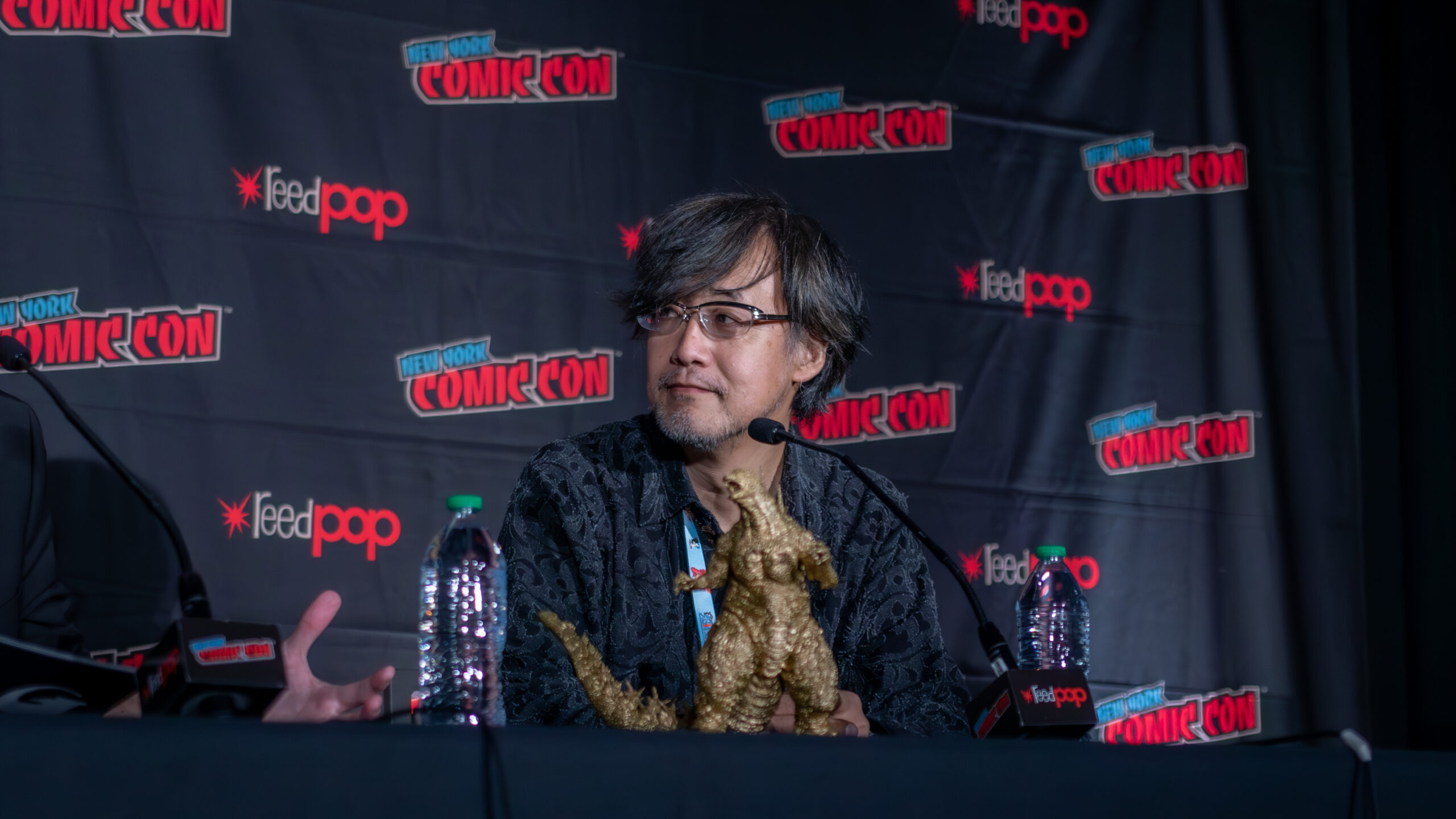
One filmmaker that has directly stated the influence of The Host on his movies is none other than Takashi Yamazaki. The director of Oscar-winner Godzilla Minus One has been incredibly open about the inspirations for the film, stating in a conversation with Nikkan Sport that The Host was “incredibly influential for the creation of his own film.” He has also stated his apparent jealousy for the film upon its release, stating that he “wishes that it was a movie he had made” in a conversation with Bong Joon-ho, as well as admiring the focus on the family dynamics within the film. Similarly, Godzilla Minus One focuses heavily on these family dynamics as well, wearing the influence on its sleeve. Both films also won accolades for their visual effects, with The Host winning Best Visual Effects at the first ever Asian Film Awards and Godzilla Minus One winning the Academy Award for Best Visual Effects. It is very interesting to see how both directors now have Academy Awards in their resume, with Bong Joon-ho’s later film Parasite taking home the Academy Award for Best Picture in 2020. With this, there is always the exciting possibility of more arthouse directors taking a dabble in the Kaiju and creature feature genres.

Image Credit: Shingo Nogami
The story of The Host remains one of the most interesting in all of Kaiju culture, from its initial conception to the influence that it has had on the genre going forward. Originally, the film had plans for a sequel as well. Though not much of the plot was ever revealed, concept art as well as test footage had been released, showing that the production had at least gotten to the visual effects stages before eventually being scrapped.
While it is incredibly disappointing that this project never came to life, Bong Joon-ho was still able to work with mysterious creatures in both his 2017 film Okja and his 2025 film Mickey 17, proving that monster films can be much more than what general audiences typically think about. Both of these films contain incredibly heavy environmental themes as well, linking them strongly to The Host.
The Host is a masterpiece of a monster movie, through and through. Not only is it one of the freshest takes on the genre to date, but its incredible visual effects, performances, and directing take it to a whole different level. It remains funny while still being incredibly heavy. It keeps the typical monster formula while simultaneously breaking every tired convention at the time. Its influence in today’s Kaiju films cannot be overstated enough. While many may still consider Parasite Bong Joon-ho’s defining film, it is a shame that The Host gets overlooked. For anyone wanting to see a piece of Kaiju history, this film is an essential viewing.
References
Reyes, M. (2023, December 4). Godzilla Minus One’s Director Talks Lessons He Learned Watching Cloverfield, And It Makes A Lot Of Sense. CinemaBlend.
Spada, D. (2016, July 28). Horror of the Han River. Monster Legacy. https://monsterlegacy.net/2016/07/28/gwoemul-the-host-bong-joon-ho-monster-creature/
“Director Takashi Yamazaki Reveals That He Learned from Bong Joon-Ho’s ‘The Han River Monster’ When Creating His Oscar-Winning ‘Godzilla 1.0’.” Nikkan Sports. www.nikkansports.com/entertainment/photonews/photonews_nsInc_202503260001443-0.html.