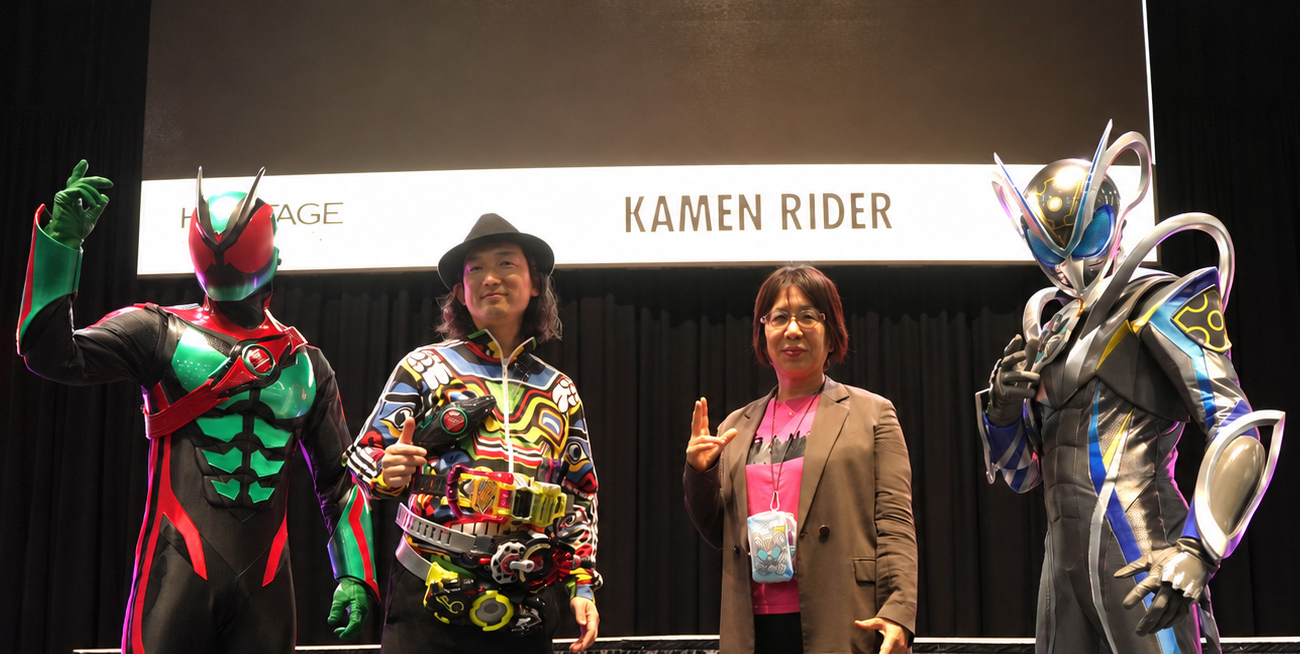
Kamen Rider, one of Japan’s most seminal tokusatsu franchises, is celebrating its milestone 55th Anniversary this year to great fanfare and excitement. Kamen Rider studio Toei Company marked this major celebration in the United States by having a rousing presence at this year’s L.A. Comic Con during Halloween weekend, with fans being able to visit and experience various activations and meet & greet opportunities. During the convention, Kaiju United had the opportunity to discuss this new era of Kamen Rider history with franchise writer Yuya Takahashi (Kamen Rider ZEZTZ) and producer Naomi Takebe (Kamen Rider MY-TH), gaining insight into creating these shows for an international audience, how each guest feels about being a part of the next chapter of Kamen Rider, and some interesting behind-the-scenes details on Kamen Rider ZEZTZ and Kamen Rider MY-TH.
Kaiju United: We’ll begin with Yuya Takahashi. When working on Kamen Rider ZEZTZ, what did you want to do differently from your past work on shows like GEATS, EX-AID, or ZERO-ONE?
Yuya Takahashi: With ZERO-ONE, GEATS, and EX-AID, there are multiple Kamen Riders in those; plus it was also Kamen Rider vs. Kamen Rider situations. Each of them had different philosophies when it comes to their battles. But with ZEZTZ, I decided on a solo hero who had their own goals and ambitions.
A second point: ZERO-ONE was AI-focused, and GEATS was a fight to death, so you never knew who was going to be winning in that situation. I was excited the whole time. Kamen Rider EX-AID was in the medical world, so compared to that, ZEZTZ was more focused on the spy mission, the spy world.

Photo courtesy of Toei Company, Ltd.
(c)ISHIMORI PRODUCTION INC. and TOEI COMPANY, LTD. All Rights Reserved.
Kaiju United: The ultimate conflict in Kamen Rider ZEZTZ is the idea of conquering our ultimate nightmares through our dreams. When we dream, we can pretty much do anything, right? When developing that kind of abstract and thematic story with the producer and director, what enters your mind?
Yuya Takahashi: Another two points here. First is that in a dream world, technically anything goes, but reality (and being grounded in reality) was very important because it’s great when you wake up from a dream and you realize that it was a dream. So it was the importance of being grounded in reality.
Another focus for ZEZTZ was that there is like, him being injured, gunfights, and things like that. So making sure that the fantasy was squarely in those battles and how he’s injured and all that… in case people haven’t followed [the show] a whole lot, I’m not trying to give away too much! The action was squarely in that fantasy.
Kaiju United: When writing a Kamen Rider series, do you write the basic flow of the action and special effects scenes, or does an action or stunt choreographer take over during those moments?
Yuya Takahashi: Who is battling who? That’s definitely scripted. What action items are used? Also in the script. But the actual strikes and how many strikes are blown? That is definitely up to the action directors.
Kaiju United: That’s really interesting! Back to the story of Kamen Rider ZEZTZ… The massive twist in Episode 24 was reportedly a well-kept secret amongst a small number of crew members. Tell us about keeping the secret and how the reveal went once the episode came out.
Yuya Takahashi: As the writer, it’s really myself, producers, and the leads in the departments who know what’s going on. So when we were actually filming it, it wasn’t actually that hard to keep the secret.
The fan reactions were pretty much as I thought. And, you know, they were really questioning, “Where does the dream end? Where does the dream begin?” There were a lot of comments and thoughts and theories on social media from the fans, for sure.
Kaiju United: How does it feel to have made such a major mark on the continuing and enduring legacy of Kamen Rider with Kamen Rider ZEZTZ?
Yuya Takahashi: You know, I have done a handful, as folks know. (laughs) With [Kamen Rider] EX-AID, that was my first time as Chief Writer, so that was really unique in and of itself. With ZERO-ONE… in Japan, the years changed for the emperor, and so ZERO-ONE was the first Kamen Rider for the Reiwa era, which is the current era, so that had special significance to me. GEATS is where I got to work with Takebe-san. And then currently with ZEZTZ, it’s actually simulcast worldwide, so each Kamen Rider [series] that I’ve touched there’s been various firsts with each situation.
Kaiju United: [At the time of this interview], fans in America are going to watch Kamen Rider ZEZTZ: Farewell Mission for the first time at L.A. Comic Con later today. What is your message to them as we experience the end of ZEZTZ’s story?
Yuya Takahashi: L.A. Comic Con has a lot to offer fans, so first and foremost, thank you to the fans for choosing Kamen Rider and taking their time out to watch it later today. And as you mentioned, it is the farewell, the final ending to ZEZTZ. We hope after you watch it to, you know, send me comments on socials. I am on the socials, so send me your thoughts, what you think, how you feel in the moment. So please let me know!

Photo courtesy of Toei Company, Ltd.
(c)ISHIMORI PRODUCTION INC. and TOEI COMPANY, LTD. All Rights Reserved.
Kaiju United: We’ll now move over to Naomi [Takebe]. Kamen Rider ZEZTZ was all about dreams and nightmares, while Kamen Rider MY-TH puts emphasis on animals and their zodiac signs. What was the thought process behind basing MY-TH around real animals, rather than the abstract?
Naomi Takebe: With every new Kamen Rider, we sit down and figure out what is going to be the new aspect of Kamen Rider. We already knew we were going to go in the animal motif direction, and pretty early on, focused on a mouse. The theme of the mouse was a pretty early decision – overall in the world, a mouse is… everyone kind of gravitates towards them. There are a lot of other mouse characters in the world. And even at one point during discussions, we were thinking about maybe carnivore animals versus like, vegetarian animals. That maybe was a thought that we had had in discussions.
And then we came upon the Chinese Zodiac motif, what you see now, and Bandai was like, “Oh yeah, that’d be great, because then we can have characters of all the Zodiac animals! So great!” So we got an okay from Bandai at that point.
Kaiju United: The introduction of Kamen Riders ZEZTZ and MY-TH is being called a brand new era for Kamen Rider. What do you think is perhaps the most unique feature or theme that is key to this new era? Maybe a new feature, idea, or theme that’s unique to these two Riders?
Naomi Takebe: With Kamen Rider, it’s always about the challenges that each Rider has to overcome. So that’s probably like the core between the two – the difficulty in overcoming those difficulties.
Kaiju United (to both guests): What things were kept in mind when developing ZEZTZ and MY-TH in order to capture potential international audiences?
Yuya Takahashi: ZEZTZ is a spy motif, as I mentioned before. The world loves our 007s and our Mission Impossible, right? So it’s really accessible already. Even at the top of every episode, the mission name (and even during the episode) the mission name itself is in English with Japanese subtitles. So that was definitely one thing that, you know, we as a team and as a writer, were very conscious about.
And also Baku, our main hero here. In reality, he only speaks and understands Japanese, but in the dream world, he understands English. Those were some of the adjustments I made for more of a worldwide audience.
Naomi Takebe: We wanted to jump tail off of all the great action that comes out of ZEZTZ, and with MY-TH, [we] kind of added that Japanese-esque layer that could be expressed in the wardrobe and just more subtly in that way. So [that is] kind of an added layer, especially because everyone’s in Japan these days, Everyone enjoys all the wardrobe and unique, unique designs, wardrobe designs that come out of Japan. So, visually, it was something about MY-TH.
With MY-TH, you know our cat motif… villain… or not villain, who knows? He himself is on his own mission, so that was kind of a throwback to the Hong Kong style.
Kaiju United: MY-TH’s story begins a hundred years ago in the Taishō era. When developing the series’ narrative, what intrigued you the most about setting a major plot point in that era of Japan?
Naomi Takebe: Actually, that kind of springboards off of Kamen Rider GAVV. There was an enemy that was a stomach, and we had a lot of fan art come out of that. GAVV had more of a, kind of like vampire-esque motif about it, kind of goth. And so we had a lot of fan art come out of that. The Taishō era has this nice East-West blend, so we kind of took that fan reaction from that past experience, and that’s why we chose the Taishō era.
And also 100 years ago, how people organize, how leadership was… it was a little bit different. Compared to how that is seen in the modern era is quite different, so those two views I thought would be very interesting, so that’s also why it throws back to the Taishō era.
Kaiju United: Last question for Naomi [Takebe]. The show that you are currently producing, Kamen Rider MY-TH, coincides with Kamen Rider’s 55th Anniversary. How does it feel to not only be a part of such an enduring and long lasting legacy, but to also directly influence the next chapter of Kamen Rider’s history?
Naomi Takebe: When I was growing up, I was watching Kamen Rider V3 as a child, and then you get into the Heisei era with a different feel. I think Kamen Riders always have kind of had a rebirth and a retake on the entire franchise itself. So I think that’s what makes people come back and enjoy Kamen Rider overall.
Kamen Rider, whether you’re an adult or a child, you kind of take away something different depending on where you are in your life. And also, you know, our actors, our crew – we know what the fans always want; we know that Kamen Rider is going to offer everyone something different every year, so that’s what we’re always trying to give [to] the fans. And now we’re in the United States, and hopefully that will give us some new perspective for the next Kamen Riders. So, you know, we’ll continue to watch and continue to really take in everyone’s feedback and joy with Kamen Rider.
Created by Shotaro Ishinomori, the Kamen Rider franchise has produced over 30 television series and numerous films, standing alongside Super Sentai (the basis for the Power Rangers franchise) as one of Toei’s most enduring intellectual properties. For 55 years, the franchise has delighted and amazed generations of tokusatsu enthusiasts around the world. Those who are new to Kamen Rider and are looking to experience the franchise for the first time can catch the simulcast of the latest series, Kamen Rider MY-TH, as well as view select episodes of other past shows in the franchise, on the Toei Tokusatsu World Official YouTube channel.