When a Godzilla fan makes a pilgrimage to Los Angeles, the itinerary usually includes obvious stops like Little Tokyo, with its array of specialty shops selling imported collectibles dedicated to the King of the Monsters. Immerse yourself in the world of Skull Island at Universal Studios. Where guests can ride a tram through the backlot and see up close and personal the Eighth Wonder of the World engaging in mortal combat with prehistoric creatures. Or take a stroll on Hollywood Blvd., where you might be able to catch a glimpse of both monsters adorning museums and gift shops. Continue walking on the Walk of Fame, and you’ll find gold-plated stars laid out on the sidewalk in honor of Godzilla and his co-star Raymond Burr. Godzilla’s own star! It’s there, it exists! It proudly sits near Grauman’s Chinese Theatre, surrounded by human actors.
But between the chaos of Hollywood and the hustle & bustle of Downtown L.A. is a location so unassuming, fans almost forget it’s there, or don’t know it well enough to mark on their map! Most likely because it’s a functioning school situated between a residential area and a very active urban spot: The Frank Del Olmo Elementary School.
What does an inner-city elementary school have to do with Godzilla? The edifice possesses some charming history, and that history is what made Godzilla the icon it is today the world over.
Sitting on a small hill, at the end of a block of apartments on 100 North New Hampshire Ave in Los Angeles, is an ordinary looking facility with beige columns and a grand set of concrete steps. Prior to the campus being built, in 1950’s Los Angeles, atop this hill was the site of a small movie studio called Visual Drama, Inc. It was here at Visual Drama that all of the additional footage, including Raymond Burr’s scenes, were filmed and edited into the original GODZILLA for its North American release! Imagine being a kid with a hyper-fixation on dinosaurs knowing GODZILLA (sort of) was filmed at your school?

A quick history in both the original GODZILLA and the inception of Frank Del Olmo Elementary: In 1954, Toho Studios in Japan released GOJIRA, essentially a protest film against nuclear proliferation with THE Bomb disguised as a monster. Though clearly inspired by King Kong and the growing trend of giant monster movies in the U.S. spawned by atomic testing, GOJIRA was an exception to the rule, because it came from the only country (at the time) that experienced firsthand the horrible effects of radiation. It was a story crafted from the current headlines of the tragic Lucky Dragon No. 5 fishing boat incident; the ongoing testing of Hydrogen bombs by the U.S. long after the war; and exorcising some of the trauma left by the atomic bombs dropped on Hiroshima and Nagasaki. When North American distributors showed interest in bringing the movie stateside, producers felt that those core themes wouldn’t resonate with an American movie going audience.
As a consequence, the removal of scenes featuring character development and controversial discussions would make the film significantly shorter, and a plan was hatched to hire an American director (Terry Morse) and film an American actor to seem like they were interacting with the original Japanese cast. The task of playing a character who would be the voice of the audience or the “American” perspective, fell to Canadian Raymond Burr. At the time, Burr had just played the villain in Alfred Hitchcock’s seminal classic REAR WINDOW, but GODZILLA was a few years before he’d play successful lawyer PERRY MASON on television. In GODZILLA, Burr played a newspaper reporter named “Steve Martin” (yes, you read that right) who was on layover in Tokyo while en route to cover another story, occasionally narrating the movie in Film Noir style. Released in April of 1956, the now christened GODZILLA, KING OF THE MONSTERS! became a success worldwide.
Another newspaper reporter, this time in real life, was Pulitzer Prize winner Frank Del Olmo (May 18, 1948 – February 19, 2004), an editor who worked with The Los Angeles Times. Del Olmo was a heavy advocate for educational equality and more schools in overcrowded parts within the Los Angeles Unified School District. He began his journalism career as an intern for The Times in 1970, working his way up to being a columnist and reporter, and eventually, editor. During his years at the publication, he received both a Pulitzer Prize and an Emmy Award, continuing to work with The Los Angeles Times up until his death. Though construction began on the school a year prior to Del Olmo’s passing, the school opened its doors in August of 2006 and was officially dedicated in memory to the award-winning journalist in November 2006.
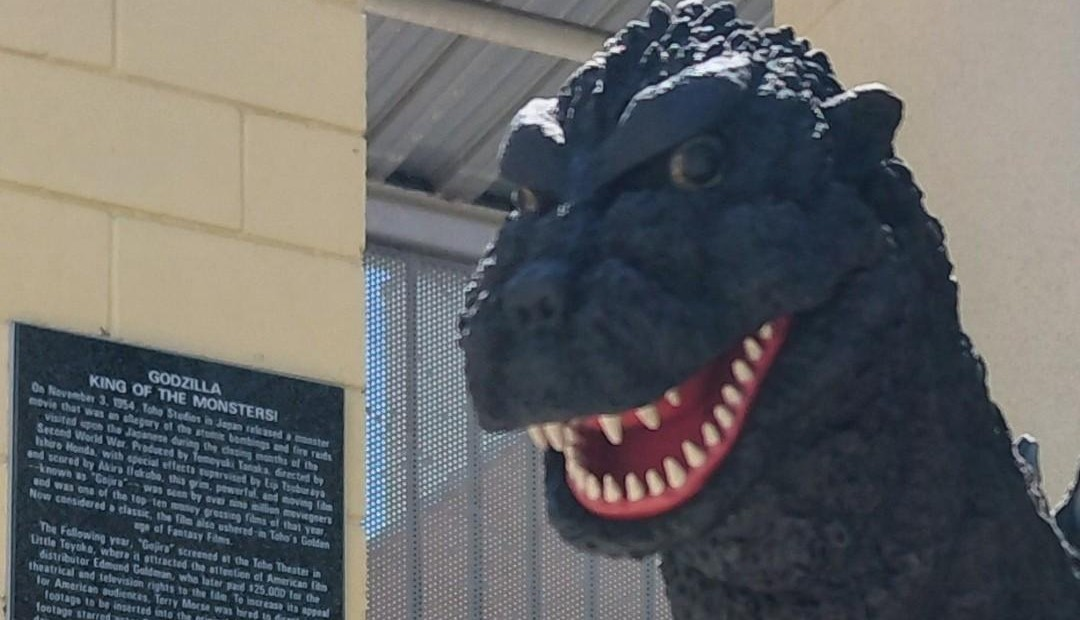
Another dedication in November of 2006 was the Japanese debut of GODZILLA on November 3rd in its homeland. Both Del Olmo and Godzilla would be dedicated in the same month and honored via plaques that would be erected on the front gates to tell their stories. For Godzilla, 2006 marked the 50th Anniversary of the release of GODZILLA, KING OF THE MONSTERS!

[Image Credit: Christopher Bryan Gomez]
Now, twenty years later, celebrating the film’s 70th Anniversary, Kaiju United caught up with the school’s current Principal, Rania Nahle, and Public Information Officer Sam Gilstrap. Together we discuss the legacy of their Godzilla plaque; how Godzilla can be taught in class for its historical significance; why this version of the film should be defended among fans, and how their school’s mission aligns with Del Olmo’s vision.
Christopher Gomez: Did you always have a passion for education, or was that something that developed gradually over time?
Rania Nahle: It gradually developed. I immigrated to the country in 1978. Once I graduated high school, it was a lot of transitioning for me. I missed out on an opportunity to be on a college path due to language barriers, my parents not being as involved, challenges of adapting to a new culture and understanding the school system. My passion really was ignited once I became a teacher’s assistant in 1998 at Virgil Middle School across the street and learned more about the system. I had teachers I worked with that really motivated me to want to become an educator. I began pursuing that career so I can change the pathway for students that cross my path.
This building wasn’t here yet when I was at Virgil; it was still THE lot. I didn’t realize this was a filming lot! I never knew until 2006 when I was invited as a teacher for Professional Development, and I saw that they had opened up this building. Back then, I didn’t realize that this was going to be a historical landmark.

Sam Gilstrap: It came as a surprise to me too!
CG: Were you present when they mounted the Godzilla plaque?
RN: I was not. However, I was teaching at another elementary school at that time. I understand it was placed in 2006, the year that the school had opened.
CG: What was your reaction when you first heard those scenes for the American version of Godzilla, King of the Monsters! were filmed here at your school?
RN: You know, I was genuinely surprised when I learned about it, and it was in a delayed fashion. You’re focused on becoming a principal, and there’s a lot to juggle. Then, you begin to realize that you’re at a historical landmark. You don’t expect an elementary school to be built on a filming lot! But the exciting part is that it adds to the story of the campus, right?
SAM: Oh for sure! And sometimes, we forget that we’re in Los Angeles, the Entertainment Capital of the World, and you find these nuggets, which kind of bring you back, and you go “Oh, that’s right, this was here! We have a place in history!”
RN: I think our community, our students, and stakeholders should learn more about it. I’m always looking for community partnerships, and I’m ready to move forward with that.
CG: Based on the contents of the plaque, did you ever go down the rabbit hole to research what exactly was filmed?
RN: I have. To be honest, it wasn’t until a few days leading up to this interview to prepare for it. I should really know more about the movie and immerse myself to see if I’ve ever watched it or not in the past. I may not have had the same perspective back then and now it’s even more exciting for me and fascinating. I think it’s important to learn more about it.
SAM: You just made me think of something. A minute ago you were just talking about your experiences as an immigrant. As you know, many of our students are immigrants or come from immigrant backgrounds. So, they may not have grown up with Godzilla. Even though Godzilla is a property that is seventy years old, it’s going to be brand new to them! That presents an opportunity to introduce something culturally new to them!
RN: What I love about that immigrant part and international movies is, given that the movie started internationally in Japan, is being able to make that connection to our students. The international newcomer students, whether they’re Japanese or not, it’s part of that connection. It’s a contribution stemming from our immigrant status to the American community.
SAM: Bringing cultures together through pop culture.

CG: Were you ever reluctant to share the information on the plaque with any of your staff or faculty?
RN: I have not shared, nor have I discussed with the staff. I’m quite surprised, especially for the staff that have been here for 20 – 21 years, since the opening of the school. It never came up in conversation, and it should! We have career day every year; we talk about our students becoming future leaders, getting them ready for the world, and college & career readiness. I think this is something to bring up with the history of our school, just to ignite our students who might be interested in being future architects and future engineers; to know what was here before. Or future filmmakers or scientists that connect to our building and take pride and have those bragging rights… We HAVE those bragging rights. I think we need to be aware of it and run with it.
CG: Have any of the students, or their parents, made any remarks about the plaque?
RN: They’ve never asked directly about the plaque. But I know for a fact in my upcoming “Coffee with the Principal” meeting that it’s going to be a topic of conversation, and it may very well start up conversation amongst the students and parents. I think I’ll see more people walk up intentionally to read the plaque and take a picture with the plaque.
CG: It’s nice that it’s outside of the gates so that the public can actually see it!
RN: Yeah, it’s in a great location and it’s still secure. Though after office hours we do have an outside gate so they may not have access to it. But it’s protected.
CG: The American edit of the movie is what made Godzilla famous the world over. It was the version most people grew up watching on TV. How do you feel about global cinema history being made here?
RN: Once the community becomes aware and I raise awareness around the subject, I think it will make them proud. This is very unique to our school. No other school has this opportunity to speak about a historical landmark. It would definitely bring forth ideas and inspirations. So, I’m really excited about how to roll it out.
CG: Would you ever consider having a “Godzilla Day” for the students?
RN: We’re always looking forward to motivating students about coming to school. I think that would actually add to the motivation factor of why you should be in school every day and “why do you love your school?” It definitely makes a lasting impression.
CG: What is the highest grade that you teach?
RN: Fifth Grade is the highest.
CG: With that in mind, is World History part of that curriculum?
RN: It’s really California History that’s part of their grade level standard and the focus. World History may come up if it was current affairs.

CG: If World History is ever brought up, since the original Godzilla deals with the themes of World War II post-war trauma and the subtext of Godzilla being a metaphor for the atomic bomb, do you think the movie itself would be used as a window for students and for teachers that want to discuss history?
RN: One hundred percent! The key here is, would it be age-appropriate content and age-appropriate language? You could still teach about the history, as long as it is handled in that manner. Obviously, you need to know your audience. There are aspects where you can share them in a way where it’s received as a learning opportunity versus you’re creating a trauma.
CG: Absolutely, and there’s a level of sensitivity that needs to be approached.
RN: Yes and, the approach we take with them is to be innovators and problem solvers. Example: “If this [Godzilla] was a problem in the world, how could YOU, a citizen, be impactful?” “What ideas do you have to offer that could’ve changed the situation?”
CG: Yes!
RN: I’ve gotta be honest with you… I had a teacher last year, a new teacher that I was evaluating, and her lesson in ELA (English Language Arts), WAS about Godzilla! Now I realize, “Oh my gosh!” Had we had the awareness (of the plaque) and of the conversation we’re having now, her lesson might’ve gone differently. The contribution of the students would have been at a different level as well. I’m really excited to have this follow up conversation with this particular teacher about her rolling out that unit. I don’t know why she decided to show clips from GODZILLA, but it was totally appropriate! She was talking about the dilemmas, why Godzilla behaved in the way it did, and the students were having a discussion! So yes, absolutely we can bring it into our classrooms!
SAM: I was just thinking. Not just World History, but English Language Arts as well. It’s a way to teach about metaphors.
RN: And THAT was the lesson!
SAM: We were talking about age-appropriate; it may be difficult for international affairs to be taught in elementary school. But for something like Godzilla, something that’s very easy for them to pay attention to. And you teach about how this represents more complex ideas.
RN: And she integrated Godzilla into the lesson. I don’t remember but, the lesson may have been about metaphors and similes because they do learn about that in the fifth grade.
CG: Are any of you fans of the series?
RN: Well, I wouldn’t call myself a longtime “fan,” but now I’ve definitely developed a great interest in it and dusted that off.
SAM: I think I’m in the same boat. It’s something that I grew up with as a kid; I remember it as being so embedded in pop culture. Not just Japanese pop culture, but American pop culture, too. There’s so many references to it, so everybody knows what Godzilla is. That’s why it’s kind of exciting to have this discovery and know this is in our backyard.
CG: You mentioned earlier your son went to Japan?
SAM: Oh yeah. And he’s a fan of all that pop culture stuff.
RN: I mean, you have to have an appreciation for the cultural significance of those films.
CG: Global phenomenon.
RN: Which is why this is an important story to tell! And our school is now a Historical Landmark. Additionally, we’re a public servant to our L.A. Unified community and students. I serve low, social economic families, and any exposure I can give them in their time that they’re learning here is advantageous; something that is going to remain with them for the rest of their lives. Any interactions that we have, including this knowledge, is going to impact them.
CG: If you had to pick a favorite giant monster, which one would it be?
RN: Given the lineage of women in my family, I would say Mothra. Just because of the representation of protection and resilience. I see that in myself and the lineage of my family. See, I DID do my research! (laughs) That was good huh?
CG: (laughs) Yeah, that was great! …Final question, what are some of the rewarding aspects you are most proud of here at this school, being principal?
RN: Just changing the lives of little ones. As a child, the deprivations I had in my immigration opportunity and the lack thereof, just “making it happen” for students today. I’m definitely proud of the culture that my community and I have built for our students. I feel like I have a strong, loving staff that are deeply committed to the students and love them. The dedication the staff brings to campus and to the students on a daily basis to create that loving, safe, learning environment. I think it speaks to the leadership, the vision, the mission, the practices, and whatnot. I’m super-duper proud to be that factor to add to the work. It’s such important and intricate work. It’s impactful work that could be great or dangerous. Everyone that comes on this campus is onboarded to understand the mission, ambition, and drive forward together. And if that’s not your vision, then you don’t belong. I feel that’s my responsibility as a principal and the custodial representation of these students. While they’re with me on my watch, I am doing everything in my power to make sure that they have that healthy educational experience. I think it gives me fulfillment for what I missed out on as a child. Seeing our students grow and thrive academically, socially, and emotionally, and knowing that this impact is forever lasting.

In defense of the version known as GODZILLA, KING OF THE MONSTERS!, one has to view the movie in the context of the time it was made and the kind of audience the producers were aiming for. While the subtext is watered down, certain concepts and themes are retained from the original Japanese version. Another innovation was the clever editing for the time. While portions of the film were dubbed, the process was still in its infancy and the film heavily relied on that new footage, therefore one has to give credit where credit is due to the editing. Burr is interacting with doubles wearing identical costumes to the original Japanese cast in sets meant to blend in with previously shot footage. The result, for the most part, is seamless, and it convinced generations of audiences that Raymond Burr was actually in Japan. Another of the re-edits’ underrated aspects in Burr’s “Steve Martin” character. There is an eeriness when Burr’s character records his voice to report his eyewitness accounts of Tokyo’s destruction. His chilling, deadpan delivery echoes both the Hindenburg disaster and an Orson Welles-ish intonation that becomes an ominous hybrid, grounding the story. Burr’s narration also complements the documentary-like original footage directed by Ishiro Honda, lending a sense of verisimilitude. It honors the dread of the story. While in other cases, Raymond Burr’s Steve Martin character feels truly involved in the story with the use of body doubles for the Japanese cast.
When Raymond Burr was asked to reprise his role in the film GODZILLA 1985, the filmmakers of THAT re-edit had plans of doing a parody to the original, serious tone of the Japanese film THE RETURN OF GODZILLA. When Burr caught wind of their intentions to make a joke of it all, he threatened to walk off the project if they didn’t take Godzilla seriously. Since the 50’s, Burr had the foresight to see the potential of a property like Godzilla and saw beneath the surface the themes the character represented.

Going back to GODZILLA, KING OF THE MONSTERS!, consider some of the films that came out in the 1950’s: THE BEAST FROM 20,000 FATHOMS; THEM!; TARANTULA; and THE DEADLY MANTIS. While all are wonderful movies in their own right, 1956’s GODZILLA, KING OF THE MONSTERS!’s impact was undeniable. Had it not been for this version, you would not be here reading this article (or any articles related to Godzilla or the world of tokusatsu). GODZILLA, KING OF THE MONSTERS! also gave a launching pad to actor James Hong, who was the English dubbing voice for the two male lead characters in Akira Takarada’s Ogata and Akihiko Hirata’s Dr. Serizawa. Hong had stated in previous interviews that he recorded all of his lines in three days, sitting at a table and speaking into a microphone. Since GODZILLA, Hong has gone on to have a prolific career starring/ voicing such films as EVERYTHING EVERYWHERE ALL AT ONCE, WAYNE’S WORLD 2, BIG TROUBLE IN LITTLE CHINA, the KUNG FU PANDA series as Ping, and now joins the ranks of Raymond Burr and Godzilla by garnering his own star on the Hollywood Walk of Fame in 2022.
For 50 years, the original Japanese version of GOJIRA was never seen publicly in North America. It wasn’t until 2004 that Rialto Pictures was given the greenlight to release the movie in selected theatres. To audiences now getting to see what they had been missing, the film was not only drastically different, but surprisingly moving in its social commentary. Soon after this re-release, a growing number within fandom began pooh-poohing its American counterpart KING OF THE MONSTERS. Through the lens of today and at face value, yes, America’s GODZILLA: KING OF THE MONSTERS is the inferior version. But one could, and should, appreciate the legacy KING OF THE MONSTERS left behind when viewed in the context of the time it was made. The re-editing is 50/50, both parts ignorant and clever. For example, due to the re-shuffling of scenes, in KING OF THE MONSTERS, a character is heard mentioning the name “Gojira” before any of the characters are aware of the existence of the monster.
Without the ’56 movie, there would be no 38-movie franchise. No pop culture references. No worldwide recognition. No merchandise. No conventions. No inspiring future filmmakers like Tim Burton, James Cameron, John Carpenter, and Steven Spielberg, with the latter citing it as a huge influence on JURASSIC PARK and has stated in the past, “[GODZILLA] was the most masterful of all the dinosaur movies. It convinced audiences it was really happening,” no doubt in thanks to Burr’s narration and delivery. One wonders if the 1954 Japanese original would’ve fallen into obscurity? Flaws and all, Godzilla’s legacy all traces back to the popularity of the 1956 version. We at KU look forward to Principal Nahle and PR officer Samuel Gilstrap’s future educational Godzilla plans and continue to wish them and their students all the best with their strive to make this world a better place. GO FALCONS!