Godzilla vs. New York City, the latest edition of IDW’s Godzilla vs. America series has hit comic shelves everywhere. All eyes are on this issue as Big G tackles the Big Apple, continuing on the intriguing relationship between Godzilla and New York City throughout the franchise’s history. The anticipated comic released on November 11th, and has already earned its praises.
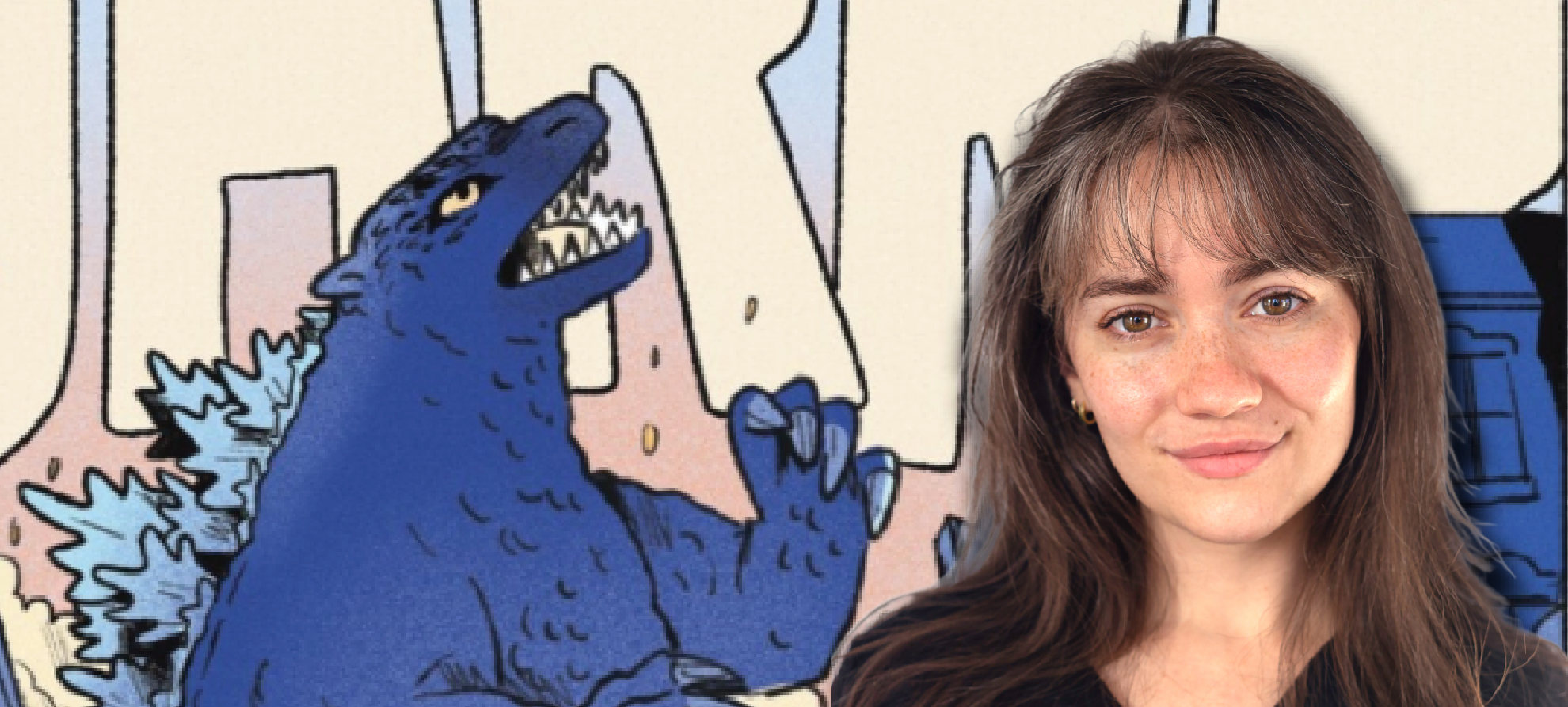
Kaiju United had the opportunity to speak on video call with Anna Meyer, author, artist, and letterer of Party Crashers, the final short story in the new comic! Our discussion featured many interesting topics such as the relationship between Godzilla and New York City, Anna’s creative process, and the important strengths that comics have when telling stories about Godzilla.
Mario Macchiarulo: Can you tell us more about yourself and your career? How did you get to this point of being involved in [Godzilla vs.] New York City?
Anna Meyer: Yeah! So, professionally I work as a graphic designer, which is what I have been doing for most of my professional life, but I’ve been making comics ever since I was little. I’ve always loved comics and graphic novels, and I was doing them on the side of my 9 to 5, and I started a web comic, and I had a couple web comics that I did throughout my life. And I started a web comic called St. Catherine that got picked up by an editor, and that then got published by First Second.
MM: That’s awesome to hear. Did you have any background in Godzilla?
AM: No, other than just liking Godzilla, again, I’m so new professionally, but I’m just a fan and I think my graphic novel that came out last year very much deals with monsters and demons and also it takes place in New York City as well. And so I think the editors were a fan of that and felt like they wanted to see my style of writing translated to a Godzilla comic.
MM: As someone who read your story, I really enjoyed reading it, and it was clear that you know New York really well. What are your thoughts about the relationship between Godzilla and New York City throughout the franchise’s history?
AM: Yeah, I mean, it seems as far as I know, typically when Godzilla comes to America, he does come to New York, like with the Matthew Broderick movie in 1998. I know he makes an appearance in the new movie as well. But I think it makes sense because New York has so many iconic skyscrapers and buildings to destroy. I think the pairing of Godzilla and New York makes a lot of sense because I think that anyone, most people around the world, they know New York. And so I think it’s just this really iconic city for him to smash around in.
MM: That’s a good point!

TM & ©Toho Co., Ltd.
AM: There was one joke that I didn’t put in the comic, but I kind of wish that I did. That was a reference to the 1998 movie. In the comic that I wrote, I’m kind of making fun a lot of like overpriced places in New York. And me and my friends always joke that you’ll order cheese and they send you like 2 little slices, and they’ll also a lot of times have tin fish. And so I wanted to do a joke that was them looking at the menu, and the line would have, “$16 for a can of sardines?” and the other character would have said, “That’s a lot for fish.” It would have been a joke of that famous line from the 1998 movie where he says, “That’s a lot of fish.” I decided to have not put it in, but I kind of wish I would have.
MM: Thank you for sharing that! That is very clever. I remember not being the hugest fan of the 1998 movie. It is a pretty polarizing movie, and while I personally perceived that the film did not seek to handle the IP in a tactful or faithful manner, and that is why it got a lot of criticism. The reason I bring this up is because I am glad you thought about incorporating 98, because I think it’s still a really important movie. It was America’s first go with Godzilla and it’s a cool movie. This was also the first time a Godzilla movie really soloed in on New York, which was also important.
AM: Yeah, you are dealing with 10 pages, and there’s only so much that can fit in there, especially for like pacing. But yeah, when I think about Godzilla and New York, I do think about that movie.
MM: This next question is directly related to your comic. I thought the humor was really fun, when it came to the coffees in Brooklyn costing too much money, and that coffee shops also being a winery was very funny. The juxtaposition between how the friends were having a problem that was pretty trivial compared to Godzilla destroying Soho was engaging to read through.
What was your desired approach when you were writing the story, was the script already given to you?
AM: Overall, the editors really gave me a lot of freedom when it came to the story. They really wanted to see what I would come up with. They had a couple of rules and one of them was that Godzilla had to be like a force of nature. He had to be scary, like you couldn’t make him super cute or anything. He did have to be a sort of large and imposing force. One of my ideas was having Godzilla work in an office as a callback to that vintage ad of Godzilla and the little printer, and very quickly they said, “Well, no, that’s too cute, that’s too silly.”
So I went back and thought about stories I could write about having Godzilla attack the city or something similar to that. And I knew ultimately I wanted to something a little funny and a little silly. Because I think that’s just where my strengths lie. And as a writer, I think it’s always good to write and draw to your strengths. You should always challenge yourself and try something new. And doing this shorter comic, maybe as someone who usually does long graphic novels, 10 pages was definitely a challenge for me. But I knew that I felt my story would be more successful if I did something that was a little goofy and a little silly. I also had a couple ideas about like, a pigeon kaiju, like a pigeon accidentally turned into a kaiju and Godzilla was happy to attack it, which would have been also funny and silly too, but I felt like anyone could have written that.
I wanted my story to be very specific and I wanted something that felt like people in New York and people in Brooklyn would be like, oh, like, I totally get that. Of course, I wanted to appeal to a broader audience as well, but I really wanted to write a story for New Yorkers and for Brooklynites. And so I decided to have this story revolving around overpriced coffees and lines. Like there’s a huge thing in New York where like everyone’s waiting in these lines for no reason, it’s an epidemic. And so, just putting in little jokes about overpriced Ubers, and a joke about how there are so many buildings and skyscrapers in New York: New Yorkers hate that 432 Park building, so [we have] Godzilla destroy that and everyone cheering and being happy about it. So I decided to focus on campy, silly, and also specificity, too.

TM & ©Toho Co., Ltd.
MM: I think you did a really nice job of having New York and Brooklyn specific humor, but still making it a fun story to read for a broader audience, for someone who may have been a New York outsider and was curious about how Godzilla would react with New York and the New York humor. I think the creative freedom that you had definitely paid off.
I checked out some of your other illustrations on your website. Really neat stuff! I wanted to ask, what are your inspirations for your art style in general? Like, what works do you maybe pull from?
AM: I think I’m definitely very inspired by folklore. I love old folklore and art history drawings. I also grew up reading a lot of manga and so I feel like a lot of manga is an inspiration for me as well as American art styles, like even just Disney and things like that. And I think I also pull from Studio Ghibli and Miyazaki. I feel like I’m taking all of those traditional folklore drawings, manga, cartoons, and Miyazaki, all sort of to create my own style.
MM: Was there a specific suit or a specific Godzilla design that you took any inspiration from when you were drawing Godzilla in your comic?
AM: Oh, definitely the 1950s early Godzilla, which is really the Godzilla that I love. The sort of campier, old school, person-in-the-suit Godzilla. I think those are just the type of movies I’m really drawn to. I love practical effects. And also my style of drawing is very cartoony and very stylized. I felt that more old school fit really comfortably within my style. And again, like, going back to the tone of my story: It’s kind of ridiculous and there’s a lot of suspension of disbelief that’s happening in the story. Having the design be a little more cartoony and even the way that it’s colored be a little more fantastical, sets the reader up to be taken along for that ride.
MM: What’s interesting is that during the Showa era, there were many different suits, almost a different suit for each movie. I think that you took the traits and kind of made it into your own art style, which was really cool to see.
AM: For sure! And you know, this is my first time ever working with IP, and there’s, you know, rules that you have to follow, and they did really want us as artists to draw Godzilla in our style, but there were certain things that needed to be like he had to have the correct number of toes and fingers. One of my favorite things is he has to have tiny ears. There are certain artistic regulations that you need to follow when you’re working with IP, but I think they really leaned into allowing each of the artists to interpret.

TM & ©Toho Co., Ltd.
MM: Thank you for the extra info! Godzilla’s presence in comics has grown exponentially this past year and a half, with all these different series and crossovers between IDW, Marvel, and DC. What do you think is the importance of a film franchise like Godzilla having stories told through sequential art? What can the comics medium specifically do to tell interesting stories about such an interesting character?
AM: I will say, I think comics are just such an incredible art form and way to tell stories in general. I think more stories should be told in comics, and people should be reading comics, because there’s just a way to tell a story that you can’t achieve in a film and you can’t even achieve in a prose book that you can really get in a comic with both words and visuals, and you allow the reader to set their own pace. There’s just so many wonderful things about comics.
That’s my general promotion of comics as an art form. I think for Godzilla, what’s so great is that Godzilla really has taken on a life of his own and everyone has their own interpretation; so there’s so many interpretations of him. He’s his own sort of monster in folklore in of its own right. And you’re able to, with comics, unlike a movie, have a smaller amount of creators or minds be involved in showing their interpretation of Godzilla. I think that it allows so many different voices to show their vision of Godzilla, with not as many barriers that I feel like come with film. And I think that’s really special. The other great thing about comics is your limitations are just what you can draw and what you can imagine. With film, you’re dealing with CGI, you’re dealing with so many technical things. If you have an artist that can draw your vision, the possibilities feel very endless. I think there’s such a level of imagination and creativity that you can achieve with comics that you can’t really achieve with other art forms.
MM: That’s an awesome answer. If you had another opportunity to write a Godzilla story, what would you do?
AM: As a writer, I feel very comfortable with a campy style of writing and drawing, so I would want to work within that. This story was only 10 pages, and there’s a lot of wonderful things that can happen with constrictions, but sometimes it’s fun to be able to have more pages and more story to really build out more characters and really get those themes kind of set up and paid off. I think that overall that it’d be really fun to write another Godzilla story, but maybe have a little more time to build out story and characters.
MM: I hope you one day get more pages to work with, I think you would do great.
My final question is a bit of a New Yorker question. What is your favorite thing about New York?
AM: I like the people in the community in the sense of everyone is so close to one another. We’re all in such close proximity with where we live, riding the subway, and I think it creates this really great sense of camaraderie. I think people have this idea that New Yorkers are really rude, but I actually find them to be some of the most helpful and kind people. They’re not ever gonna sugarcoat anything and there’s such a brutal honesty out there. But if someone’s going through it, everyone will help each other out. I think it’s because everyone lives so close and you’re seeing your neighbors every day – it just reminds you that you are part of a community.
You’re part of the city. That’s what I really like about it.
MM: Thank you for your time and care that you put into your story about New York. It was great to speak with you Anna!
AM: Thank you!
Godzilla vs. New York City is now available for purchase in comic shops everywhere. For more on the book itself, we encourage you to check out our review of the one-shot comic here. If you would like to check out more of Anna’s work, visit her portfolio page here. Check out her debut graphic novel, St. Catherine, here!