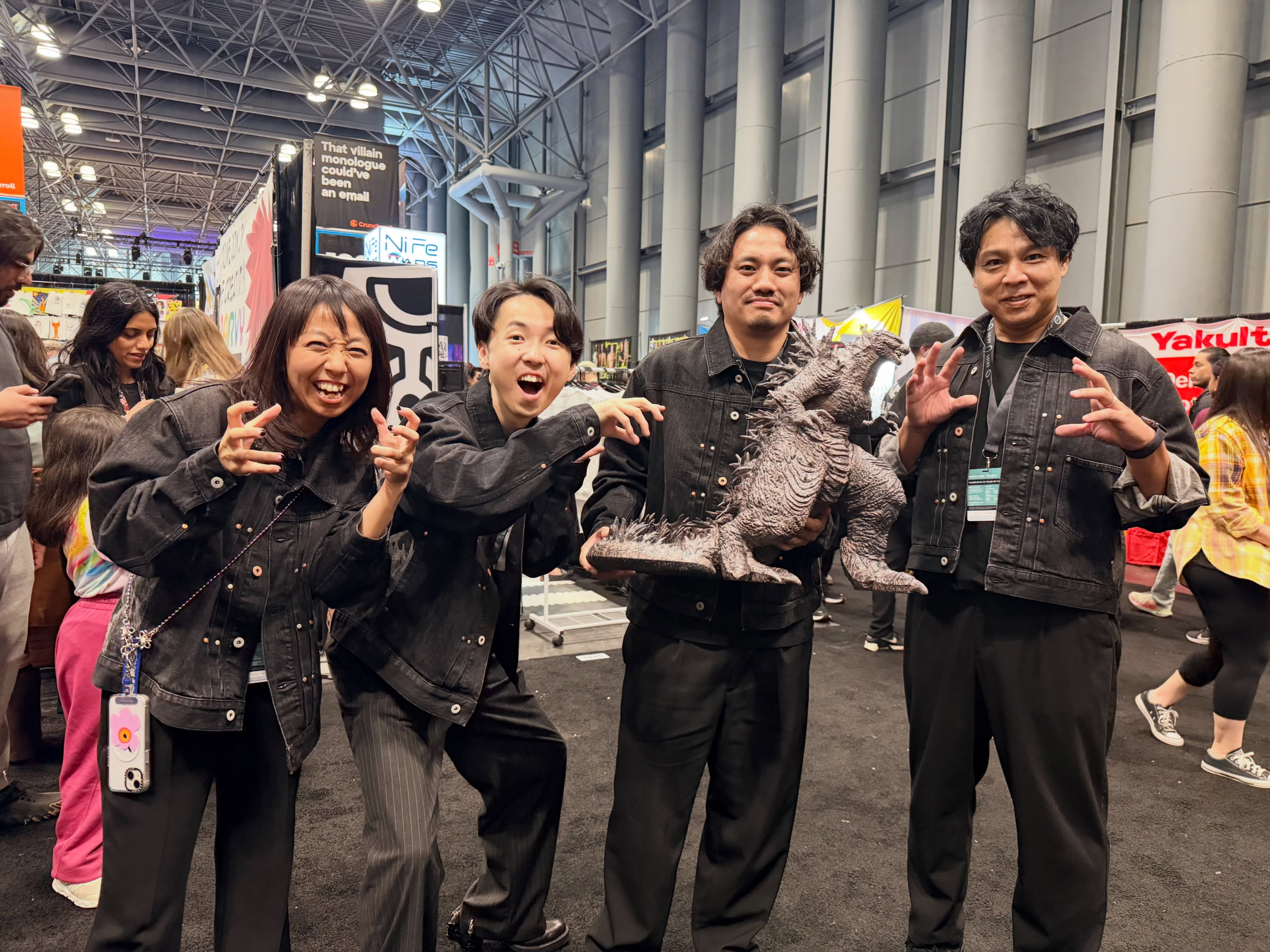
One of, if not THE most highly anticipated moments in the history of the kaiju fandom, Godzilla Minus Zero, has finally been released. The King of the Monsters has stomped his way back onto screens all over the world, with eager fans lining up to see Takashi Yamazaki’s next addition to his Godzilla “Minus Series.” While director Yamazaki is on the forefront of this film’s creation, it’s important to remember the people behind the scenes who played major roles in helping bring Minus Zero (and its predecessor) to life. Among them are producer Kazuaki Kishida, VFX artist & compositor Tatsuji Nojima, production & post-Production sound mixer Hisafumi Takeuchi, and sound designer & foley artist Natsuko Inoue.
These 4 individuals have certainly been getting the attention and credit they deserve for lending their talents to two of the most prominent Godzilla films of all time, making several appearances at screenings and events as part of Minus Zero’s extensive press tour. One notable stop along this international tour was their appearance at the Javits Center in Midtown Manhattan for New York Comic Con, where Kaiju United had the opportunity to sit down with them ahead of their scheduled appearance in Room 405 for the Godzilla Minus Zero Panel and gained further insight on their roles in the film’s production.
[Japanese to English translation conducted by Mikey McNamara]
Nick Crispino
First question is for Nojima-san. Talk to me about Godzilla’s new design. Did you and the team build upon the existing model from Minus One, or did you make something entirely new from scratch?
Tatsuji Nojima
It looks similar, but the model was made bespoke for Godzilla Minus Zero.
Nick Crispino
Godzilla Minus One was praised for the efficient VFX process. When creating the VFX for Minus Zero, did the team innovate on their process at all, or were things kept relatively the same?
Tatsuji Nojima
I would say we built on the existing pipeline. We didn’t want to change things too much because it was working really well on Godzilla Minus One. So with Godzilla Minus Zero, we kind of expanded the team a little bit while keeping everyone’s motivations high.
Nick Crispino
Pretty much, “Don’t fix what’s not broken.”
Tatsuji Nojima
Haha, right.
Nick Crispino
Last question I have for you, can you talk to me about the VFX process for King Ghidorah’s evolution.
Tatsuji Nojima
So I wasn’t in charge of that specific scene of animation and VFX, but I can speak to the gravity beam if that’s of interest.
Nick Crispino
Yes, please.
Tatsuji Nojima
With regard to the gravity beam, director Yamazaki had an image in his mind, and he was trying to explain this to me, verbally, but it sounded so abstract, like, “I don’t understand what you’re saying. Could you sketch this out for me?” So he got out some paper, and he made a ton of sketches that had a bunch of blue lines on it. So I thought, “What are these blue lines supposed to represent for the gravity beam?” And visualizing that in a 3D space, of course, is where I started. And I decided to express a lot of the lines through dots, so I was sending a lot of particles in the VFX pipeline, but I tried to make it so it feels like it was like spiraling, twisting, and then whenever it grabs an object, it felt like it was kind of grabbing and wrapping itself around it, and blurring the background to give it some of that effect like it’s bending space. So that was the process I used to create that gravity beam effect.
Nick Crispino
Kishida-san, what was it like working with [Takashi] Yamazaki and Toho to bring the vision of Godzilla Minus Zero to life?
Kazuaki Kishida
Working on Godzilla Minus One, I don’t think anyone thought that there was going to be a sequel. But when we had the first screening for industry members, people, cast and crew, a lot of people wanted to know what happens next, and said, “Hey, what’s the continuation of this story?” So Yamazaki and I, we kind of joked around about it, “Well, maybe there’s going to be a sequel. What if there was a sequel?” And one month later, Yamazaki-san writes a plot for what a sequel might look like, and at that point had most of the core elements that you see in the current Godzilla Minus Zero.
So behind the scenes, when we’re on the Oscar campaign for Godzilla Minus One, Yamazaki and I are talking in our rooms about, “Okay, how can we make this happen?” There’s a lot of back and forth about what the story might be, what [the] themes would be. There were incremental upgrades every day, I guess you could say. But I think the process for me was about communication, it was about talking to Yamazaki-san everyday, understanding what his vision was, and then moving the project forward one step at a time.
Nick Crispino
Coming off the success of Godzilla Minus One‘s groundbreaking accolades, were there more resources allotted for Minus Zero’s production and if so, how did you utilize those resources?
Kazuaki Kishida
Well, I can’t give any specific numbers, but I can say the budget did increase from Godzilla Minus One to Minus Zero, and one core concept that we kept was that we wanted to prioritize quality. So quality first was the directive. And we also wanted each department, each artist to be able to do something that they wanted to do. So, it’s like what type of visual expression – whatever they’re good at and they want to put into the movie – we were trying to gather all of that to make sure that it was reflected there. We got a lot of requests and a lot of different ideas. So…I regret saying that for one thing [laughs], but the box is open. But, after that, I think we have a lot of great VFX expressions that we were able to explore as a result of this process.
And despite us having more money and resources than Godzilla Minus One, I think we had 35 artists on VFX, [but] for Minus Zero it was 50. And I’m sure everyone’s asking the question, “Well, with the increase in budget, why don’t you scale it up even more?” But I think that’s Yamazaki’s style and kind of what we hinted at earlier, we don’t want to fix what wasn’t broken. So we kept everyone on the same floor, people can communicate, like, roll their chairs around, talk, etc., and I think that really lent itself well to the final product in Godzilla Minus Zero. So the team was kept small in spite of there being more budget accessible.
Nick Crispino
Takeuchi-san, what story did you want to tell through Godzilla Minus Zero‘s overall sound mix? What emotions did you want the audience to feel?
Hisafumi Takeuchi
With Godzilla Minus Zero, I had two areas of focus. That was the balance of the overall mix as well as the role of each sound. So obviously, if you want a scene that has a lot of impact, we’re going to increase the levels overall, but it’s not always beneficial to have sound at any given time, to make sure we have that contrast and emotion. So in regards to the role of each sound, I would think about the scene, “Okay, well, the dialog is doing this, the sound effects and sound design is doing that, and the music is doing this,” to make sure that each role of the sound design is very clear and me giving that piece of sound a place to come through to the audience. So for every scene, I try to imagine what the audience wants to feel and what the director wants the audience to feel. And then if this is something that is very intense, perhaps it’s going to be very effects forward, or there might be an emotional moment, so I let the music carry the emotion of the audience. Or if there’s a lot of information, maybe dialog takes center stage. So it’s all about the balance of what information we’re trying to convey.
Nick Crispino
So this is a question for both you (Takeuchi-san) and Inoue-san. Talk to me about how you guys collaborated. How does a sound mixer and a sound designer collaborate to create the final audio for a finished film?
Natsuko Inoue
Well, first off, I want to say Takeuchi-san was one of the very few people who was on set from the very beginning. So he was there from pre-production through post-production. I would say he’s probably one of, if not the only one of the very few people who was able to do that. I joined around post-production. But because Takeuchi-san was on set with director Yamazaki every day, when they’re shooting different scenes, Yamazaki would make the comment, “Hey, I want this scene to have this type of feel, this type of sound design.”
It wasn’t just the information that Director Yamazaki communicated to Takeuchi-san, he was also somehow able to capture the atmosphere and the vibe that was on set, and then bring that back into post-production when giving us instructions on what type of sound to design. So I think it was a very important part that he was on set to kind of create that architecture and structure for us to design sound and in post-production. And because of the information he was able to bring back to us, I think I was able to get really closer to what director Yamazaki wanted on the first iteration, rather than having a lot of different retakes and remixes.
Nick Crispino
When designing sounds for creatures that don’t exist, such as Godzilla and King Ghidorah, how do you ground the fantastical in reality through sound design?
Natsuko Inoue
As you mentioned, because these kaiju don’t exist, what I’ve learned in Godzilla Minus One is that if you pursue the sound design component too much, you actually start to fight with the visuals that are happening on screen, and it’s almost a little distracting. So I wanted to make sure it was preserved, the core of what makes the Godzilla Minus franchise great, which is the CG, the human drama, and add details to it. And that’s something I learned on Minus One that I took into Minus Zero. So the first question I had to answer is, “Is it okay for Godzilla and King Ghidorah to exist in this world?” And our answer to that is we went out to a dam and used their giant alarm speakers, and then actually played back the sound of the creatures screeching and recorded that. So in a way, the sound exists in our reality that we record because it’s reverbing off of all the environments. And I would take that and combine it with other voices and foley design that I did in post-production. It was important to not make the sound too pretty, too clean. It had to feel very raw and grounded, hence the recording at a dam. So to me that was how we were able to connect our world, our reality, to the fantasy of kaiju.
Godzilla Minus Zero releases today in theatres across the United States. As an extra bonus, we have also included the audio recording for this interview below for those who wish to listen to it.