When people discuss Tokusatsu, they are, by the very token of the terminology, in discourse with film and television, as opposed, most commonly, to the written word or drawn image. The word itself is literally derived from the Japanese term for Special Effects, thereby precluding that which is static, unmoving, and outwith the cinematic medium and its televised idiom. However, one would be remiss to not at least entertain the notion of the complementary relationship, and conversational sharing of influence, between the Tokusatsu genre of moving image, and the static panels and word bubbles of comics and manga. After all, in a world wherein just about every Godzilla movie gets adapted into a Manga at some point, and Kamen Rider as a franchise stems from such a sequential literary genesis, it ought to be betoken no small amount of sharedom.
This wee article will not discuss Manga, as its relationship with the Toku industry is synonymous with its creation, and the two have long shared history, rather, this will specifically highlight the matrimonial confluence of American comic books and the various Tokusatsu derivations and adaptations that have sprung from within it; in particular looking at five separate instances of American comics taking inspiration from, or directly adapting Japanese Tokusatsu properties. One need only look at the bespangled and brightly-adorned superheroes of the Marvel and DC universes, and see readily a commonality of design, narrative, and interest readily with the visual and performance aspects of the Japanese cinematic phenomena. It is perhaps inevitable, then, that a shared final product would also share a fanbase, and that the creators who stem from said fanbase would introduce familiar elements of one into another.
The First Series that I want to look at, and inarguably the biggest on this list, is Radiant Black, published by Image Comics and beginning in 2021, written by Kyle Higgins and with a variety of artists.

Radiant Black follows Nathan Burnett, a 30-year-old writer who has been forced to move back home to the small town in which he grew up, after his first credit card debt reaches an impossible height. There, he gets reacquainted with an old friend, Marshall. The two of them later discover a strange glowing orb which, when touched, transforms Nathan into the eponymous hero, endowed with the power of a Black Hole. However, after sustaining an injury in battle, he is temporarily forced to pass the mantle onto Marshall, leading to a conflict between the two as they find themselves suddenly in possession of an immensely powerful alien artifact that has thrust them into a cosmic conflict they cannot hope to comprehend. To make matters worse, other “Radiants” have begun popping up all over the world, some good, some bad.
Higgins himself is no stranger to Tokusatsu, having first hit his stride with an immensely popular run on Power Rangers (a run that I am sadly yet to read), as well as eventually moving over to Marvel to pen a short-lived Ultraman adaptation that I will go into more detail about below. Thusly, Radiant Black is something of an apotheotic passion project for the writer, whose career has seemingly all but primed him for this series. Radiant Black succeeds because it not only adapts the imagery of a familiar Tokusatsu series (most obviously Super Sentai, but with elements of Kamen Rider and even Anime also), but because it utilises much the same storytelling techniques and themes found within said franchises, only adjusted for a more adult audience with its heavier moments and frequent violence and swearing. Like Sentai, it features a focus on transforming heroes, team-ups, and many, many flashing lights and bizarre alien weapons. At its biggest, it is a vast cosmic story involving giant robots, superheroes, and the fate of humanity resting on the shoulders of two long-time friends whose lives are both at impasse. Radiant Black is a Toku story for older fans, ones whose lives have been expunged of the same childish whimsy carried by these shows, and who are perhaps in the most need of it. Higgins is able to utilise the comic format to turn Radiant Black into something that reads as both a loving homage to classic Toku and Anime, but a fast-paced and compelling comic book drama that succeeds in both its adult drama and childlike imaginative excess.
Since its release, Radiant Black has garnered a following quite unlike anything else that’ll be on this list, accumulating a large fanbase that has seen it go on continuously for now five years. In that time, not only has it undergone massive changes to characters and world, but from it has sprung an entire expanded universe, from which other writers have added their own Tokusatsu-inspired heroes, such as Cherish Chen’s direct spinoff Radiant Red (2022), and Mat Groom’s wildly bombastic Inferno Girl Red (2023), all of which have converged in the so-called Massiveverse. This shared comic book universe acts as something of an American love letter to the ways in which Tokusatsu has shaped the writers behind these projects, injecting the all-too Japanese style and conceptual elements of Toku into the American comic book landscape. Radiant Black may be an excellent book, but the universe it holds in its palm is as vast and intriguing as it gets. It is a comic that has shown the ability to appeal to both fans of its own medium and genre, as well as Tokusatsu and Anime fans.
The second series I’d like to highlight is the aforementioned Ultraman series from Marvel, written by Kyle Higgins, also. Beginning in 2020, with the miniseries The Rise of Ultraman, Marvel’s Ultraman series is something of a retelling of the first several entries into the Ultra franchise – establishing a universe in which monsters have been appearing for a long time all around the world, necessitating a monster-hunting agency to capture them. However, when these monsters get both bigger and more frequent, the newly arrived Ultraman seems to be their biggest hope at defeating them, even as the very agency entrusted with capturing these monsters may soon turn against their new defender. This miniseries would be followed by The Trials of Ultraman, and The Mystery of Ultraseven, as well as the one-shot The Fall of Ultraman, encompassing a story about government cover-ups, pocket dimensions, and a battle between man and monster that challenges our definitions of both.

©Tsuburaya Productions
Though not the masterpiece on the level of Radiant Black, Higgins’ comic again attends to the themes inherent in the Ultraman series and property, whilst adapting it to an American comic form, stringing together influences from within Marvel’s pantheon of heroes, and the many decades of Ultraman on the big and small screen to create something likely to find itself beloved by both parties.
Though the series may lack the Monster Of The Week format of the original series, and certainly has too much plot and too little time in which it is to happen, it still carries with it an incredible dexterity and composure that makes it feel like a big-budget American superhero-style blockbuster adaptation and interpretation of the first several seasons of the Tsuburaya classic franchise. Its story expectedly follows a young man as he joins the SSSP and finds himself bonding with Ultraman, becoming one being, before setting out to beat monsters and uncover a dark truth. The art, provided by several artists, features lovingly rendered recreations of classic monsters, as well as a distinctive Marvel flair that elevates it above the simple renditions it could’ve attained otherwise. More than a simple homage, Ultraman reads like Higgins’ providing a perfect entry point for American readers into one of his favourite Tokusatsu franchises, and for that it must be recommended.
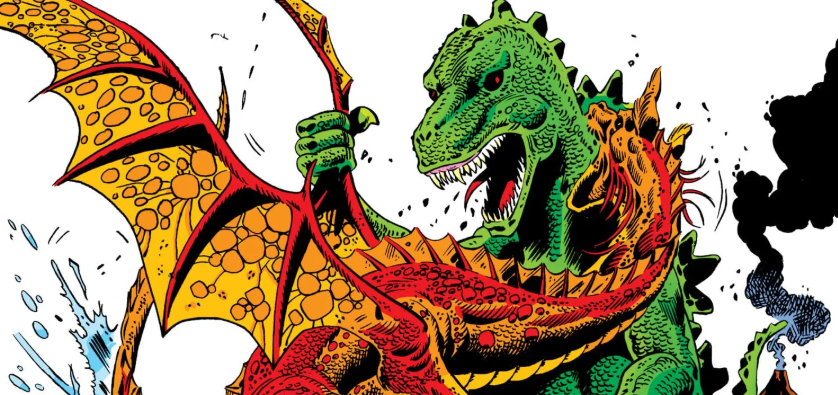
Staying with Marvel, but moving on from Ultraman and onto Godzilla, the third series I’d like to highlight is also one of the most interesting parts of both Marvel and Godzilla history. For a brief period in the seventies, spanning the years of 1977 to 1979, and written by a cavalcade of writers and artists, Godzilla entered the Marvel Universe. Across this series, charting 24 issues in total, Godzilla not only expectedly lays waste to numerous American cities, but does battle with several of Marvel’s most notable heroes, and even several new and original monsters.
Rendered in the Marvel house style of the time and period-typical prosaic dialogue and narration, Marvel’s Godzilla may seem a touch dated and slow-paced. That’s probably because it absolutely is, and can take quite a while to get through – but that also doesn’t mean that it is bad whatsoever. In fact, within these pages exists something that feels both timeless and sublimely of its time. As Godzilla battles superhero teams like the Champions and the military organisation “Shield” (who at one time built a giant mecha Samurai to fight him), he also explores various locations across the Marvel universe, culminating in the infamous “Monster Island” – that many heroes still visit today. Godzilla himself has continued to appear throughout the Marvel canon, at one point being mutated by the villain Dr Demonicus (which was done when Marvel lost the trademark and needed to change the design), and more recently, found himself under the control of classic Fantastic Four foe Mole Man.

TM & ©Toho Co., Ltd.
An interesting piece of trivia pertaining to this oddball series is that the commonly used Toho trademark for the character of Godzilla, seen on virtually all of the merchandise featuring the character, is actually an image of the Marvel version of the character, and not any original Toho design.
If you want dumb fun and old comics, or just to see famous Marvel characters do battle with the King of the Monsters himself, then this is a book that is liable to meet those needs.
Another, and more recent Godzilla-centric series is Godzilla: Rivals, a book that I have written about before. Rivals is a book published by long-time Godzilla publisher IDW, which follows the King of the Monsters across a revised history, with each issue focusing on a different battle from throughout his canon, written and drawn by different artists and writers, and taking place in entirely different years, or even decades, from the preceding or succeeding episodes. Running from 2023 through 2025, this composite series re-orchestrates the Godzilla timelines into a singular, albeit jumbled experience, as each chapter takes the reader from place to place, featuring battles between many a popular Kaiju.
Perhaps a more unique Tokusatsu-inspired series, and one whose genesis is obvious at first glance, is Ultramega, written by James Harren and published by Image Comics. As the name might imply, one would rightfully assume this series to take heavily from the Ultraman franchise, and it most certainly does; however, it would not be so notable were it to stop there, as Harren takes the basic concept of a transforming giant hero and transforms it into a massive, brutal, and exceptionally bizarre comic book series.

Running between 2021 and 2025, Ultramega takes place in a city previously home to a bevvy of giant Ultraman-style superheroes, who have long since perished in a climactic battle with a hoard of giant monsters. The city, having been drenched in monster blood, causing new, man-sized beasts to emerge, has been cordoned off by the rest of the world, leaving the survivors to fend for themselves. However, when a boy, the son of one of the deceased heroes, discovers he too possesses the ability to transform, he sets out to train for an inevitable battle as the Kaiju begin to make their return.
Ultramega is an extremely violent, bloody, and grotesque book that revels in its brutality, whilst also being totally off-the-walls insane in terms of its terrific art and design – leaning heavily into a style that is both absurdly cartoonish and unbelievably violent with its displays of blood and gore. At its absolute worst, UltraMega is a gleefully fun and absurd comic book about every little kid’s dream of fighting monsters, and at its absolute best, it is a vivid and addictive series that thrives on more than just its violence, but on an element of humanism and dark aesthetics that shines through the blood and guts. This is heavy metal Ultraman. There are, of course, innumerable other worthwhile Tokusatsu-inspired comics and comic book adaptations of Tokusatsu franchise materials that are worth a mention, from the countless Ultraman, Super Sentai, and Kamen Rider manga, to the more recent Mothra series by writer Sophie Campbell, but these were the ones that stood out to me as the most enraptured by the material from which they draw their genesis. These works exist as both a love letter and an introductory point; a nexus position at which American Comic Book sensibilities and Japanese Tokusatsu genre elements become aggregated in a new, albeit familiar style. All of these books are worth picking up or looking into, either for Comic Book fans or Tokusatsu fans alike.