
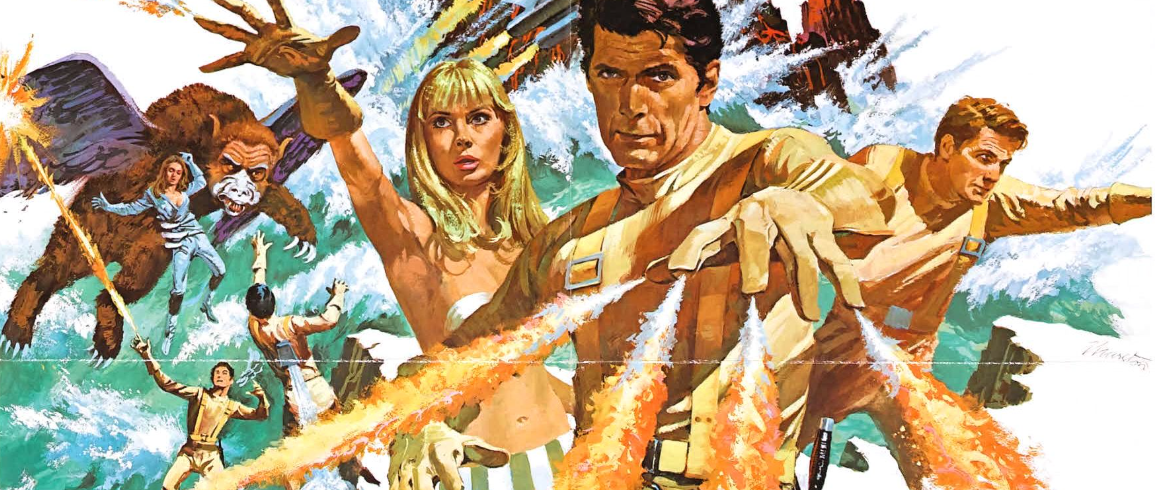
Two immortal exes are at war – one a captain from an undersea utopia with an artificial sun, the other a mad scientist who really, really loves putting people’s brains in giant mutant animal bodies.
We’re talking about 1969’s Latitude Zero (緯度0大作戦, The Great Latitude 0 Operation), which is bonkers, bizarre, bananas, mindbogglingly absurd, and quite possibly Toho’s gayest kaiju movie (which is saying a lot considering how many movies queer icon Mothra appears in).
What makes this a perfect tokusatsu/kaiju movie for Pride Month? Let’s explain!
What is Latitude Zero?
Immediately following the all-star kaiju bash of Destroy All Monsters, Ishiro Honda and Eiji Tsubaraya started work on a sci-fi film with just enough monster mayhem to be declared a kaiju film, and a Japanese/United States production collaboration.
The film follows a journalist and a couple of scientists accidentally stumbling upon a secret undersea utopia of nice immortal people at the titular Latitude Zero. From there, they get caught up in stopping a cartoonish supervillain who’s abducted a scientist and his daughter in his evil submarine known as the Black Shark. As you’d expect, he wants to put their brains into mutant animal bodies. There are jetpacks, giant rats, a magic gender neutral hot tub called “the bath of immunity,” and eventually a lady gets her brain put into a winged lion and is enlarged to kaiju size. It’s a very normal movie.


Originating as a mostly lost radio serial by Ted Sherdeman (writer of the American monster flick Them!), the sprawling story was condensed into this single film co-penned by kaiju legend Shinichi Sekizawa. Unlike other Japan/US collabs like Invasion of Astro-Monster or King Kong Escapes, this joint venture had an all-English-speaking cast, an English script, and included multiple well-known Hollywood stars. Citizen Kane’s Joseph Cotten plays Captain Mackenzie, the Big Good; the Batman ‘66 Joker himself, Cesar Romero, plays the villainous Dr. Malic. All this alongside Toho mainstays Akira Takarada, Akihiko Hirata, and Haruo Nakajima, with another banger score by Akira Ifukube.
It had its share of strife behind the scenes – the usual conflicts between US and Japanese producers, language barriers and condescending American attitudes, illnesses, and the American producers declaring bankruptcy during production and saddling Toho with a slashed budget. If anything, though, these conflicts probably boosted the movie’s “throw everything at the wall” energy, a sinking sub still chugging along to share its grand idea of an undersea utopia.

Utopia is an All-Accepting Queer Commune
Some of you might hear “undersea utopia” and get nasty Bioshock flashbacks, but Latitude Zero isn’t cynical. Inspired by Gene Roddenberry’s core Star Trek ideals, the fantasy of this movie is that there could be utopia with nothing seedy under the surface. Journalist Perry Lawton (Richard Jaeckel) questions it at every turn, but as the film unfolds, it’s exactly what it appears to be – just a chill commune where everyone is having a great time.
Honda had a vested interest in showcasing pacifistic scientists and civilizations rising above borders and politics to cooperate for the greater good in his films, and Latitude Zero is an extension of that. Instead of seeing established governments cooperate, we get like-minded people who formed their own community and turned it into a model of what society could be, a place run by the people and for the people.
And while he certainly wasn’t thinking about a queer reading, Honda’s vision of an accepting but protected place aligns nicely with what queer people throughout history have had to create for themselves to survive. Queer and queer-friendly spaces like gay clubs, drag events, balls, queer book clubs, etc. are a big part of the experience, and in certain times and places they had to be kept under the radar to protect the community within them. Like how the residents of LZ slowly introduce their innovations and philosophies into the world above while keeping themselves safe, so do queer activists who try to help the world hopefully progress to a place where queer people are safe, too. (And trust me, at least one of your queer friends has probably thought about wanting to live in a commune with their fellow gays at some point.)
Here, we have the ultimate wholly accepting queer space. Latitude Zero residents wear whatever they want, with all genders showing lots of skin in fully transparent plastic tops and shirtless shiny open vests, while others sport 100-year-old attire from their previous life. Some are the smartest people in history, others are your average layman, but they’re all treated equally and with respect. Diamonds and gold have no monetary value because there’s no capitalism, which means you can accentuate and bedazzle yourself to your heart’s content.

When we see newcomers show up, they’re immediately given free healthcare, gifted a home and allowed to live there for free forever, and there’s no catch or anything sinister about it. If they want to leave, they can, no questions asked. Mackenzie outright says they aren’t nervous about new folks joining them because as soon as they see how awesome everything is, they’ll get it. As anyone who’s ever struggled to come out can attest, there’s nothing more freeing than the moment you feel like you’ve been welcomed for who you are for the first time – when you’re there, you get it.
We’re told that politics are irrelevant in LZ – and yeah, usually hearing “we don’t need politics in this” is a big red flag, but the point in Latitude Zero is that if everyone just chills the heck out and is accepting and willing to work together, those structured institutions aren’t necessary. Fantasy? Sure. Still an ideal to strive for? Totally.
The Immortal Exes
It’s implied that the only way to be kicked out of LZ is to actively harm people, and that’s shown in our main villain. A mad scientist in the “I don’t want to cure cancer, I want to turn people into dinosaurs” vein, cape-adored Dr. Malic is obsessed with putting people’s brains into mutant animal and kaiju bodies. (If he’d just asked permission, plenty of people would have said yes – you’re telling me you wouldn’t at least consider becoming a giant flying lion who doesn’t have to pay taxes?)

Cesar Romero is top form camp here as Malic, playing everything the biggest of the big and embracing the flamboyance that made him sing as the Joker, while also leaning in a very Vincent Price direction. (Worth noting that though he was never publicly out, it’s been all but confirmed that Cesar Romero himself was gay.)
His companion in villainy is the wine-sipping Lucretia (British old Hollywood veteran Patricia Medina), who sits in leopard print chairs in a gaudy rainbow-adored villain layer, herself decked out in gorgeous outfits that range from luxurious high fashion to straight-up drag costuming. She’s just as in charge as Malic, his partner in nearly every sense of the word except romantic. She pines for this exciting guy who shares all her interests, but he doesn’t give her advances the time of day – an experience plenty of gay men who were closeted in high school are familiar with.
Other than that and a chaste, near-non-existent romance between Dr. Lawton (Linda Haynes) and Dr. Masson (Masumi Odaka), the romantic tension is all between Mackenzie and Malic (which, let’s face it, even sounds like a good couple name.) Despite being separated for most of the movie, the sparks are there in the way they talk about one another – Mackenzie describes their days as students a century ago as “not friends, not enemies either,” yet they clearly know each other intimately.
The calm and rational partner to balance the ambitious daydreamer, these two men certainly made an electrifying power couple before they chose to diverging paths, as Mackenzie describes it. But they never fell out of love. Some couples break up when their boyfriend gets too swayed by right-wing YouTubers; others break up because their boyfriend wants to turn people into kaiju.
Still not buying it?
Okay, fine. Here’s the obvious stuff you’re actually here for – Big Gay Lightning Round!

The camp. It doesn’t need to be said, but gays love camp, and this movie is capital-C Camp. The colorful interior sets are over-the-top. The fusion of theatrical tokusatsu acting styles with naturalistic Hollywood actors lends to off-kilter, hammy performances that ramp up the energy. It’s flamboyant, big, ridiculous, but most importantly it’s deadly serious about its absurd concepts and what it has to say about society, while also being manic and stupidly fun.

Kuroiga/Griffon. Malic’s black-leather-clad general is what queers would call a “Dommy Mommy.” So much so that when she’s turned into the Griffon, a giant lion/condor fusion with her brain inside, her dominance can still overpower Malic’s control. In a movie full of strong and fierce women, she still stands out by contrasting her short stature with a booming voice and intimidating energy. You WILL be calling that winged lion “MOTHER”!

Kobo. He’s the resident bear (the gay kind – his brain was NOT put in an animal body). His open gold vest, bare exposed chest, and skirt would be a hit at the club. He’s presented as a soft-spoken gentle giant and kind of a himbo, the big muscle while also being a sensitive huggable bestie.

The Bat Men. The goth and cryptid gays will get it. These guys are the biggest evidence that Malic wasn’t all bad – they seem to be totally happy having been turned into bat people and working for him.

The fits. Sure, it was sci-fi in the late 60s – shiny metallic sci-fi outfits were in. But couple that with the gold belts and chains, exposed skin, arm cuffs, and the ascots…come on, man. And if you think, “But Kamen Rider wears an ascot, too” well, I’ve got news for you about Kamen Rider.
And lastly… the Japanese title on the poster is literally a rainbow.

Sure, as far as we know, no one (outside of maybe Romero) was actually trying to make Latitude Zero gay. But even the ending – an incomprehensibleTwilight Zone/Wizard of Oz twist that forces Perry to keep LZ a secret, the worst part of the movie – suggests that to be kept safe, LZ must be a curated space until the world catches up to them. It’s not unlike some queer spaces that prefer to remain queer-only, where we can openly and safely be our authentic selves until the world catches up with us, and is one of many reasons we celebrate Pride every year.
Sure, there’s the camp, and the costumes, and a queer icon in the Griffon. But this absurd movie also posits a beautiful message for Pride: A better future is possible, and it looks like the undersea queer commune of your dreams.
References
Ishiro Honda: A Life in Film, from Godzilla to Kurosawa by Steve Ryfle and Ed Godziszewski


I love this piece! I am always a champion for the non-Godzilla sci-fi films of Honda because I think they are often far more revealing about the man. They feel like his “one for me” while the Godzilla’s increasingly become “one for them”s.