There’s a Terrible Monster afoot, wreaking havoc upon our cities and endangering the innocent. Whether it was never meant to be here or is simply here to destroy us with no remorse, it’s a reminder of humanity’s ego and hubris at large. The only way we can stop this looming threat is together, but even all of humanity’s collective efforts are not enough sometimes. Just when we think all hope is lost, and humanity is to die, a single human being emerges from the fleeing crowd, puts his hand in the sky, and clicks a button…
SCHUWATCH!

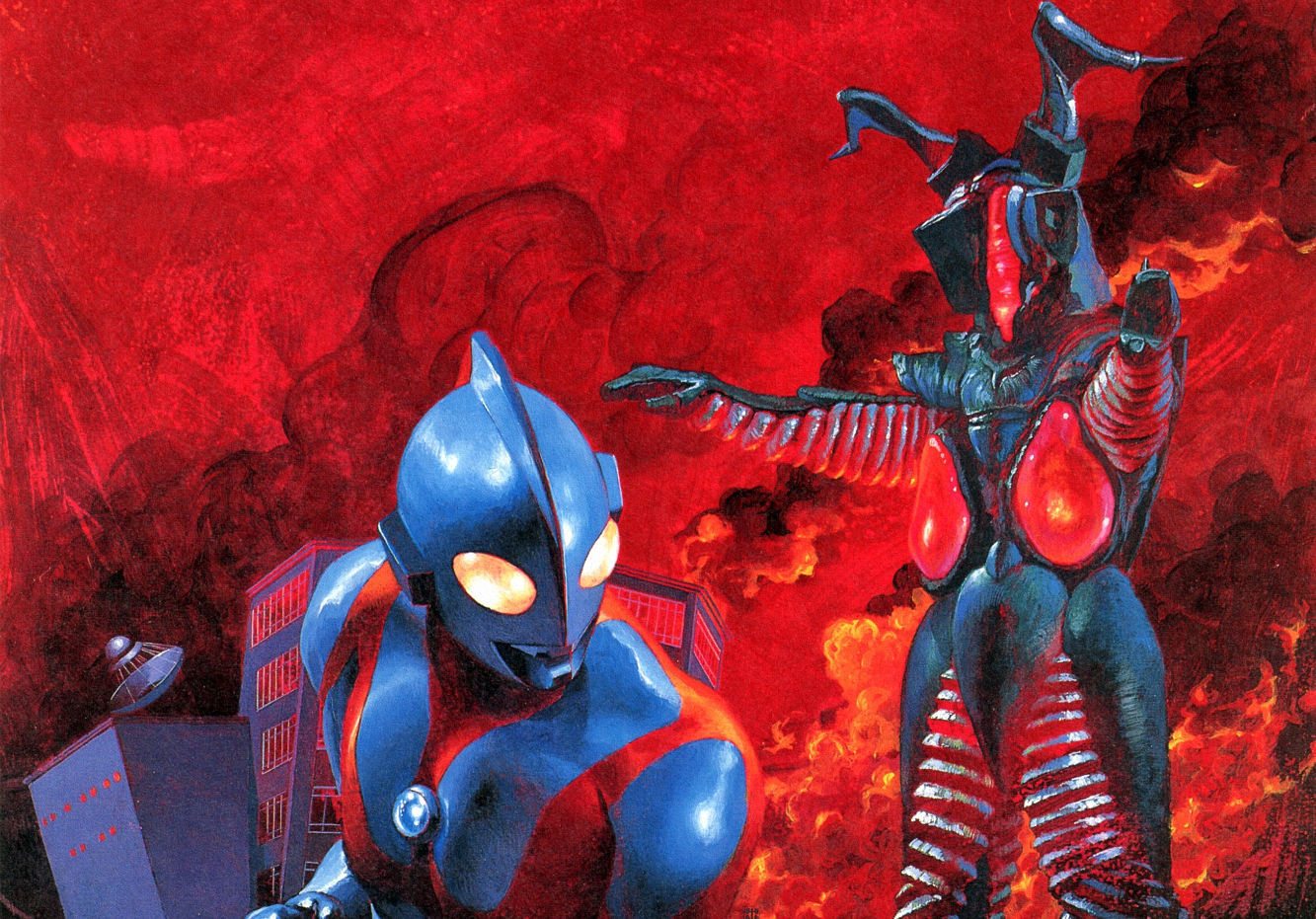
Suddenly, a being of pure light, shining with red and silver coloration, appears before us. We don’t know where this being came from, or what its intentions are, but its strange alien face looks upon us… and we just know that everything is going to be okay. Ultraman is here, and he will protect us, because we have shown him we have the capacity to make humanity better for all human beings, and we finally now understand just how sacred and precious life really is. Ultraman will always be there to protect the living beings of Earth, and for the past sixty years in the media, has inspired us, captivated us with wonder and imagination, and, at the core of this piece, has truthfully made me a better man through all the lessons this amazing series has taught.
It’s undeniable to state in simple terms that Ultraman has had a profound impact on pop culture. There’s the obvious: The capsule monsters from Ultraseven directly inspired the phenomenon known as Pokémon; there’s a plethora of fun homages to Gomora in anime and manga, and even the King of the Monsters has adapted to the times because of Ultraman’s impact. There is no greater superhero in Japan, and it’s clear that the country holds the hero in the highest regard possible. As Dore Kraus told us, “[Ultraman is] in our blood, like Superman is in the American blood.” But how can a series like Ultraman translate itself over to an ordinary young man living in the suburbs of Utah? Well, I’m here to tell you how and why.
“To love humans, you must know them. You must learn their strengths and weaknesses, beauty and ugliness. Only when you know both sides can you love this planet.”
– Ultraman Jack
I first discovered the franchise with the original series, a fitting way to begin this saga. On school nights, I often would put in a DVD or VHS tape to help me fall asleep, and the easiest one to put on was that original show that started it all. There was a nice comfort in the original Ultraman show; the series perfectly encapsulates a bygone era of classic science fiction, giant monsters, and overall kaiju aesthetics that I had loved from watching a bajillion Godzilla films. It was the perfect transition piece into the greater world of kaiju media. Going into my teenage years, Ultraman was always a fond figure, and I had pleasant memories of meeting individuals like Bin Furuya, the legendary suit actor in the original series, but it wasn’t until my early twenties that everything really began to click with me. This set me on a path of rediscovery, rekindled my adoration for kaiju & tokusatsu, and I’ve grown with the franchise and its themes ever since.

As an adult, I have seen the rise of hatred and bigotry across the board, especially over the past ten years. Society at large has turned into a vapid, self-obsessed, and bitter group of individuals. It really saddened me, especially being a young man who was raised to always do the right thing and to stick with doing the right thing on principle, no matter how much it got me in trouble or infuriated others. Human beings aren’t perfect, and I’m not here to dismiss my own personal flaws and shortcomings, but the fact of the matter is, we need to aspire to always be better, to put one foot in front of the other and make the world around us a better place. In my darkest days, whenever I doubted myself, there was that shining beacon; that silver-suited superhero was always there. Ultraman reminded me that I was enough, and that always reaching to do the right thing was possible, even if it felt like the world was too mean and vicious to be a “good guy” and fight against injustice. Ultraman embodies the spirit of never giving up, no matter how insurmountable the odds, no matter how “unpopular” it is to champion the oppressed, and that was the first true stepping stone. If Ultraman can get back up after getting a beatdown from Zetton, and risk his own life for even a mild shot at humanity becoming a better and more peaceful society, then I can stand up for others and call out injustice.
“Nobody knows your future. Do you know why? That’s because the future is for you to make…”
– Ultraman Dyna
Through my journey into more Ultraman media, I became attached to Ultraman Zero and his arc of going from a hotshot that trash talks his enemies before delivering the ass-kicking of a lifetime to the more refined, humble, and graceful personifications seen in the Showa Ultras. Zero’s great, and I love that he tells his enemies that they can try and beat him again in 20,000 years, but it was seeing that character become that humble, graceful, and wise mentor that made me realize I was on the same path. Zero and I both grew together, and we both became better together, around the same timeline. As Zero got his Hero’s Mantle and began mentoring the next generation, so did I. Zero will always have a special place in my heart for that reason, and I think his arc perfectly encapsulates what it means to hit your early twenties and then exit into your late twenties. You become stronger and wiser, but you are still learning to become your very best.

The final lesson for me, at least for this piece, is the sanctity of life. Every Ultraman story begins with an ordinary human being who answers the call of being a hero, even if they must pay the ultimate price for doing so. Many Ultras throughout the series’ long history have witnessed this capacity for selflessness and pure heroism and have bonded their lifeforce to these humans, even giving up their lives for the human beings they have become attached to. Tokusatsu shows, especially from the Showa era, show that to be a real hero, you must be ready to make great sacrifices for a better world that you may never end up seeing.
Furthermore, it’s no question that superheroes are strong and muscle-bound, but the mark of a TRUE hero is being strong enough to be gentle, and that is something that every single man on this planet should learn from this series and exemplify. Ultraman is delicate with mankind, evoking great strength to protect the smallest organisms possible, but knows when to display raw power when the time requires it. We must apply these ideals in our own lives and find appreciation and gentleness for all walks of life, no matter how small and insignificant. As The Kaiju Papers states in a remark that perfectly embodies this theme of life, “Are we not all strange beasts, figuring out how to be alive for the first time?”

Ultraman has been a fixture of kaiju media, classic television, and science fiction for six decades. That staying power is no easy feat – as we’ve seen various franchises and fandoms rise and fall with the times – but there’s a timelessness to Ultraman that will empower this series into the next sixty years and beyond. What Eiji Tsuburaya created to inspire the children of Japan has struck the hearts and minds of human beings all over the planet, inspiring us all to continue the aspiration to become “Ultra” ourselves. Will you heed the call of Ultraman and spread light, wonder, and joy throughout the world? Ultraman has inspired me to do so, and I will be forever grateful for this classic franchise that is always teaching me new things about the world, life, and myself.
Thank you for everything, Ultraman.
“Never lose your kindness, take care of the weak, help each other, and don’t lose the desire to be friends with people from any country… even if that feeling is betrayed hundreds of times. That is my last wish.”
– Ultraman Ace