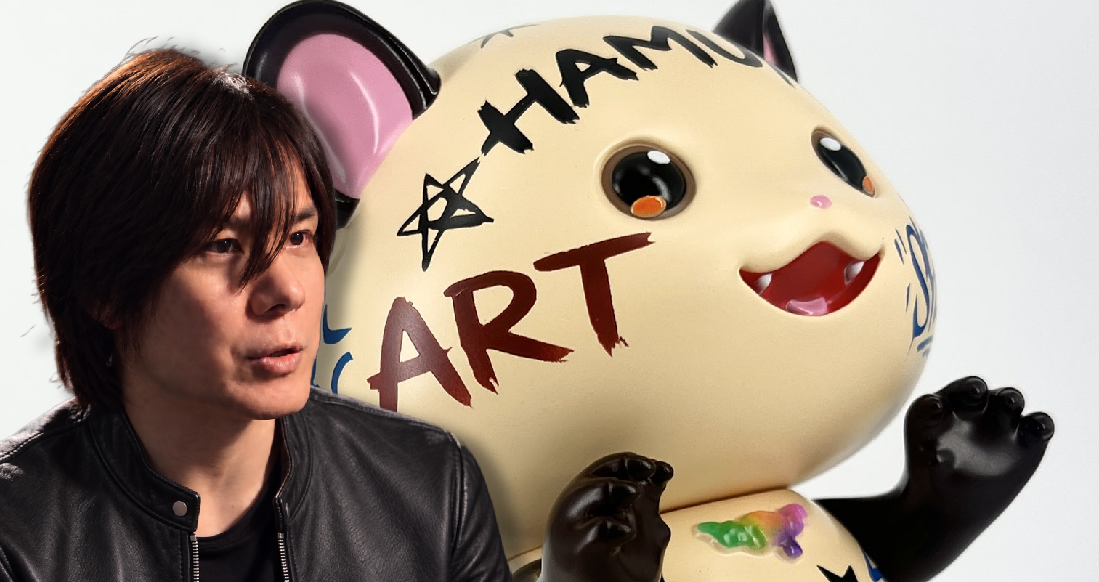
Many kaiju fans out there know the word sofubi, but they might not know just how vast the art form really is. Whether it’s at Wonder Festival or DesignerCon, there’s a vast array of incredible artists that design, sculpt, and produce their own soft vinyl figures for fans all over the world to enjoy. Kaiju United had the opportunity to speak with Tokyo-based sofubi artist Kenji Yoshida ヨシダケンジ(吉田健児)to discuss his creator-owned IP, Hamura & Hamuo, some of his commercial work, and just what goes into producing your own sofubi figure.
Kaiju United: What brought you into the world of sofubi/sculpting? Was there a particular piece that captured your imagination?
Kenji Yoshida ヨシダケンジ(吉田健児)
In Japan, kaiju sofubi—especially characters like Godzilla—have always been a very familiar part of popular culture. I grew up buying and collecting sofubi figures of Godzilla, King Ghidorah, and other monsters.
I wouldn’t necessarily say I belong to the generation that grew up at the very height of tokusatsu, but in Japan, Godzilla has remained an extremely popular character across generations. He was simply part of the culture around me from childhood.
At the time, though, I don’t think I was consciously fascinated by sofubi itself.
There wasn’t one particular piece that changed everything for me. What really captured my imagination was seeing the culture around sofubi itself begin to change.
As an adult, I started seeing more independent designers and artists creating sofubi of their own original characters, as well as reinterpreting existing monsters and characters through their own artistic perspectives.
Until then, I had thought of sofubi largely as children’s toys. But I began seeing them expand into art toys and designer toys—objects that adults could also collect and appreciate as works of art. I found that incredibly interesting.
At the same time, there was a growing culture of individual creators turning their own original characters into sofubi and releasing them as personal works.
Seeing those pieces made me appreciate sofubi from a completely different perspective than I had as a child.
Eventually, I didn’t just want to be someone who looked at these toys. I wanted to create an original character of my own in three dimensions.
So I started making sofubi myself soon afterward.
KU: Many sofubi characters are based on animals – what inspired you to choose a Hamster for the character of Hamura?
Kenji Yoshida ヨシダケンジ(吉田健児)
The biggest reason is that hamsters have always been part of my family—living right beside me.
I wanted to preserve the existence of one particular hamster in some form, as a character that could live on. But simply making a realistic sculpture of a hamster I loved didn’t feel quite right for the kind of character I wanted to create.
At the time, I was living with a male hamster of a type we call “Kinkuma” in Japan—a cream-colored Syrian hamster—and he grew unusually large, weighing more than 200 grams.
When I started thinking about how to develop him into a character, the idea of a kaiju naturally came to mind, probably because monsters had also been familiar to me since childhood.
Hamsters are tiny, cute animals that people keep at home as pets.
So I thought: what if this tiny creature gradually started growing larger and larger until it became a kaiju?
That was the starting point for Hamura.
Unlike Godzilla, who is already enormous and intimidating from the beginning, Hamura started as an ordinary pet hamster. He gradually grew larger, and at the moment he is roughly human-sized.
And perhaps he will continue growing even larger in the future.
I wanted him to be a hamster that is still in the process of becoming a kaiju.

©KENJI YOSHIDA / Hamura Project
Kaiju United: Who is the other character that is paired with Hamura? Where did the idea for this character come from?
Kenji Yoshida ヨシダケンジ(吉田健児)
To be honest, Hamuo is very much a projection of myself. (laughs)
He is a boy who deeply loves Hamura, and he is Hamura’s owner.
But Hamuo is more than simply “the owner of a hamster that is becoming a kaiju.”
While Hamura is gradually becoming more like a kaiju, Hamuo is moving in the opposite direction—he is gradually becoming more like a hamster.
He has developed ears similar to Hamura’s, his nose has begun to change, and he has even grown a tail.
People often say that pets start to resemble their owners—or that owners begin to resemble their pets.
With these two, that idea is happening in a slightly more extreme way.
Hamura is no longer an ordinary hamster.
And Hamuo is no longer an ordinary boy.
I wanted to tell a story about two beings who gradually change as they influence one another.
Why is Hamuo changing this way? What happened between the two of them?
A picture-book project that explores that part of their story is currently in development.

©KENJI YOSHIDA / Hamura Project
Kaiju United: Do you think the idea of something traditionally seen as small becoming larger-than-life is an interesting theme?
Kenji Yoshida ヨシダケンジ(吉田健児)
I find it incredibly exciting. There is a real sense of wonder to it.
Maybe that has something to do with growing up in Japan.
Kaiju are familiar to people across many generations here, and that culture is also closely connected to toys and sofubi. For me, the idea of something gigantic has felt familiar since childhood.
Usually, though, a giant monster is frightening. It is something dangerous, something that threatens people.
With Hamura, I wanted to reverse that idea a little.
His body keeps getting bigger, but becoming enormous doesn’t mean that he has to become frightening.
He can stay cute and lovable no matter how large he becomes.
I thought it would be interesting to have a kaiju like that.
This may sound slightly unrelated, but Japan also has enormous statues such as Sendai Daikannon and Ushiku Daibutsu, which are around 100 meters tall.
When you actually stand in front of something on that scale, it overwhelms you in a way that is difficult to explain logically.
There is simply something exciting about something being unbelievably huge.
To me, that sense of wonder is connected to the appeal of kaiju as well.

©KENJI YOSHIDA / Hamura Project
Kaiju United: Tell me about the different Hamura sofubi figures you have attached in the initial email. One of them has rainbow dorsal plates, and the other has various words written across its body. What was the design philosophy behind these variants of Hamura?
Kenji Yoshida ヨシダケンジ(吉田健児)
In Hamura’s standard appearance, his dorsal plates are rainbow-colored.
That has been part of his design from the very beginning, and it is one of the visual features that represents the character.
At the same time, I see Hamura not only as a character, but also as a sofubi art toy that can take on many different visual expressions.
One of the interesting traditions in Japanese sofubi is that the same sculpt can take on a completely different personality simply through changes in color and paint application.
With Hamura, I enjoy exploring how many different versions of him can exist without changing the sculpt itself—using only color and paint.
The version covered in lettering was one of those experiments.
For that piece, I wanted Hamura’s body itself to become a kind of canvas, using a visual language inspired by street culture and graphic art.
I’m also currently developing other colorways, including a slightly humorous and cute skeleton-inspired paint scheme.
What fascinates me is that even though the physical sculpt remains exactly the same, changing the colors can make Hamura feel as though he has an entirely different personality.
I want to preserve Hamura’s core design while continuing to explore many different versions of him through paint.

©KENJI YOSHIDA / Hamura Project
Kaiju United: You primarily use Zbrush. What do you prefer in Zbrush that isn’t in other applications like Blender? Which one is more beginner friendly?
Kenji Yoshida ヨシダケンジ(吉田健児)
I primarily use ZBrush. What I like most about ZBrush is that even though it is digital, it feels remarkably similar to sculpting clay with your hands—pushing, pulling, adding, and carving material.
It is especially intuitive when creating organic forms such as monsters, animals, and characters.It is very good for creating things like muscles, skin thickness, subtle asymmetry, and the small irregularities that make something feel alive. I think that is one of the reasons ZBrush has become so widely used for creature work in film and games.
For robots or mechanical objects built around very precise straight lines and surfaces, ZBrush can of course be used, but it can require a little more effort. I personally create a lot of organic characters, so ZBrush fits the way I work extremely well.
For me, it feels like the ultimate sculpting tool for taking a form that exists in my head and turning it directly into three dimensions.
I don’t use Blender in my professional work, so I can’t make a direct hands-on comparison. But from what I know, Blender is an extremely broad tool that covers modeling, sculpting, animation, rendering, and many other parts of the 3D pipeline.
And because it is free, I think it is an extremely attractive entry point for someone who wants to begin working in 3D.
So if someone simply wants to start exploring 3D, Blender is probably the easier entry point because it is free and extremely versatile. But if the main goal is specifically to sculpt characters or kaiju, I would still recommend ZBrush.
I’m also very interested in how AI may change 3D workflows in the future, including workflows built around software such as Blender.
The ZBrush interface can feel unusual at first, but once you begin to think of it as “digital clay,” you stop thinking so much about operating software and can focus more directly on sculpting.

Image courtesy of Kenji Yoshida
©KENJI YOSHIDA
Kaiju United: As you have mentioned in our correspondence, many sofubi designs begin as a story or illustration, and then later become a sofubi collectible figure. Why did you choose to go the opposite way and create the sofubi figure first, and then branch out into other forms of media?
Kenji Yoshida ヨシダケンジ(吉田健児)
Usually, a character begins as an illustration or part of a story and is later turned into a three-dimensional object.
So yes, my process is almost the reverse.
But I never consciously decided, “I’m going to do this backwards.”
At the time, I had no experience drawing illustrations or sculpting.
Then I started seeing different sofubi works in shops and around the city, and for some reason my first thought wasn’t, “I want to draw a character.”
It was, “I want to make something three-dimensional.”
So I began designing the character and sculpting it at the same time.
Rather than completing a design on paper and then translating it into a sculpt, I developed the character through the three-dimensional form itself.
I would think things like:
“Would this be cuter if the head were a little larger?”
“What kind of personality does this silhouette suggest?”
“What shape would feel appealing when someone actually holds the sofubi in their hands?”
And I developed the character while answering those questions through sculpting.
It is a very time-consuming way to work.
But I wanted the character to have appeal both as a character and as a three-dimensional object from the very beginning.
Hamura was not created with a complete backstory or detailed world already planned.
Hamura first existed as a three-dimensional form.
Then I began wondering:
“What kind of personality does this character have?”
“Why has he grown so large?”
“Who does he live with?”
Those questions eventually led to Hamuo, and from there their world and story gradually expanded.
Now that process has even developed into a picture-book project.
So for me, the three-dimensional work was never the final destination of the character.
The three-dimensional form was where everything began.

©KENJI YOSHIDA / Hamura Project
Kaiju United: With technology advancing, do you think there is a future for traditional, non-digital molding and sculpting of soft vinyl figures?
Kenji Yoshida ヨシダケンジ(吉田健児)
In my professional work, I handle a wide range of sculpting and master-model projects—from original works by independent creators to major IPs that have been adapted into film and other media.
What is interesting is that even when the scale or popularity of the property is completely different, the fundamental process of turning the design into a sofubi product does not change very much.
There are some exceptions when production reaches a very large industrial scale, but within the sofubi world, the production process that has been passed down for many years is still essentially intact today.
For sculpting itself, digital methods and 3D data have already become extremely common. I use ZBrush myself.
At the same time, there are still artists who deliberately sculpt by hand using clay and other physical materials, and I believe that approach will continue to have value.
When something is made entirely by hand, tiny distortions and asymmetries naturally appear.
Those imperfections—things that the human hand cannot completely control—can become part of the personality and beauty of the work.
And what is especially interesting is that even when the original sculpt becomes digital, the rest of the production process does not suddenly become digital as well.
After the master is printed, it still has to be finished by hand, converted into a wax master, used to create a metal mold, slush-cast in vinyl, trimmed, assembled, and painted.
So modern sofubi production is not really a choice between “digital” and “analog.”
It is a combination of digital tools and traditional hand craftsmanship.
Processes such as mold-making and vinyl casting still depend heavily on craftspeople making decisions based on the material in front of them, which makes them difficult to simply replace with machines.
Technology will certainly continue to change parts of the process, but I believe the human element will remain for a very long time.

Image courtesy of Kenji Yoshida
©KENJI YOSHIDA / Hamura Project
Kaiju United: Do you consider 3D printing something that works within the realm of sofubi production? If so, why? If not, why not?
Kenji Yoshida ヨシダケンジ(吉田健児)
Yes.
Digital sculpting has become very common, so 3D printing has naturally become an extremely important tool for turning a digital sculpt into a physical object.
For figure and sofubi master production in particular, high-resolution resin 3D printers are widely used because they can reproduce very fine sculptural details.
I also use a high-resolution resin 3D printer professionally.
It can reproduce very subtle details from ZBrush—the expression, skin texture, and small surface details—very accurately, so it has become an essential part of my process.
Another major change is that highly capable machines have now become affordable enough for individual creators to own.
That is a huge development for artists.
In the past, you might have needed to send a 3D file to a specialist company just to turn it into a physical object.
Now you can print something in your own workspace and immediately hold it in your hands.
However, what comes out of a 3D printer is not automatically a finished sofubi master.
You still need to remove support marks, sand and finish the surface, and sometimes make small corrections by hand.
And there are also things you only notice once the object becomes physical:
“This area is thinner than I expected.”
“This angle may be difficult to remove from the mold.”
“It looked good on screen, but the proportions feel different when I actually hold it.”
So for me, a 3D printer is not simply an output device.
It is the bridge between a digital form and a real product.
Digital sculpting and sofubi production work extremely well together, but understanding the hand-finishing and manufacturing processes that come afterward is still essential if you want to create a master that can actually become a product.

Goma-chan ©Futabasha

©Yokoyama Ai / Sasebo Kaiju Nyaon Project
Kaiju United: Tell me about your favorite commercial work that you have done. What was fun about the process of creating it?
Some of the most rewarding projects for me have been my ongoing sculpting work for Space Brothers, a very popular Japanese manga that was also adapted into a live-action film, and my work on characters from Shonen Ashibe, a long-running manga series that has also been adapted into anime and has been loved across generations in Japan.
As I began working on more well-known titles like these, I also saw a significant increase in requests from independent artists who wanted to create their own original sofubi.
That has been very rewarding for me as well. In addition to working with established characters, I now have more opportunities to help individual creators turn characters they have imagined into actual three-dimensional products.
My mother has actually been a longtime fan of Shonen Ashibe.
Through that work, I was fortunate enough to receive a signed and illustrated board from the creator, personally dedicated to my mother.
It is still one of my treasures. (laughs)
One of the most interesting things about working on established commercial characters is that the audience already has a very strong idea of what that character is supposed to look like.
A design can look completely natural in an illustration but feel strange when translated directly into three dimensions.
You have to imagine areas that may never be shown clearly in the original artwork and make sure the character still feels correct from every angle.
The challenge is to translate the original design into three dimensions without losing the impression people already associate with that character.
That difficulty is also what makes commercial sculpting so enjoyable.
And even now, there is still something very satisfying about seeing something I sculpted on a screen become an actual product and appear in a store.
My own project, Hamura & Hamuo, only began its full-scale development in 2026, so it is still at the beginning of its journey.
At the same time that I am trying to grow characters of my own, I also have the opportunity to work on characters from properties that have already been loved by many people for years, while also helping independent creators bring brand-new characters into the world.
Being able to experience all of those sides at the same time is something I consider extremely valuable—both as a sculptor and as someone who creates characters.

Image courtesy of Kenji Yoshida.
Kaiju United: What is something that sofubi fans overseas might not know about and/or might have misconceptions about?
Kenji Yoshida ヨシダケンジ(吉田健児)
Rather than saying there is a specific misunderstanding, I think that when people only see the finished sofubi, it can be difficult to realize how many hands, decisions, and ideas are involved in making it.
Today, ZBrush and 3D printers are increasingly common in the sculpting process.
But that does not mean you can simply send a 3D file to a factory and have a machine automatically produce a finished sofubi figure.
After the master is printed, the surface still has to be finished by hand, converted into a wax master, used to create a metal mold, slush-molded in soft vinyl (PVC), trimmed, assembled, and finally painted one figure at a time.
Even in modern sofubi production, there is still an incredible amount of handwork behind every piece.
And in Japan, traditional slush molding is still the main production method for sofubi.
It has a very distinctive appeal, but it also comes with a number of structural limitations.
Not every shape can simply be manufactured as-is.
Depending on the design, a part may be impossible to remove from the mold or may not cast properly.
So you have to think about where the figure should be divided into parts, which direction those parts will be pulled from the mold, where articulation should be placed, and even how the sculpt itself may need to be adjusted.
Even something as simple as the dorsal plates on a kaiju can look fantastic as a sculpt, yet be impossible to remove from the mold at that angle.
In that case, you may need to make them separate parts, change the part division, or modify the sculpt itself.
So there are always limitations between “the shape you want to make” and “the shape that can actually become a product.”
Sculptors and craftspeople have to overcome those limitations through their own ideas and ingenuity in order to complete the final piece.
This may sound like a sudden change of subject, but before becoming a sculptor, I was a musician, and I still love playing guitar.
A guitar also comes with many physical limitations.
You have six strings, a fixed tuning, and the physical reach of the human hand. Unlike a keyboard, the notes available to you at any given moment are constrained by the strings, the tuning, and what your fingers can physically reach. Some voicings are simply impossible to play.
But to me, that is exactly what makes it interesting.
If you cannot play every note, perhaps you leave one out.
You use an open string.
You find a different voicing or position.
You distort the sound.
You change the tone itself.
Over time, guitarists have developed countless techniques and forms of expression precisely because they had to work within the physical limitations of the instrument.
I see something similar in sofubi.
Slush molding also has things it can do and things it cannot.
But because those limitations exist, you start asking, “Then how can I make this shape possible?”
And from that question come new ideas about part separation, sculpting, casting, and painting.
Limitations do not necessarily restrict expression. Sometimes they are exactly what creates new forms of expression.
That is one of the things I find so fascinating about sofubi culture.
In Japan, sofubi culture has developed over many decades alongside kaiju culture.
So to me, sofubi is not simply a toy or a material.
It is a culture of making that includes sculpting, wax work, mold-making, casting, painting, and all of the ingenuity that happens at every stage.
I would be very happy if overseas fans became interested not only in the finished pieces, but also in the culture of making behind Japanese sofubi.

©KENJI YOSHIDA / Hamura Project
Kaiju United: With the sofubi market reaching an all-time high internationally, how can we support independent creators with their own IPs?
Kenji Yoshida ヨシダケンジ(吉田健児)
Of course, purchasing the work is one of the most direct ways to support an independent creator.
Those sales make it possible for creators to keep producing new work, and a purchase is also one of the clearest signs that someone genuinely sees value in the character or creation.
But I do not think support is limited to purchasing something.
Sharing the work on social media, posting photographs, leaving a comment saying, “I like this character,” or telling the creator directly at an event what you thought of the work—all of those things can mean far more to an independent creator than people may realize.
Unlike a major corporate IP, an independent original character usually begins from an extremely small place.
When you create a new character, almost nobody knows it exists.
But then one person likes it.
That person introduces it to someone else.
Then another person discovers it.
I think those small chains of discovery are how a character’s world gradually expands.
And I especially feel that three-dimensional work can cross borders very easily.
Stories and written language inevitably have language barriers.
But with a three-dimensional object, someone can see a single photograph and immediately respond to its shape, color, expression, and texture.
Someone overseas might happen to see a small sofubi figure made in Japan and think, “What is this character?”
That curiosity can become the starting point for discovering the character’s background, world, and story.
Sometimes the physical object carries the character overseas before words ever do.
And if a fan in another country introduces the work to people around them, it can travel even farther.
There are borders that an individual creator cannot cross alone, but sometimes the work and the fans can cross them together.
I see enormous potential in that.
My own project, Hamura & Hamuo, only began its full-scale development in 2026.
From here, I want to expand the world beyond sofubi into stories, picture books, and many other forms.
If someone sees Hamura and simply thinks, “He’s cute,” or becomes interested in the relationship between Hamura and Hamuo—and then tells someone else about them—I already consider that meaningful support.
I think an original IP may not truly be complete at the moment it is created.
Perhaps it grows little by little together with the people who discover it and come to love it.
So if you find an independent creator or character that interests you, I hope you will tell them how you feel.
Sometimes, hearing a single “I love this” can be the reason a creator makes the next piece.
Kaiju fans and sofubi enthusiasts looking to follow Kenji Yoshida’s work can visit his official website, where he provides updates, a gallery of his various works (both commercial and for fun), and an even deeper look behind the scenes of sofubi creation. His work has been featured on the cover of Wonder Festival, and as a sculptor, he has worked on numerous soft vinyl/art toys, including those for Space Brothers (Kodansha) and Shonen Ashibe (Futabasha). He aims to create things that leave a lasting impression on someone’s heart. Yoshida-san is currently focused on branching out Hamura and Hamuo as an IP, with more soft vinyl figures, merchandise, and even a picture book in development.