
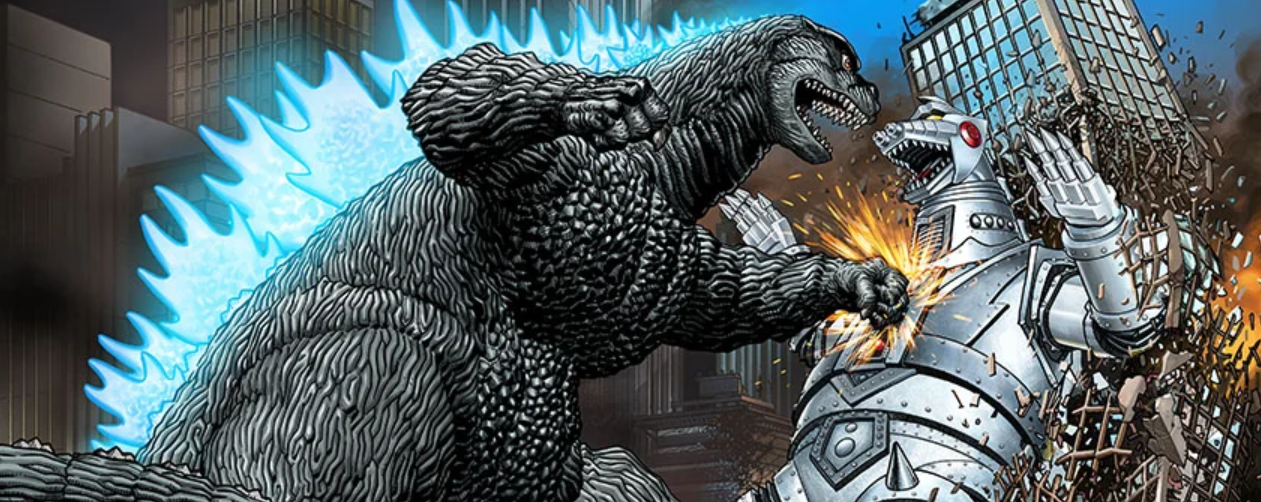
Tomorrow marks a historic moment in a historic time for the Godzilla franchise, with Godzilla Day, the early access IMAX release of Godzilla Minus Zero, and of course, Godzilla: Destroy All Monsters Melee Remastered hitting video game systems everywhere. 24 years after the beloved original game, 19 years after the final Pipeworks trilogy game, Godzilla: Unleashed, and 12 years following the most major recent Godzilla video game release, Godzilla (2014), fans of the series can finally load up on an immersive experience of playing as their favorite Toho kaiju in a major console video game once again. The question is… should fans pick up this brand new experience that was built from the ground up by the original game’s developers, or should the avid Godzilla fan just stick to what came before? Godzilla: Destroy All Monsters Melee Remastered is indeed a quality revival of the classic arena fighter from yesteryear, but may have some hurdles to cross in its tedious leveling & unlock system for players to truly have that Godzilla gaming experience they’ve been craving.
UI and Accessibility
Of course, as many have seen from the initial demo released on October 15th, the UI has had some big changes. It’s quite different from the original game, but keeps a charm that is visually appealing and fitting for the franchise. There are a ton of really good accessibility changes to this remaster, as well. For each playable monster, the player can view a description of the kaiju, their nickname, and what faction they belong to, such as “Earth Defenders” or “Alien Invaders,” something carried over from 2007’s Godzilla: Unleashed that fans will be delighted to see return.. You can also view full move lists and combos with inputs by navigating the interface, plus monster stats are shown to the player to see what strengths and weaknesses each one has. All of these changes and extra details are great to see and will make things easier for players to learn the game and build their skills. Overall, the menu is simple and easy to navigate, and while lacking perhaps the intensity or moxie of the original menu’s volcanic interface, it still holds its own.

Image captured mid-gameplay.
Graphics and Aesthetics
The graphics are very solid and are certainly a modern upgrade, especially for a Remaster of a 24 year-old game that was done from the ground up. In fact, Destroy All Monsters Melee Remastered has many higher tier graphical options for those playing on PC with higher end rigs. However, the system requirements are not all that rigorous, and a mid level or moderate computer system can easily run it, so players looking to run this game on Steam should have no issues doing so with a basic PC gaming setup.
Diving further into visual aesthetics, the roster of monsters is overall very sharply designed and everyone is looking on point, with a healthy blend of design accuracy and retention of the original game model designs. Destoroyah in particular has the most striking upgrade, with numerous awesome details such as the kaiju’s villainous glowing eyes, and a slimmer, but still bulky build. The design philosophy as a whole suits the mecha-based monsters (Mecha-King Ghidorah, Kiryu (Mechagodzilla 3), and Showa Mechagodzilla) particularly well, with metallic textures being visually striking and full of detail.. One thing that perhaps could be added in future updates or content is alternate skins or costumes for the kaiju (for example, Final Wars Gigan!), for more optimal customization.

Image captured mid gameplay.

TM & ©Toho Co., Ltd.
The visual customization doesn’t stop with the monsters. There is a lot of variety in how you can make the battlefield look, as well. Once you choose your city, you can pick the zone type and the weather (overcast, hazy, clear, etc.). It makes things feel very fresh every time you play. Players should definitely try out different locations, zones, and weather combinations! One of KU’s personal favorite combinations in map selection was picking Seattle, “Complete,” and “Mooncast.”
Another aspect of the aesthetics that deserve great applause are the kaiju sounds. They are absolutely excellent and sound great, especially Rodan and King Ghidorah, and Mecha-King Ghidorah. The sound effects, building crashes, and monster noises make things feel huge. The sound engineering is definitely a huge highlight of this game. Most roars seem to be relatively unchanged from the original game.
Core Gameplay / Leveling
The gameplay, as expected, is a hit. It feels similar to the original game in the right ways but adds a sense of heaviness that makes you feel immersed in controlling a giant kaiju. Most of the monsters play similarly, but it is a nicely varied roster where each one has its own quirk to make it unique. For example, when hitting Anguirus’ back while he guards, the attacker takes damage. Megalon keeps his ability to drill underground and perform grabs, while Gigan can surprise opponents by teleporting around and behind them. You can have fun playing as any monster, and with the nice depth that the combo system and move list add, you can really experiment and make fighting more engaging than just mashing the same buttons (although that also works great for a fun time!)
Speaking of the combo system, the combos are button combinations and do not involve difficult motion inputs or canceling like a standard fighting game combo. The expanding on combos and providing a list of moves to the player serves more to create a more fluid fighting experience with more individual player variety and expression. I look forward to what players can come up with at the game’s release, and see what a “meta” in online play looks like. Online play, which we also experimented with, works pretty well. There were not any problems with the netcode. Currently, there is no crossplay between consoles, but it may be considered for implementation post-launch depending on post-release support

TM & ©Toho Co., Ltd.
There are also, of course, grabs. Monsters can grab each other, small objects, and larger buildings. I consider grabbing to be very strong and a great tool to utilize in your moveset. Some monsters can grab very quickly but have shorter range, like Godzilla 2000, but some grab a lot slower but have a longer range, like Gigan. Throwing your opponent into a large building that collapses onto them does massive damage. Just like in the original game, you can also press certain button inputs to get different grab animations and executions, some of which look really cool!
There are a couple of gameplay modes in single-player: Destruction, Adventure, Survival, and Custom Battle. Destruction has no real differences from the original, and is still a fun time and good way to get acquainted with the characters without worrying about fighting another monster. Each single player mode also features “Director Mode” built in, where you can play with the camera and scenery to get movie-like shots of the action, which is a nice addition for the remaster. We’re looking forward to the community’s screenshots from the game in this mode!
Adventure Mode once again follows the same formula as the original, as the Vortaak are coming to take over with their ultimate secret weapon – the newly introduced Showa Mechagodzilla. Adventure Mode is what you expect, a fun time that does not take too long to complete, and each character has a different route. Some may find it stale that Showa Mechagodzilla is always the final fight in the route; the repetitiveness of the Adventure Mode grind could have been alleviated and gameplay more interesting if there was a bit more variety, like Kiryu (Mechagodzilla 3), King Ghidorah, or Mecha-King Ghidorah being used for some routes. The only time the final boss is not Showa Mechagodzilla is when you play as Showa Mechagodzilla itself, and the final boss in that route is the aforementioned Mecha-King Ghidorah.

There are also special Adventure Gauntlets that are essentially Adventure Mode, but harder. You face off against two monsters at once, who are on the same team, and it can definitely be a challenging time. Defeating one monster, however, lets you move on to the next stage and challenge. Things can get janky, difficult, and frustrating, but all is normal for a challenge mode where you are in a 1v2 situation. One thing we must note is that players must be at least level 4 with their individual monster to do the standard Adventure Gauntlet, and at least level 7 to do the Adventure Challenge mode.
Another thing worth commenting on about the general gameplay is that when monsters are thrown or knocked over into certain medium sized buildings, they go through the building rather than smashing into it. It could be understood why this is in the game to keep a greater flow, but it does take away slightly from the immersive experience of destruction. Throwing a kaiju into a massive building is satisfying, and it looks a bit awkward when they phase through one just to hit another.
Custom battles are well-done in this game. It follows a points system, similar to timed mode from Super Smash Bros., and you earn points throughout for hitting kaiju, defeating kaiju, and destroying buildings. It is a chaotic but fun time that would be a blast with friends at a couch party, and the camera does well to keep up with all the action.
As to Survival Mode, the mode is very helpful for earning research points, because it earns double the normal amount, but the tradeoff is that it yields no character level experience. In Survival Mode, every bit of damage you take in one fight carries over to the next, with a slight bit of healing in between. In the easy difficulty setting, it is a good way to grind research points. On normal or hard difficulty, it is a solid challenge that is perhaps more nuanced than the adventure gauntlet. Rather than dealing with an immediate and overwhelming 1v2 battle, you must fight strategically and conserve your health in 1v1 situations.
Now, for the leveling system. Unfortunately, there are some slight issues with this system: It is not intrinsically bad because it rewards you for playing the character more. However, once you really start grinding, the flaws become more noticeable. One in particular that we found disappointing is that players must level up each kaiju in order to unlock their specific rage attacks, and for some playable characters, this does not unlock until level 5. Some may consider that a hurdle for enjoying the kaiju, and they will have to play a lot more than they think they need to in order to unlock everything that comes with their favorite monster Overall, I think it is a positive change, but it certainly needed some tweaks in execution.

Quality of Life Features / Replayability
This might be the biggest change to the overall core gameplay loop. Touched upon briefly in the previous section, the game features a new leveling system, in addition to a new unlocking system. In the original game, unlocking other characters took a fairly straightforward approach. You played through Adventure Mode as one character (say, Godzilla ‘90s), and at the end of the run, you’d unlock another character (in this case, Godzilla 2000), along with a new stage in which to fight.
Admittedly, it’s a pretty barebones loop. Given how quickly you can run through Adventure Mode (the remaster even has an achievement to finish it in under 12 minutes), you could feasibly unlock everything in a few hours. Not so with this version of the game. For both characters and stages, you have to choose what you want to research in the G-Force Lab menu, allowing you to earn Research Points alongside character XP to go towards unlocking new characters or stages, depending on what your priority is. Problem is, that’s still not the end of it. Some characters require you to jump through multiple hoops. Rodan, for instance, requires you to unlock 8 different stages first, and THEN you can start earning points towards unlocking the creature.
It’s a double-edged sword. On the one hand, the attempt to add further replayability to what is already a pretty short single-player experience is appreciated, but going for every character and stage is a bit of a time-sink. Replaying the same modes and missions starts to feel too much like a grind, bordering on unfun. Thankfully, the gameplay itself is tight enough to keep players engaged, and most modes are short enough that you can launch the game on your lunch break, do a quick Adventure Mode run, or Destruction Mode match, earn some research points in 20 minutes, and then go back to the rest of your day. While it sounds quick and easy, it still does take a decent amount of grinding to hit that 100% completion point that many fans, both of Godzilla and video games in general, will likely hope to attain. It’s a good idea on paper, but in execution, the system feels too long-winded; players might end up feeling burnt out trying to get everything unlocked.

Verdict
Pipeworks’ return has been awaited by fans for years and years. This may not be the grand Godzilla video game that everyone may want, but in terms of being a remaster of the beloved Godzilla: Destroy All Monsters Melee, it gets the job done. Smooth graphics, fun gameplay, and a clear heart that was put into the product shines through for an enjoyable experience. Some quality of life features and a convoluted unlocking system holds things back, but this game is certainly a step in the right direction, and we can not wait to see what the future holds for not just this title, but possible Godzilla console games in the future. In this moment of the franchise where everything seems to be at its peak, another chapter of Godzilla gaming history has been added to the mix, and it’s a fairly solid starting point for this new era of kaiju gaming.
Overall Score: 7/10. Godzilla: Destroy All Monsters Melee Remastered delivers a faithful remaster of what captured our hearts in 2002, held up by smooth graphics, fun gameplay, and other improvements, with some quality of life shortcomings that may disappoint players.
Godzilla: Destroy All Monsters Melee Remastered releases November 3rd, 2026 on Steam, Xbox, PlayStation®5, and Nintendo Switch 2.


