KRAKEN is the kind of monster movie I’ve always wanted to see. The depths of our ocean are as alien to us as the stars in the sky. Since mankind made the first floating plank of wood, we’ve wondered about these depths and populated their dark waters with all manner of horrifying legends, not the least of them being the KRAKEN, quite possibly one of the most influential monsters in aquatic fiction besides Moby Dick.
Directed by Pål Øie (The Tunnel), this movie comes to the US and UK several months after it was released in its home country of Norway, thanks to Fandango at Home/Vudu. I had to watch this movie on that platform since no theaters near me had any screenings, nor are any other streaming platforms hosting it. Pål Øie and his team were inspired by Norwegian folklore to bring this monster back from the fabled past, citing the old stories ancient sailors used to mutter under their breath between bites of salted cod and sips of ale.
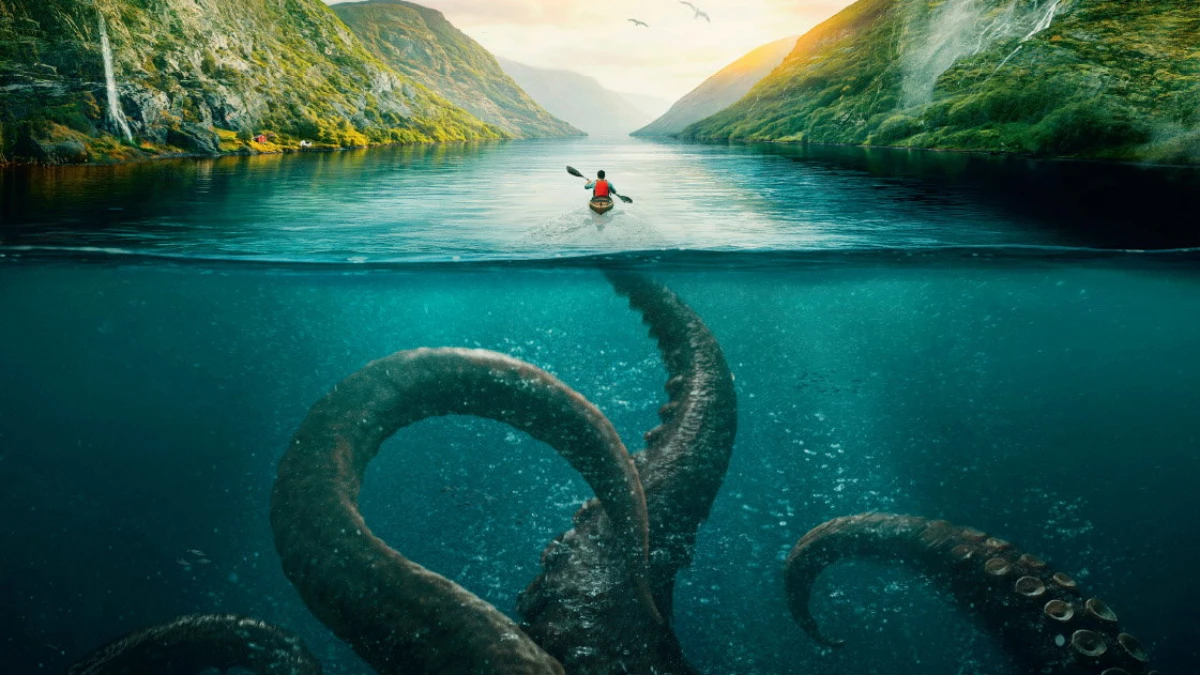
For a budget of only €5.3 million, the special effects are pretty damn good. Lots of practical effects are used when the characters study parts of the kraken that get chewed off by floating machinery, and these parts are as gooey and glossy and gross as they should be. The living monster itself is wonderfully obscured, for the most part. When we aren’t looking through its eyes, we only catch a glimpse of it beneath the surface; a clever and affordable way to build tension, although we do get to see this thing in its full glory in a beautiful shot depicting its head surrounded by red mist after a flare goes up. The cinematography borrows from Spielberg, occasionally giving us the perspective of a curious monster looking up at us from the shadows, while also capturing the human perspective of the horrifying creature. The scenery above the surface is beautiful: a gorgeous tour of a broad fjord in Norway, the perfect funnel for something terrible to wander through. This fjord is so old that people are still discovering new things about its past every passing year. It’s too bad one of these things is about to climb out from the depths and give these students a first-hand look at what their grand ancestors used to fear.
The plot follows the same formula I love seeing in these movies: A montage of unexplainable sightings, the death of two unfortunate bastards that kicks off an investigation, and a jaded expert in the field who reluctantly agrees to participate in solving the mystery. I love these plots. The personal stakes involved with the larger scale of the problem helps anchor me to a group of characters I DONT wanna see killed, a stark contrast from some otherwise enjoyable slasher movies that make most of its cast fussy and frustrating to watch. These characters aren’t all exactly heroic or iconic, but they’re not meant to be. They’re just people. Curious, flawed, and brave, and they’re thrust right into the groping tendrils of an impossible creature that couldn’t exist… or could it?

In 2004, the first live photos of the fabled Giant Squid were captured by Japanese researchers, officially proving a discovery that was made in 1857. These things have been living in our oceans so much longer than we ever knew about, right under our noses, but just out of sight. In 2012, we finally managed to capture images of these giants in their natural habitat. Imagine how many other species of that size exist out there without any verifiable proof?
What sets this movie apart from most other aquatic monster types is how grounded in tone it is. It doesn’t approach the monster like something out of HP Lovecraft, a cosmic being sleeping in ancient ruins found at the bottom of the ocean. It approaches this creature like a long-lost species newly exposed to a surface-dwelling habitat, finding new prey to feast on. Not a totally unique take, but seldom done as good as it is here. The environment is a big topic of discussion here, as the monster moved out of its deeper habitat because it felt threatened, and it moved closer to humans while we were destroying everything else around it. We see constant references to how bad things have gotten over time, our relentless desire for technological progress pushing whole ecosystems to destruction. We’ve seen this too before in many monster films, but I think for a very good reason. It doesn’t feel tired here because it’s very much still true. The closer we get to replacing sea moss with a rusty data center, the further we dive into the belly of an unstoppable beast. The message is poignant and honest.
There are chase scenes in this movie, on par with the kind you’d expect more from movies like Alien or The Blob. There’s no hiding from this monster when you’re close enough for it to grab you, and its arms are long enough to scan their way through a large hospital. You can’t expect the vents to keep you covered. Cephalopods can squeeze their way through very tight spaces to get to their prey. All this, and you still have to avoid the oversized parasites that cling to this beast for sustenance. This thing is menacing through and through. You can’t fight it, you can’t hide from it, you can only try and run away.
In the original Godzilla (1954), the monster’s origin was from nuclear weapons blasted across its habitat, mutating and disfiguring it to resemble the iconic monster it eventually became. The only way to defeat it was to use something even more terrifying than nuclear weapons, the Oxygen Destroyer. Humanity made Godzilla, and then humanity unmade it. I’m reminded of this while watching KRAKEN because, in the end, the plot follows a very similar pattern. Humanity’s push for technological progress is what began this whole mess, attracting the monster to our home due to the harm we caused to its environment. The movie ends on a climax that completes the cycle, we use the same technology that attracted it to burst its heart into pieces. We brought it here, and then we killed it. Humanity wins again, but at what cost? Our heroes resurface from blood soaked waters and take a deep breath, and then they think to themselves, “Now what?”
We are left with a range of emotions. When it comes to the deep sea, we’ve hardly touched the tip of the iceberg. Maybe it should stay that way, but it won’t.
As far as I know, a proper widespread American release is still in progress, as the film’s current theatrical run is limited to select cinemas. Hopefully, soon, more fans like me can enjoy this creature feature. It doesn’t tread on unfamiliar waters when it comes to your average monster movie, but it presents a very well-made retelling of a familiar cautionary tale: How far can humanity go before it’s eaten alive?