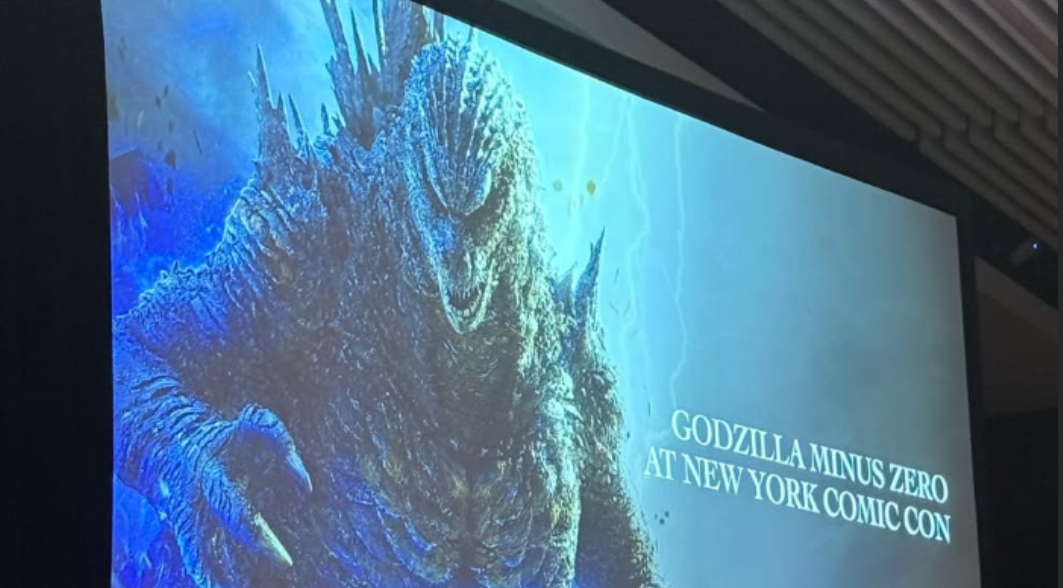
The global premiere of Godzilla Minus Zero is less than a month away, and at New York Comic Con 2026, fans eagerly filled seats in a packed house for the Godzilla Minus Zero Panel on Saturday afternoon featuring Producer Kazuaki Kishida, Visual Effects Artist and Compositor Tatsuji Nojima, Sound Designer and Foley Artist Natsuko Inoue, and Production and Post-Production Sound Mixer Hisafumi Takeuchi. Moderated by Seth Green, the production team discussed updates and behind-the-scenes insights regarding the film’s production ahead of the heavily anticipated film’s November 6th North American release.
Fans were first treated with a welcome video from Ryunosuke Kamiki (Koichi Shikishima) who thanked the audience for attending. Seth Green got the ball rolling by introducing each panelist alongside the panel translator, Mike, and began questioning. All answers provided by the panelists were given to the audience via translator.
He first asked, “What is your favorite personal Godzilla film, and why?” Producer Kishida answered, “Destoroyah! I am a huge fan of Burning Godzilla and remember that when this movie came out in theaters, I was 5 years old. And the marketing copy was, ‘Godzilla Dies.’ So, I thought who could Godzilla be fighting? And it made me very excited.”

Nojima answered, “Shin Godzilla. I was a senior in high school, and I remember watching the film and being overwhelmed, and thinking, ‘How did they design this kaiju?’ The way it shoots its heat ray, I thought, ‘How could someone even think of this?’ I was telling all my friends about it.
Inonue shared, “I’ll have to go with the 1954 Godzilla. It launched this franchise and it was a very important milestone for me in my career.”
Takeuchi gleefully answered, “I’m going with Biollante. I just remember, the mouth, and the tentacles… it felt very raw. I can’t explain it. It was also my first Godzilla movie. I am sure everyone has a special place for the first Godzilla movie they saw.”
The panel then moved into the behind the scenes regarding the digital effects process. Nojima shared that VFX started as a hobby while he worked as a compositor, but after a project caught the attention of Director Yamazaki, he broke into it as a career. Fans were treated with an example one of his former projects on the projector, clearly, the talent in working with water effects was definitely there.
Nojima continued to share that Director Yamazaki, “Loves new things, loves innovations, and always try to integrate them into his films.” Kishida, when asked about his thoughts about young talent and their contribution to this film, and the importance of fostering this young talent, answered, “There are even younger team members on the Minus Zero team, aged 22, 23… and they are talented enough to be given an entire cut or scene to be managed on their own.” Clearly, the trust from the higher ups has given the young talent the keys to produce an excellent product. Blending veteran insight with new talent has been a winning formula, clearly shown by Minus One’s Oscar win. “Director Yamazaki really enjoys working with young talent and is very open minded and absorbs whatever fresh takes or whatever new ways younger talent are approaching solving problems. It is a great environment for young artists to flex what they have.”

The panel showcased multiple scenes from the film and showcased the effects compiling that went beyond the scenes, even showing what it looked like in preliminary stages in the studio. Nojima shared that many live action shots were not created from an original live plate like in Minus One, and in conjunction with the increased ratio from IMAX and heavy use of CG, that particular Minus Zero scene of Godzilla rising above the plane in the trailer was 2 BILLION particles. They showed a scene from Minus One for comparison, which was 200 million particles.
Moving into sound design, Seth Green asked Inoue and Takeuchi why the sound team thought the approach to use real sound rather than digital. Takeuchi answered, “It would be possible to make kaiju sounds digitally. But even since Minus One, we were very adamant about getting analogue sounds and going out into the world to capture audio. With Godzilla Minus One, we actually went out into a baseball stadium and played the roar and recorded that to capture the echo effect of the roar in a large space.” He revealed, “To record the roars and sounds for Godzilla and Ghidorah, we went to a dam,” and the panel played behind the scenes footage of the sound recording to boom through the entire room.
Inoue was asked, “Why did you feel it was important this way, despite the obstacles?” She answered, “There were many challenges to pull this off… But the first time we sent that roar out through the speakers, I could see the relief and confidence in people’s eyes, I knew we had Godzilla and Ghidorah.” “And we are trying to create these roars of creatures that don’t exist, it’s very fantastic. But by using speakers, and projecting it into the real world, capturing the reverb, the echo, the reflection of the sound… in a way it manifests it in our world and that’s what we did with Godzilla Minus Zero. We took sound and made it manifest in this world as we know it.” To hear this philosophy behind the sound design is very revealing and intriguing as to the vision the production team had, and the desire to create a Godzilla film that felt very real and personal.
The sound team also shared the behind-the-scenes process for the sound of Ghidorah’s wings, showing on the projectors that the sound was made from flapping a rubber fisherman suit and air duct.
Seth Green continued on, asking the entire panel, “Are there any key aspects about the sound design that people should be paying attention to?” Takeuchi answered, “Of course fans are going to be going to the theaters expecting to hear a lot of intense sounds, impacts, and Godzilla’s roar. But as important for me is a certain contrast to the sound. We can’t just crank the volume of the whole movie because that would diminish the effect of the emotional journey that people go through. So pulling back is just as important and the important moments where you see Godzilla or Ghidorah roaring the first time adds to the impact if the movie has that contrast.” A great philosophy, and using sound in this way in balance makes the big moments very impactful and stronger. As we get ready to view Minus Zero in theaters, thinking about the sound philosophy in this manner can help us appreciate the movie in a different way.


Just when things looked were about to be over, fans were treated with a huge surprise. A video message from Director Yamazaki himself, followed by the premiere of the final Minus Zero trailer! We won’t spoil here, but fans will certainly be even eager for the film to come out after the colossal trailer drops tomorrow at 8:00 AM EST.
After quite an hour, the panel came to a close with a production team picture with the audience. This panel was an incredible experience for all those who attended and gave incredible insight into the production and behind-the-scenes process of creating the film that has us on the edge of our seats during this final month before premiere. Clearly, the philosophies and passion of all involved are reflected in a great product, and Yamazaki’s belief in young talent is particularly encouraging. Godzilla’s presence at this year’s NYCC went beyond just this panel- with Bandai having a dedicated Godzilla booth and many other booths with licensed products for fans to choose from. One of the most anticipated Godzilla films in the franchise’s history, Godzilla Minus Zero, releases on November 6th, with tickets available now!