As of 2026, the Ultraman franchise has achieved what seldom few other long-running franchises have been able to. This year will mark the 60th Anniversary of its namesake, and it is still running strong with annual additions to its overarching science fiction mythos. With a new, heavier push into the west over the past couple of years, it is likely that many people are now discovering the series for the first time, be it via the English-language Netflix movie Ultraman: Rising or the readily accessible high definition Blu-rays of almost every series available via Mill Creek Entertainment (now AHE).
But ultimately, if not the precursory Ultra Q, the place many people will go to start their descent into the franchise will be with the original series, which began in 1966 and ended the following year with a total of 39 episodes. Though no hefty number of episodes, a return to 1960s television is daunting to some, and the legacy seemingly spawned by these episodes alone makes for a Goliath expectation of the accounts therein. With all those episodes, which ones are the most worth watching?
If there were an “essential” Ultraman watch-guide, which covered not only the best episodes, but the most relevant or thematically indicative of the show proper, what would that look like? Well, here I’ve narrowed down 15 core entries in the saga that should give any skeptical viewer a good first dip into the series before venturing further to explore the expanded franchise. These episodes are chosen either by their quality, their significance to the show, or their long-lasting impact on the franchise as a whole.

Ultra Operation No. 1 (Directed by Hajime Tsuburaya)
Where else to start but the beginning? Ultra Operation No. 1 is an episode fondly remembered as being the place where the eponymous hero first made his debut. Though technically a televised prequel stage show did predate the airing of the pilot, this is the one most recalled as being the true beginning of the saga. The episode manages to keep itself extremely simple, yet manages to introduce the ensemble cast, premise, organisations, etc., to the viewers with rapid pacing.
The episode begins with two meteorites, one blue and one red, crashing down in the Japanese countryside. The Science Special Search Party (or SSSP), an organization dedicated to exploring the super-scientific unknowns and extremities, send an agent, Shin Hayata, to investigate, but when he too disappears, a full inquiry is launched that reveals that one of the meteorites was in fact a “travel orb” harbouring the monster Bemular, who now rests at the bottom of a lake.
Hayata is rescued by the occupant of the other orb, who turns out to be the intergalactic monster hunter, the eponymous hero from the land of light. With Hayata on death’s door and Ultraman himself close to losing his life in the crash, the two meld their bodies together, allowing a symbiotic relationship to occur that enables them to switch from unassuming human agent and giant superhero at will with the usage of a transformation device, the Beta Capsule. Now, as a single being, the two are given a means by which they can take the fight to Bemular, who threatens to destroy the SSSP.
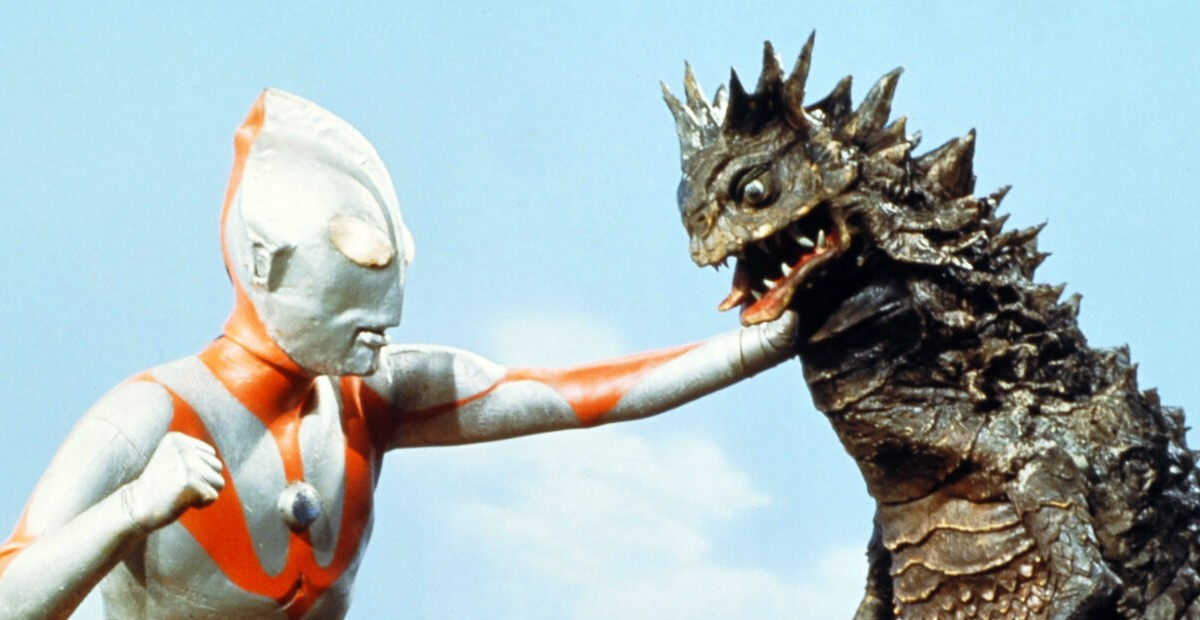
It’s a small premise, rendered memorable by its simplicity. But it works. The Ultraman suit, or the Type A suit as it would come to be known as, is far from the best the character would ever look, and the eventual brawl between the two titans is underwhelming to say the least, but it is nonetheless a sturdy beginning to the series that succeeds in bringing the viewer into a world of heroes and monsters, all the whilst establishing the investigative structure of the show as well as its characters.
Interestingly, the concept for the show began life as a series wherein Bemular was the hero. A protective guardian of mankind who warded off villainous creatures and giant behemoths. This was scrapped early, as studio Tsuburaya feared that having a heroic monster would make it difficult to distinguish who was who when monsters inevitably clashed.

Shoot the Invader (Directed by Toshihiro Iijima)
Despite its archetypal alien-invasion premise and its dated old-school title, the second episode of the original series is important for a myriad of reasons. Firstly, and perhaps most importantly, it introduced the species most commonly considered to be the nemesis of the heroic Ultraman. The Lex Luthor or Joker to Ultraman’s Superman or Batman figure.
Secondly, it introduced the second major archetypal villain of the Ultraman franchise, aliens, or Seijin. If Kaiju represent the homebound menace of belligerent, unthinking brutes, then aliens are the intellectual threat that confounds the Science Patrol. The alien introduced here is Baltan. A species of insectoid, size-changing invaders who have since become synonymous with villainy in the Ultraman universe. Although this is the first episode to feature Alien Baltan, it is far from the last across the franchise.
The episode is surprisingly comedic in tone, following the childish and buffoonish Agent Ide, who is deployed to investigate a UFO spotted over Tokyo. What he discovers are the Baltan who have begun the process of eradicating mankind and replacing our numbers with their own. The 2.3 billion members of the alien race now rest in waiting above Earth’s atmosphere, having shrunk themselves down to microscopic size, following the devastation of their own planet.
It is an episode notable for focusing on the fan-favourite character of Ide, and for featuring a recurring motif within the franchise: that of a verbal joust between Ultraman and the alien invader of the episode, wherein the hero attempts to bargain for the planet. It’s a sturdy follow-up to the pilot and showcases the series’ balance of tone with the goofball Ide and the horror-tinged sequence in which he first encounters the Baltan. The final battle between Ultraman and a giant member of the invading species is also noteworthy as being the first of these battles to occur primarily in the air.

Five Seconds Before the Big Explosion (Directed by Samaji Nonagase)
Episode Four is the first in the series to establish any semblance of continuity between different shows from within the franchise, featuring the return of the monstrous Ragon from the prior series in the franchise, Ultra Q. Whereas in that precursory entry the monster was human-sized and warded off with the usage of music, here Ragon has been irradiated to the size of Ultraman (how convenient) and has begun a rampage across the Japanese coastline all the whilst an unexploded nuclear missile remains wedged between his fins, which prevents any form of attack, as the SSSP wish not to set off the explosive.
The episode is also notable for focusing on the two characters of the ensemble who receive the least attention overall, that being Fuji, the sole female character of the whole cast, and Hoshino, an era-typical kid sidekick and wannabe member of the SSSP who tags along on myriad missions across the early episodes. Though the actor for Hoshino would eventually sustain an injury that would prevent his character from returning to the show, he has become something of a figure of minor importance among the franchise, setting a mould followed by the succeeding child characters to follow.
Though the fight between Ragon and Ultraman is one of the show’s more lacklustre, it doesn’t detract from the overall episode. It’s a fun romp with a great premise and some silly action beats that succeed at merging the Ultra Q adventures into a greater canon.

The Blue Stone of Baradhi (Directed by Samaji Nonagase)
The seventh episode in the series is one that has rightfully been considered racist by posterity for its depiction of Turkey and its brown inhabitants as being primitive residents of a crumbling nation, portrayed, of course, by Japanese actors in Brownface. With that being said, however, it’s nearly impossible to discuss the overall lore of the Ultraman mythology without mentioning this particular episode. This is where the broader context of the universe in which this franchise comes from begins to expand and be explained properly.
The episode begins with various SSSP units from other nations disappearing when investigating several meteorite crashes above the Middle East. The Japanese Science Patrol is sent out to figure out what is happening, whereupon they stumble across an ancient civilisation plagued by a giant monster, Antlar, who has been creating a magnetic pull around his location. Investigating further, the SSSP discover that this city was rescued once before by a hero from beyond the stars, a member of Ultraman’s race named Noa, who safeguarded the city against Antlar by bestowing upon them a modicum of his power in the
form of the titular blue gem. However, with Antlar now returning, Hayata must step up to protect the aging city state once more.
Not only is Antlar a fantastic monster, the first truly great kaiju of the series, but also one of the most powerful, able to battle Ultraman and remain the victor throughout most of their fight until human intervention. Antlar, like many Kaiju, has made periodic returns across the franchise, always a threat whenever he rears his carapace. Where the episode truly shines, however, is in how it expands the lore with the introduction of Noa, a figure still relevant today, most especially in 2004’s Ultraman Nexus series. No longer is this a battle between a singular hero and an onslaught of monsters and aliens, but an ongoing intergalactic conflict with various figures of note. Ultraman isn’t just a defender, but a member of a race of defenders.

The Lawless Monster Zone (Directed by Hajime Tsuburaya)
Is Episode 8 the most iconic episode of the original series? Quite possibly. It’s the first in which an entire gang of monsters threatens our human cast, and, like King Kong, features an island upon which they dwell in endless war against one another. It’s an episode that introduced two of the franchise’s most important and enduring kaiju: the warmongering brute, Red King, and the friendly man-sized Pigmon.
The episode follows the SSSP as they search for a group of scientists who went missing whilst conducting research on a mysterious island. Upon their arrival, they find themselves disrupted by a cacophony of monsters: the living plant Suflan, the burrowing Magular, and, embroiled in battle, the despotic brute Red King and the winged Chandlar. With the revelation that the last member of the missing team is being kept alive by the peaceful and protective humanoid Kaiju Pigmon, a rescue mission is mounted that places Ultraman directly in the path of Red King.
Red King remains today a prominent recurring antagonist of the ongoing additions to the franchise. Pigmon has become something of an iconic fixture of the franchise, with a loveable design that borders between ugly and cute; it is one of the most memorable ever achieved in the series. His relationship to mankind makes him a monster with a greater degree of flexibility amongst the canon. A human-sized monster was uncommon after Ultra Q, but Pigmon made them iconic once again. Though the other monsters in the episode haven’t achieved the same longevity, the premise of a monster island has remained a feature of the franchise.

Science Patrol Into Space (Directed by Toshihiro Iijima)
The sixteenth episode marks the return of Alien Baltan, thus creating the first recurring foe for the hero from the Land of Light. Overall, a marked increase in quality from the villain’s first outings, Science Patrol Into Space is the episode wherein Baltan truly becomes the ultimate nemesis for Ultraman.
The episode follows the failed first mission to Venus, whereupon the alleged only survivor returns home, revealed to be a Baltan in disguise as a man. With Venus as the new temporary home of the failed invaders, the invasion begins once again upon their discovery. It’s a tightly paced and suspenseful episode, bettered by the fact that this was the first time in which a prior enemy returned in such a manner, thus rendering it unlikely anyone would have expected it.
The redesigned Alien Baltan II is a phenomenal success and is equipped with an almost mechanical armoury designed to counteract the unique “Spacium” energy of Ultraman’s attacks. Where the episode really succeeds is in how it iconises the villain. It’s an episode that has been recreated and homaged in various other entries of the franchise and turned Baltan into the most iconic nemesis for the hero, such that he has appeared in media outside the franchise, such as a surprise cameo in DC Comics’ Green Lantern: The Sinestro Corps War.

Brother from Another Planet (Directed by Samaji Nonagase)
Only two episodes following the return of Baltan does another extraterrestrial terrorist rear his ugly mug. Here, Alien Zarab. Another of the more iconic foes to grace the screen of this era, Zarab sports a unique design and has also garnered a spot as one of the recurring villains across the franchise proper, most notably a redesign and reimagining in 2022’s Shin Ultraman.
The episode begins with an announcement – an alien species, claiming to be a distant relative of mankind, has sent an envoy to Earth to begin discussions of alliances. At the same time, Ultraman appears to have gone haywire and attacked humanity. With Hayata having not transformed into Ultraman, he is aware that the one attacking mankind is a fake, but cannot uncover the truth without exposing his dual identity. Thus, he sets out to find the unseen link between the enigmatic Zarab alien and the destructive new Ultraman.
The concept of a dark mirror Ultraman, or an imitation Ultraman, one who wears the guise of the hero for their own nefarious means, is a well-worn trope across the series. Be it the robot Ultraseven of Ultraseven (1967), Dark Tiga of Ultraman Tiga (1996), or the forthrightly evil Ultraman Belial from Mega Monster Battle Ultra Galaxy: The Movie (2009), it all began here with the brother from another planet. It’s iconic, and rightfully so, its final battle, partly sky-bound and draped in the cool blanket of night, was recreated almost frame for frame in Zarab’s appearance in Shin Ultraman. It’s essential.

Overthrow the Surface (Directed by Akio Jissoji)
Episode 22 marks the first of a tradition amongst the canon, that of the underground society, left behind by posterity now emerging from below to enact a vicious vengeance on mankind – here via the monster Telesdon.
Two core themes emerge in this particular episode. The first is that mankind has a darker side to it, one buried just beneath the so-called civilised society. The dark tone and imagery of the episode, as well as the subterranean society that controls the monster of the week, are indicative of a more dire exploration of humanity. The second theme to arise here is that of Ultraman, and his people from Nebula M78, are both literally and figuratively beings of light. Hayata is kidnapped by the underworld occupants due to their weakness being light, and Ultraman is both powered by it and made of it. However, the franchise would develop a more metaphorical approach to the beings of light. Future additions to the franchise would frame the heroes as beings of optimistic power and hope, who are uplifted by the very essence of humanity.
Though these themes are still somewhat undeveloped here, they are present nonetheless and make this episode one that is an assured must-watch. Telesdon is an iconic monster, and the concept of a society left behind and left below would return multiple times, most notably in Ultraseven (1967) and Return of Ultraman (1971). It is also noteworthy that it continues to establish that the SSSP is a worldwide organisation, with Parisian member Ann, arriving to help search for Hayata once he is kidnapped.

My Home is Earth (Directed by Akio Jissoji)
Episode 23 of the series is also perhaps its most thematically dire. Hitherto, the show has maintained a childlike approach to its monstrous episodes and its discussions pertaining to humanity. This episode upends and directly challenges the notions put forward by the series prior. The episode follows, as one would expect, the arrival of a giant monster, Jamila. As per usual, an investigation and attack are launched at the monster, which marches onwards towards the UN building. The revelation that Jamila is, in fact, a mutated human astronaut whose existence of agony and suffering was due to the machinations of governmental failure, causes the team to introspect.
Where does one draw the line between man and monster? Has Jamila gone too far to be saved? What good is the SSSP and the future mankind is allegedly walking towards if they cannot even save one man? They are all questions raised within the episode, and the climactic fight between Ultraman and Jamila is one of the show’s most tragic. Other tragic monsters had existed heretofore, but never so overtly so as to be reasoned with as a fallen human. Whereas other monsters of saddened ilk had been creatures of nature wrought evil by man’s makings, Jamila had at one point been a human being, and the question remains of whether or not the vestiges of humanity are still within him.
It’s a solid episode, and one of the show’s absolute best. It’s a precursor to the same kind of explorative and thematically rich episode that would become more commonplace in the following Ultraseven, only a year later. It serves as an early yet exceedingly well-mapped entry into what would become a staple of the franchise at large. Some may find the monster’s design a touch silly looking – but that only serves to humanise him even more.

Mystery Comet Tsuifon (Directed by Toshihiro Iijima)
Episode 25 is about as juxtaposed to My Home is Earth as one could strive for, a fun romp if there ever were one. In many ways, it is the archetypal Ultraman episode. Marking the return of Red King, the episode also recreates the monster mash shape of The Lawless Monster Zone. A strange comet passes over the planet, threatening to detonate nuclear warheads with its strange cosmic rays. The SSSP go in search of a missing warhead, only to discover it has been consumed by Red King, who now walks the Japanese Alps. With two other Kaiju, the abominable Snowman-like Guigass, and the proto-Gigan Dorako, having seemingly been awakened by the magnetic forces of comet Tsuifon, a monster brawl thusly sprawls out, all as the Science Patrol struggle to keep Red King under control.
It’s arguably the more iconic of the two Red King episodes in the original series. It’s more refined, has a stronger premise, and, though the final battle may be equally unconvincing as the last, it is fun nonetheless. Though Guigass hasn’t quite endeared himself to the longevity of the franchise (even if he is one of my favourites), Dorako has become a recurring figure a la Red King in subsequent series, although never to the same degree as the despotic brute.

The Prince of Monsters Part I & II (Directed by Hajime Tsuburaya)
This infamous two-parter (26 & 27, the first of the franchise and only one of the original series) may be the single most iconic Ultraman “episode” of all time. With its abundance of online reposts, beginning as far back as early YouTube, this is an episode ingrained within the mind of any longtime fan of the franchise. For what reason has it achieved such notoriety?
This is the first episode in which the eponymous hero is rendered unable to win and is, in fact, forced to retreat. The episode follows the awakening of an enormous kaiju, Gomora, who, stirred from a several-million-year slumber, lashes out at the modern world in fear, along the way battling and defeating Ultraman, and eventually being greatly weakened by the SSSP before the inevitable rematch.
What may surprise some is that the title itself does not refer to Gomora, but rather a young
boy who has proclaimed himself the Prince of Monsters. When Ultraman is defeated by Gomora, Hayata is separated from his Beta Capsule, which is found by the young boy, who ventures to return it to the broken hero in time for the rematch. However, it is easy to see why, even today, people have taken the title to refer to the kaiju himself, not merely due to the gravity of Ultraman’s first defeat, or the equally tragic and powerful Goliath, but because of just how popular Gomora has become. After several minor reappearances across the many decades of the franchise proper, Gomora would come to live up to that title of Prince, eventually achieving something akin to a starring role in the Ultra Galaxy series and film,
wherein Gomora is summoned by the protagonist of the show, Pokémon style, to battle other
kaiju and aliens. This is THE original series episode; it is more than iconic, and for good reason.

The Forbidden Words (Directed by Toshitsugu Suzuki)
Episode 33 is by far the most unique alien invader episode, showcasing an entirely different style of invasion that in many ways prefigures the cerebral plots of Ultraseven and that series’ alien antagonists. The episode follows Mefilas, an alien who has come to the planet to, of course, assume control over it and its population. However, where this oddly-designed spaceman differs is in his approach; rather than outright war, he attempts to make a deal, a trade for the planet itself. Who does he wish to make this trade with? Who else but a young boy? Of course, it is a very silly premise, but the sly, egoist characterisation of Mefilas himself makes him more than memorable as a villain, something that rings true as he has continued to pop up across the rest of the franchise, making for a compelling “episode” in
2022’s Shin Ultraman.
Where this episode succeeds is in its tone and how it elevates its premise to heights otherwise unreachable. It is a more tense, more dramatic, yet also outright melodramatic episode that makes for a compelling watch. Mefilas himself is a wonderfully devious antagonist, and one of the franchise’s most memorable foes, as his approach to rulership aligns more with a complex, too-human evil hidden behind the guise of diplomacy and market. For an episode that seldom features Ultraman or Hayata in a large capacity, and primarily focuses on a rather by-the-numbers child lead, it is surprisingly strong, and a great
start for a great villain.

The Monster Graveyard (Directed by Akio Jissoji)
Though not exactly stellar as an episode, Episode 35 features the titular Monster Graveyard, which comes to play an important role in the future of the franchise and makes for a fairly strong first impression here. The episode follows a living corpse, the monster Seabozu, a spirit from the eponymous ether who descends to the planet below and becomes trapped, longing to return to the quietude of the void. Whilst on Earth, Seabozu naturally incurs the ineffectual wrath of SSSP, who try to devise a way in which to return the forlorn monster. As an episode, it is mostly noteworthy for the introduction of the Monster Graveyard itself, but it offers some spectacular visuals, a lot of camp fun, and an almost childlike fairytale wonder that makes it altogether a highly memorable outing.

The Little Hero (Directed by Kazuho Mitsuta)
Episode 37 is one of the series’ most memorable, as it features the return of several popular kaiju, bringing them back in a new and exciting way. The episode follows the return of both Dorako and Telesdon, brought back from the dead to serve the necromancer kaiju Geronimon (who bears a striking resemblance to a certain King of Monsters). With now three kaiju running amok about Japan, it is actually the return of the similarly reanimated Pigmon, who holds the key to their defeat. The titular little creature defects from Geronimon, instead returning to the SSSP, whom he remembers fondly from his past life. All this concludes in what is easily the biggest climax of the entire original series in aggregate, with, shockingly, some very effective monster fighting from SSSP, who are here more effective than ever.
The trope of another force resurrecting prior kaiju in order to fight the hero as a warm-up of sorts, would become a trope throughout the rest of the Showa era, becoming an important part of both Return of Ultraman and Ultraman Taro, with the latter also seeing kaiju from across the entire franchise brought back to life to face off with a new, younger, Ultraman. However, never has it been done quite so well as here, with Geronimon making for an imposing and unique final boss in an episode already stacked with monsters. Interestingly, if it weren’t for suit decay, then this episode would’ve featured the return of Red King and Gomora, rather than Telesdon and Dorako.

Farewell Ultraman (Directed by Hajime Tsuburaya)
Episode 39, the big finale, is the episode so memorable and so dramatic in scope that it has been recreated countless times in tone, style, and scene. As the title would imply, this is the episode wherein the relationship between Hayata and Ultraman comes to an end during one final alien invasion, pushing the SSSP and the iconic hero to new heights of desperation. A deeply tight episode for a finale that easily could’ve worked as a two-part conclusion, the episode follows the Zetton invasion of Earth, infiltrating deep into the planet, and using their own biomechanical Zetton monster as their bodyguard. The Zetton alien is largely forgotten by the broader fanbase, but the monster that bears their namesake has become an iconic and ever-present face of doom and power, oftentimes signaling finality or struggle with
every subsequent reappearance.
As a kaiju, Ultraman’s attacks are totally ineffective, leaving it up to the SSSP to save themselves and the planet. I will not spoil the rest of the episode here, but it is a sublime finale to a great show. With all of these episodes, it occurs to me now that almost the entirety of this show is worth watching for anyone who adores this era of science fiction, monster movies, or superhero media. Beginning a massive decades-crossing franchise is no easy feat, but Tsuburaya and company make it look easy. With these episodes, one should find themselves equipped to decide whether or not this franchise is for them, or if perhaps, more contemporary entries are more likely to match modern sensibilities. Either way, these are the essential classic Ultraman episodes!